Environment & Energy
Related: About this forumWe're SAVED!!! Jet fuel from cellulose.
The paper I'll discuss in this brief post is this one:
Production of Sustainable Aviation Fuel Precursor from Furanics Using High Surface Area Ordered Mesoporous Sulfonic Acid Functionalized Silica Bhushan S. Shrirame and Sunil K. Maity Industrial & Engineering Chemistry Research 2026 65 (6), 3094-3105
It's not clear if the stumble bum Orange Pedophile in the White House will ever get the Strait of Hormuz that he got shut reopened, about which I am personally ambivalent, since I oppose fossil fuels. I would personally prefer that they not be phased out by catastrophe that will fall mostly on poor people - Jeff Bezos, Trumper, can afford $50/gallon gasoline - but I don't have any control at all over the world.
It's too bad that fossil fuel supplies will be cut off to make hydrogen by steam reforming, since agriculture depends on the Haber-Bosch process to make ammonia from air and hydrogen, because if it were not for the coming famine because of the breakdown of the planetary atmosphere because the so called "renewable energy" scam soaked up vast sums of money for no result, since, wow, we could make jet fuel from cellulose according to this paper, if, and only if, we can grow crops, which we may not be able to do.
From the introductory text:
Biomass is a prominent energy source, following coal, oil, and natural gas. Annually, over 140 billion metric tons of biomass (dry) are produced globally, almost ten times the world’s energy consumption. (4) The inedible agricultural waste and forest residues are the most attractive lignocellulose biomasses in a biorefinery due to their low cost and abundance. Recently, the U.S. Department of Energy listed several biomass-derived chemicals that have the potential to replace petrochemicals, known as platform chemicals. Furfural and 5-hydroxymethyl furfural are the promising platform chemicals, retaining their place in the revised list. (6) The production of these platform chemicals from lignocellulose biomass encompasses three distinct steps: extraction of cellulose/hemicellulose, hydrolysis of cellulose/hemicellulose, and dehydration of monosaccharides to their respective furans. Besides derivative products, these furans also serve as starting materials for producing SAF-range (C8–C16) hydrocarbons. SAF manufacturing from these furans involves carbon–carbon coupling reactions with carbonyl compounds to obtain the SAF precursor of the desired carbon number. (7−9) The high molecular weight oxygenated precursor is then converted to SAF via hydrodeoxygenation (HDO). The furfural derived from low-value hemicellulose is an excellent furanic carbonyl compound for SAF production. On the other hand, 2-methylfuran (MeF), a selective hydrogenation derivative of furfural, is the most promising furan for C–C coupling via hydroxyalkylation–alkylation (HAA) reaction. In 2020, the International Energy Agency estimated global furfural production at 200,000 to 360,000 tons. (10,11) The furfural market was valued at USD 556.74 million in 2022 and is projected to reach USD 954 million by 2030. (12,13) In 2025, the MeF market was valued at USD 653.1 million and is expected to grow at a 4.6% compound annual growth rate. (14) The present work thus proposes producing SAF precursors from furfural and MeF
The original process for making furanic molecules, including furan itself, was developed by the Quaker Oats Company in the 1950s.
Here's the process:
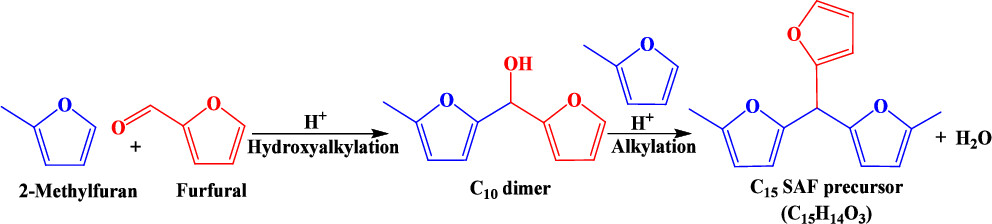
The caption:
The molecule on the left, methyl furan, is made by the hydrogenation of the next molecule on the left, furfural, which is itself made by the thermal decomposition of 5-hydroxymethyl furfural, which is made by acidic dehydration and heat from cellulose.
The catalyst, which replaces apparently, MoO3 supported on ZrO2 and an alternative, NbOPO4, is earth abundant silicon supporting an acid sulfate.
The reaction to make the jet fuel takes place at 523 K (around 250oC).
There's no information on where the heat for this reaction will come from, but of course, we can do like the Chinese do when they make hydrogen, burn coal, and hire dishonest idiots to run around and say the hydrogen comes from so called "renewable energy." There's also no information on the farm machinery to collect the biomass, transport to the chemical plant, heat it in sulfuric acid to make furans, and then hydrogenate some of it, and heat the furan derivatives to make "sustainable" jet fuel.
We're saved. If you're planning on flying to Paris to see the Mona Lisa, don't worry, be happy. "Sustainable" biobased jet fuels are just around the corner.
Have a pleasant Sunday.
 = new reply since forum marked as read
Highlight:
NoneDon't highlight anything
5 newestHighlight 5 most recent replies
= new reply since forum marked as read
Highlight:
NoneDon't highlight anything
5 newestHighlight 5 most recent replies

bucolic_frolic
(55,437 posts)I don't understand the chemistry and technicals in the paper, of course, but it seems similar to biomass energy to me. Biomass burns wood, mostly from wood chips, scrub, and dead trees. It's criticized for CO2 emissions, but isn't it reducing future natural decay (emissions) in order to burn now?
https://vnews.com/2025/09/26/column-vermonts-wood-fired-power-plants-can-lead-the-way-on-climate-change/
Here is a hopelessly rosy, optimistic, forward-looking, “free market” climate remedy that might actually work. Vermont’s two wood plants, McNeil and Ryegate, are losing money and emit over 600,000 tons of CO2 per year. That’s most of the CO2 the state Climate Council wants to reduce after setbacks to the Clean Heat Standard, EV stations and the regional Transportation and Climate Initiative. These programs deserved completion, not cancellation.
Fortunately, a multi-system upgrade can double the operating efficiency of the McNeil and Ryegate power plants, increase electric output and accrue valuable carbon credits by simultaneously reducing CO2 gas at emission point and removing it from the atmosphere. So, these projects should be quite lucrative and will salvage old power plants that are fast becoming obsolete. The same is true of such plants across the country.
~~
The Clean Heat Standard might have come with a robust biofuel program to give farmers new cash crops and put more affordable heating oil on the market with carbon offsets factored into the price. Biofuels and heat pumps might seem odd partners but cover each other’s political flaws.
So, instead of emitting CO2, these redesigned, multi-system power stations would capture, reduce and reuse CO2 from point of emission to make synthetic fuels or feedstocks such as graphite or calcium carbonate. New catalysts can turn CO2 and H2O into synthetic fuels, such as H2, methane, methanol, ethanol, gasoline and diesel. These fuels can augment fuel supply by over 20% or be sold as low-carbon fuels. Feedstocks are yet another profit center. The green icing comes from verified CO2 reductions, traded as carbon credits on the Voluntary and Compliance Carbon Markets (CCM) in the EU, California and China.

NNadir
(38,264 posts)However, antinuke paranoids, with an idiotic concern about tritium, worked to close the Vermont Yankee Nuclear plant, killing people, since combustion of anything, including wood, especially wood, produces air pollution and air pollution kills people.
(I doubt anyone ever died in Vermont from tritium exposure.)
This is well known, including in Vermont, that wood smoke is toxic. From the Vermont Department of Environmental Conservation:
Health and the Environment
Yes, all wood smoke is harmful, but smoke from uncertified outdoor hydronic heaters is worse due to the poor combustion and large amounts of smoke emitted. While smoke and gases from burning fossil fuels, such as oil, contain air pollutants like sulfur dioxide, the smoke from wood burning contains much higher levels of small particles. In fact, the vast majority of particulate in woodsmoke is very fine (less than 2.5 microns in size) and can become trapped in the delicate air exchange sacs deep in your lungs when inhaled. Numerous studies have found strong relationships between high fine particulate levels and chronic lung diseases, cardiovascular disease and premature death. According to the American Lung Association, the fine particulate found in woodsmoke can be linked to higher school absenteeism, emergency room visits and hospitalizations for cardiopulmonary conditions, respiratory infections and asthma.
Every time, without exception, anywhere on the planet, when a nuclear plant is shut by appeals to ignorance, people are killed.
There are no exceptions to this fact.
bucolic_frolic
(55,437 posts)So they're getting their emissions now. Did they get more CO2 from wood stoves, or from weed?
I've burned wood forever. I hate the process, it's a dirty mess.
NNadir
(38,264 posts)The reality of biomass combustion are recognized by all of the health effects resulting from wildfires that themselves result from the collapse of the planetary atmosphere.

Jimi du Ranty
(57 posts)Here is an article from today's ABC news:
https://www.abc.net.au/news/science/2026-04-19/are-saf-biofuels-solution-to-jet-fuel-shortages/106551088
from the article:
One alternative source of jet fuel proposed by government and industry is "sustainable aviation fuel" (SAF), a type of biofuel that can be made from oilseeds such as canola, as well as sugar cane, agricultural and forestry "residues" such as corn husks and barley stalks, and even the kind of municipal organic waste that commonly ends up in landfill.
SAF is currently used in low levels by airlines as part of their fuel mix, but it is not made in Australia.
"The technology is there, but it's super expensive," Stephen Forshaw, who represents Airbus in Australia, said.
Australia uses about 10 billion litres of jet fuel per year, and that figure is expected to increase by 75 per cent from 2023 to 2050.
While moving to SAF might improve fuel security, whether or not it is a low-carbon option is contested.

farmbo
(3,154 posts)Indonesia plans processing centers for bio-based aviation fuel
April 12, 2026 | Juan Pedro Tomas
In Indonesia, Antara News reported that Indonesian President Prabowo Subianto announced that the government will establish processing centers to convert palm oil and used cooking oil into aviation fuel, as part of efforts to develop alternative energy sources.
Prabowo emphasized that aviation fuel can now be produced from palm oil, which is abundant in Indonesia, according to the report. He added that raw materials could also be sourced from recycled cooking oil waste.
“Now, aviation fuel can also be made from palm oil, and we have plenty of palm oil. In the future, aviation fuel can be made from used cooking oil, waste, and leftover cooking oil; we can process it into aviation fuel,” Prabowo said.
He further noted that the government will soon open processing centers and refineries dedicated to producing aviation fuel from these materials, the report added.
NNadir
(38,264 posts)...year for carbon dioxide emissions until 2016.
I often refer to this in my updates on the collapse of the planetary atmosphere, most recently, two weeks ago here:
New Weekly CO2 Concentration Record Set at the Mauna Loa Observatory, 431.73 ppm
The current reading is the 9th reading to exceed 430 ppm, seven of which happened last year, out of 2617 week to week comparators going back to the opening of the observatory in the second half of the 1970s.
It is one of only 38 readings to exceed an increase of 4.00 ppm, the first to place in the current year. Four of these readings exceed increases of 5.00 ppm, three of which were in 2024. Of the top 50 week to week/year to year comparators 27 have taken place in the last 5 years of which 13 occurred in 2024, 3 in 2025, 38 in the last 10 years, and 46 in this century.
Of the five readings from the 20th century, four occurred in 1998, when huge stretches of the Malaysian and Indonesian rainforests caught fire when slash and burn fires went out of control. These fires were set deliberately, designed to add palm oil plantations to satisfy the demand for "renewable" biodiesel for German cars and trucks as part of their "renewable energy portfolio." This case represents just one of the many cases demonstrating the unacceptable profile of so called “renewable energy” with respect to land use. The only other reading from the 20th century to appear in the top 50 occurred in the week beginning August 21, 1988, which was 3.91 ppm higher than the same week of the previous year. For about ten years, until July of 1998, it was the highest reading ever recorded. It is now the 47th highest.
Palm oil as energy is an environmentally odious idea. It should have been a warning way back in 1998 that so called "renewable energy" is not sustainable, nor is it clean.
hatrack
(64,993 posts)
NNadir
(38,264 posts)A lot of bad ideas have a long lifetime, and they never actually go away.
Today I came across this solar thermal to hydrogen paper:
Scheduling of a Concentrated Solar Power Plant Integrated in a Renewable System for Hydrogen Production Minzhuo Huang, Ricardo M. Lima, and Omar M. Knio Industrial & Engineering Chemistry Research 2026 65 (6), 3353-3370
It seems that the in flight bird fryer at Ivanpah is shutting down after ten years and a two billion dollar "investment." The authors apparently didn't notice, nor did they say how to get water to deserts to make hydrogen.
Um...um...um...
We're saved.