Environment & Energy
Related: About this forumIEA: Global EV Outlook 2026 - Emerging battery chemistry and designs
Please note, contents taken from a “Creative Commons” source:IEA (2026), Global EV Outlook 2026, IEA, Paris https://www.iea.org/reports/global-ev-outlook-2026, Licence: CC BY 4.0
The first sodium-ion battery-powered electric car was introduced in China only in late 2023, but the technology is now being scaled up by leading battery producers such as CATL and BYD. Sodium-ion batteries perform significantly better at low temperatures than lithium-ion batteries, particularly LFP chemistries. The latest generation of sodium-ion batteries can retain around 90% of nominal capacity at temperatures as low as -40°C, and can operate at temperatures as high as 70°C. For the largest battery manufacturers, who can maintain multiple supply chains in parallel, expertise and production capacity for sodium-ion batteries can also help to reduce exposure to lithium price spikes.
Despite recent progress, sodium-ion batteries remain constrained by lower energy density than lithium-ion technologies, limiting their competitiveness with LFP batteries at current lithium prices. The latest sodium-ion cells can reach up to 175 Wh/kg, compared with up to 205 Wh/kg for the latest generation of LFP batteries and 265 Wh/kg for lithium nickel cobalt manganese oxide (NMC) batteries. Their disadvantage is even greater in terms of volumetric energy density (Wh/l), which translates into a driving range of up to 350 km for an average SUV equipped with a sodium-ion battery, compared with a range of 400-600 km for lithium-ion batteries under average weather conditions.
Sodium-ion batteries are therefore expected to be better suited for small-range electric cars, light commercial vehicles operating in urban areas, two- and three-wheelers, industrial equipment such as forklifts, and battery stationary storage. They can also help reduce range losses in cold weather when used in hybrid EV battery packs combining lithium-ion and sodium-ion chemistries.
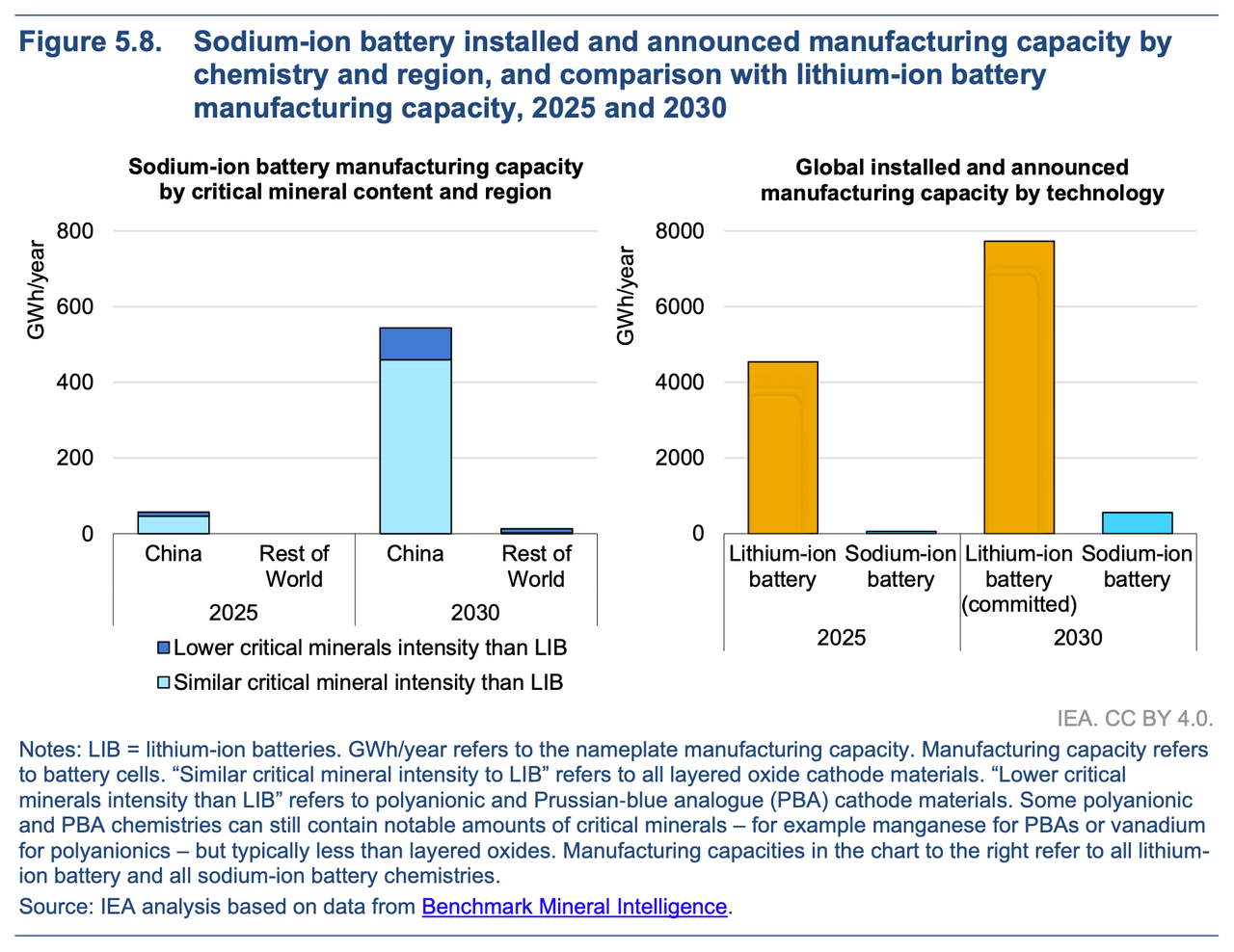
Global supply chains for sodium-ion batteries are also far less developed than for lithium-ion batteries, limiting the near-term prospect of large-scale deployment. For example, the supply chain of hard carbon – the anode active material used in sodium-ion batteries as a substitute for graphite – is still poorly developed today and largely concentrated in China. Battery manufacturing capacity is also significantly smaller. Current sodium-ion battery cell manufacturing capacity is equal to just over 1% of that of lithium-ion cells, and announced projects for 2030 amount to only about 7% of the committed lithium-ion manufacturing capacity for the same year.
Solid-state batteries are progressing, but still need to be demonstrated at scale
Solid-state batteries (SSB) have attracted attention and investment thanks to their promise of longer driving ranges and enhanced safety. However, these advantages have not yet been demonstrated in real-world applications. The term “solid-state batteries” covers a wide range of technologies, all of which use a solid electrolyte,²⁵ whereas lithium-ion batteries use a liquid solution of (flammable) organic solvents and a lithium salt as electrolyte.
Semi-SSBs are already commercial and use a solid polymer as electrolyte, which must operate at elevated temperatures (around 60-90°C), at which the polymer transitions into a soft, rubber-like phase. Almost-SSB and all-SSB designs both operate with solid electrolyte that is maintained in a mechanically rigid state during operation. In the case of almost-SSBs, small volumes of liquid electrolytes are added on the cathode electrode to increase its conductivity. The most frequently mentioned advantages of SSBs – such as enhanced safety – come from almost- or all-SSB designs, which are currently at the prototype stage.
While all-SSB cells are already being produced at small scale for testing purposes, their manufacturing remains more complex and costly than that of lithium-ion cells, and integrating them into EV battery packs is complicated by stricter mechanical requirements, including the need to apply higher pressure to operate the battery. Among the most advanced are Japanese manufacturer Toyota – which tested a first prototype in 2021 and has announced plans to launch its first all-solid-state battery-powered vehicle by 2028 – and the Chinese firm BYD, which plans to sell its first EV using all-SSB from 2027 and to begin mass production from 2030. Korea’s Samsung has set similar timelines for all-SSB production. Developments are also continuing in the United States. QuantumScape tested its SSB in a motorcycle in 2025, while Factorial Energy announced plans to list on public markets after reporting a real-world test of well over 1 000 kilometres of range.
The early costs of SSBs are likely to be high, reflecting immature manufacturing processes and supply chains. Premium markets – where customers value additional range and performance – could support early adoption, providing margins for manufacturers to navigate scale-up challenges and work towards lower production costs. Emerging markets, like robotic devices including humanoid robots, could prove an important early source of demand and revenue for SSB producers. Nevertheless, this implies that it will take time for SSBs to make a dent in the EV mass market, and they are expected to remain limited to premium segments until the first half of the 2030s.
————————————————————
²⁵ Lithium-ion and solid-state batteries are composed of four main constituents – the cathode, anode, electrolyte and separator. The cathode and anode (which are also referred to as positive and negative electrodes) store lithium ions, the electrolyte enables the movement of lithium-ion between the electrodes (cathode and anode) during battery (dis)charging, and the separator prevents the electrodes from entering into direct contact, avoiding electrical short-circuits. In lithium-ion batteries, the electrolyte is liquid, whereas in solid-state batteries it is solid and performs the dual function of electrolyte and separator.
 = new reply since forum marked as read
Highlight:
NoneDon't highlight anything
5 newestHighlight 5 most recent replies
= new reply since forum marked as read
Highlight:
NoneDon't highlight anything
5 newestHighlight 5 most recent replies

eppur_se_muova
(42,528 posts)... have about twice the energy density of sodium batteries, because Mg undergoes 2-e redox while Na only does 1-e, yet Mg atoms and sodium have nearly equal weight.
https://www.ecoticias.com/en/magnesium-battery-electric-vehicles/11434/
(The article in the OP cites sodium batteries as having a lower volume energy density than Li cells. In automotive applications, it is the mass energy density that matters most, since a lower value means heavier batteries are necessary to do the same job, and hence lower mileage. I can imagine the volume energy density matters for ships (low values mean more hull capacity turned over to batteries), and especially air- and spacecraft, which tend to be pretty cramped). Since ships are buoyant, moderate differences in mass density should not be much of an issue.

OKIsItJustMe
(22,160 posts)Oh, sure, if you want to, you can go to a salt mine, or… you can get it from sea water (maybe from a desalination plant.)
Lithium-ion has some clear advantages for mobile usage, but especially for BESS applications, energy/mass & energy/volume just aren’t as important as they are for an EV, or a hand tool, or a “smartphone” or…
Arrieta, L. A. C. et al. A systematic review of the life cycle analysis of sodium-ion batteries. Future Batteries 10, 100162 (2026). https://doi.org/10.1016/j.fub.2026.100162

Kick in to the DU tip jar?
This week we're running a special pop-up mini fund drive. From Monday through Friday we're going ad-free for all registered members, and we're asking you to kick in to the DU tip jar to support the site and keep us financially healthy.
As a bonus, making a contribution will allow you to leave kudos for another DU member, and at the end of the week we'll recognize the DUers who you think make this community great.