Environment & Energy
Related: About this forumExtinction of all life on Earth scheduled for 2031-2051
Abstract
Although the sudden high rate Arctic methane increase at Svalbard in late 2010 data set applies to only a short time interval, similar sudden methane concentration peaks also occur at Barrow point and the effects of a major methane build-up has been observed using all the major scientific observation systems. Giant fountains/torches/plumes of methane entering the atmosphere up to 1 km across have been seen on the East Siberian Shelf. This methane eruption data is so consistent and aerially extensive that when combined with methane gas warming potentials, Permian extinction event temperatures and methane lifetime data it paints a frightening picture of the beginning of the now uncontrollable global warming induced destabilization of the subsea Arctic methane hydrates on the shelf and slope which started in late 2010. This process of methane release will accelerate exponentially, release huge quantities of methane into the atmosphere and lead to the demise of all life on earth before the middle of this century.
http://arctic-news.blogspot.com/p/global-extinction-within-one-human.html
It takes more energy to melt ice than it takes to heat water once the ice is melted. After the arctic ice is gone (in 2015-2017) the heating of the arctic water will increase exponentially, releasing more methane, and putting in motion a positive feedback loop that will mean the end of all life on Earth by mid-century.
 = new reply since forum marked as read
Highlight:
NoneDon't highlight anything
5 newestHighlight 5 most recent replies
= new reply since forum marked as read
Highlight:
NoneDon't highlight anything
5 newestHighlight 5 most recent replies

Xipe Totec
(44,593 posts)I for one welcome our bacterial masters...

and lets not forget arsenic based life forms who've been just waiting for their chance once we fuck up.

Orrex
(67,500 posts)1. It was my understanding that those arsenic based lifeforms were found not to be so arsenophilic after all
2. That bacterial Eye of Sauron is totally freaking me out
Xipe Totec
(44,593 posts)Thanks for bringing me up-to-date on 1.- http://www.slate.com/articles/health_and_science/science/2010/12/this_paper_should_not_have_been_published.2.html

freshwest
(53,661 posts)
Junkdrawer
(27,993 posts)Science nerds with a sense of humor.
Voice for Peace
(13,141 posts)I've missed something in the news, I think?
Xipe Totec
(44,593 posts)Bacteria and algae capable of surviving in boiling water.
http://photoblog.nbcnews.com/_news/2011/06/03/6779556-yellowstones-vibrant-hot-springs?lite
Voice for Peace
(13,141 posts)
freshwest
(53,661 posts)
hunter
(40,922 posts)Well, no, it will kill most of us, but it will destroy the fossil fuel civilization and cool the earth down enough to give any surviving humans a little time to think. Maybe they'll create a civilization that's not so stupid as ours was.
freshwest
(53,661 posts)AverageJoe90
(10,745 posts)You do realize that a supervolcanic eruption could kill tens of millions, maybe hundreds of millions, in just a few months, or even weeks, right?
freshwest
(53,661 posts)Hunter was hopeful that a future, more sane society would get rid of the fossil fuel industry. No, I don't look forward that happening. And I feel certain hunter doesn't, either.
I live in the PNW and we do pay attention to what that ancient, deadly formation underground is likely to do one day. We follow geology reports of land uplift, earthquakes and temperature changes, as with we do with closer hazards, Mt. Rainier and Mt. St. Helens.
We've seen the scenarios of what the Yellowstone Super Volcano would do not only to our beloved North America, but the world in general. Here's a few visuals. Yes, we pay attention. I'm not sure what your comment means. So bye now.

WCGreen
(45,558 posts)kestrel91316
(51,666 posts)Eventually higher life will re-evolve from them. But it just won't be the same.....
 Earth was so beautiful, and we so completely effed it up.......

Fumesucker
(45,851 posts)The Sun is evolving toward red giant stage and will get hotter and hotter from now on, eventually becoming an actual red giant..
However the Earth will be far too hot for carbon based life as we know it long before that happens.
http://en.wikipedia.org/wiki/Red_giant#The_Sun_as_a_red_giant

jeff47
(26,549 posts)
bluedigger
(17,461 posts)What with us already inventing plastic and all. 
Speck Tater
(10,618 posts)so that 50 million years from now man's replacement will be able to get a jump start on science from us.
Javaman
(66,014 posts)personally, I'm using brass.
Fumesucker
(45,851 posts)The Cambrian explosion was about 530 million years ago..
http://en.wikipedia.org/wiki/Cambrian_explosion
jeff47
(26,549 posts)A massive extinction from global warming will not drive us back to single-celled organisms any more than the meteor impact 65M years ago did.
There's going to be a lot of plants and animals that keep doing just fine in a hotter climate. You should know this, because 200M years ago there were a lot of plants and animals that did just fine in the same climate.
Current plants and animals will probably spread northward and southward to get closer to their current climate, and then new species will evolve to fill in the now-abandoned niches near the equator.
It's gonna suck for humans. Rats will be fine.
Fumesucker
(45,851 posts)Not to mention the Sun is hotter now than it was 65 million years ago, we really don't know what climate is going to do given enough greenhouse gases in the atmosphere.
The Chicxulub impact 65 million years ago cooled the Earth, not warmed it.
Personally I don't think it's going to be as severe as post #2 implies but if it is then there probably won't be time for higher life to evolve again.
Even if climate change does no more than send humans back to the stone age there's a good chance civilization won't be able to rise again because all the easily exploitable resources, particularly fossil fuels, are already used up.
jeff47
(26,549 posts)The sun isn't hotter than 65M years ago. It's still fusing hydrogen into helium, just like 65M years ago. The sun won't get hotter until it's done fusing hydrogen. The sun's core will have to contract enough to start fusing helium into carbon, leading to more heat.
It really doesn't matter if the massive climate shock is upwards or downwards. It's going to cause a mass extinction in either direction.
You vastly underestimate our resourcefulness. These big brains are rather handy to have when your species needs to adapt quickly.
Even after climate change, our species will survive. We'll still be able to grow crops and livestock. But not as much as we currently do. So billions of people will die. But that leaves billions of survivors.
It's really, really, really, really, really hard to wipe out an intelligent species. Meteor strike like Chicxulub (or nuclear war)? Not gonna do it. Some will survive. Plague? Society breaks down thus limiting spread of the disease, thus some will survive.
Even the sun incinerating the Earth in about 2-4 billion years won't do it - we already have sufficient technology to live off of the Earth. All we lack is sufficient incentive to spend the 100s of trillions of dollars to do it on a large scale. Boiling oceans would be fantastic incentive.
In each of those scenarios, lots and lots and lots and lots of people will die. But the species will not be wiped out.
Fumesucker
(45,851 posts)Most of our really severe problems are more political than anything else. I think Romney is a perfect example, he's really not that bright and seems to have some sort of deep psychological flaw and yet he has managed to accumulate hundreds of millions of dollars and a great deal of political power while much smarter and far less damaged people are going hungry.
A way to move the Earth's orbit has already been devised, it's really not even all that difficult compared to something like say interstellar flight.. However it requires long term thinking and planning that our species is so far just miserable at..
http://news.bbc.co.uk/2/hi/1154784.stm
All that is required is for a large asteroid, about 100 km (62 miles) across, to fly past the Earth transferring some of its orbital energy to our planet. The asteroid would then move out to encounter Jupiter where it would acquire more energy that it could impart to the Earth on a subsequent encounter.
Humans would have many thousands of years to select the appropriate asteroid and develop the necessary technology to deflect the giant rock in the direction of Earth.
Favourable position
To expand the Earth's orbit around the Sun at a rate that compensates for the increasing brightness of the star would require an asteroid encounter every 6,000 years, or about every 240 generations.
I too used to be an optimist, now I've seen too much of the dark side of human nature, there's a great many ways we can screw up our civilization and our planet and there are people who will do it deliberately if they get the chance, if for no other reason than to piss off the liberals.

Auntie Bush
(17,528 posts)How disappointing!
NickB79
(20,414 posts)And it took approximately 3.5 billion years to go from the first cells to humans. For the first 3 billion of those years, it was nothing but single-celled lifeforms in the oceans.
jeff47
(26,549 posts)Climate change isn't going to kill all multicelluar life.
Voice for Peace
(13,141 posts) <-- closest smilie I could find to a burning hot red sun.
freshwest
(53,661 posts)jeff47
(26,549 posts)and go hunting conservatives with my eye lasers. 
freshwest
(53,661 posts)
Raster
(21,010 posts)bupkus
(1,981 posts)It's only science and real Americans know science isn't really American.

Can we have an end of all life on earth smilie? Closest one I could find is this:

But it doesn't really capture the essence of the current situation.
It's kind of scary to think that Curiosity could very well be taking pictures of what earth will look like in fifty years.
2on2u
(1,843 posts)it minus a magnetic field to protect mars from having its atmosphere stripped away by solar radiation?
TheMadMonk
(6,187 posts)..., we're plenty good enough to keep it topped up afterwards.
And probably good enough to generate a planetary magnetic field anyways.
In fact let's think big:
Wind great circle superconductor cables around the planet.
Pump energy into the cables.
"Grab" the solar magnetic field.
Move the planet.
GO grab the outer two Galeleans (Ganymede and Callisto). That's three. Bring them in closer to the Sun and use their gravitational fields to gently expand Earth's orbit over millions of years.
WCGreen
(45,558 posts)2on2u
(1,843 posts)ever clicked on. Kicked and recced.
http://arctic-news.blogspot.com/search/label/nano%20diamonds
Project Lucy
Project Lucy is a proposal to decompose methane in the atmosphere using beamed radio frequency transmissions, possibly assisted by further technologies.
By Malcolm Light and Sam Carana
You can view the presentation by clicking on the link below:
docs.google.com/presentation/d/10b1VGrbysjL4GDyQVldwFXtrd7xJgq89XzJNueqVkks/edit
http://arctic-news.blogspot.com/p/comprehensive-plan-of-action.html
http://4.bp.blogspot.com/-ytRrcmc5AB0/T-_eefWJa7I/AAAAAAAADPc/TdrDrgoGJ3E/s1600/Arctic+geoengineering+version+3+-+650.jpg
obxhead
(8,434 posts)

2on2u
(1,843 posts)
longship
(40,416 posts)And therefore breed more productively than we do!
Arrrrrrrgh!
magical thyme
(14,881 posts)"The United States and Russia must immediately develop a net of powerful radio beat frequency transmission stations around the Arctic using the critical 13.56 MHZ beat frequency to break down the methane in the stratosphere and troposphere to nanodiamonds and hydrogen (Light 2011a) . Besides the elimination of the high global warming potential methane, the nanodiamonds may form seeds for light reflecting noctilucent clouds in the stratosphere and a light coloured energy reflecting layer when brought down to the Earth by snow and rain (Light 2011a). HAARP transmission systems are able to electronically vibrate the strong ionospheric electric current that feeds down into the polar areas and are thus the least evasive method of directly eliminating the buildup of methane in those critical regions (Light 2011a)."
freshwest
(53,661 posts)

Speck Tater
(10,618 posts)http://www.guardian.co.uk/environment/2012/aug/11/arctic-sea-ice-vanishing
Sea ice in the Arctic is disappearing at a far greater rate than previously expected, according to data from the first purpose-built satellite launched to study the thickness of the Earth's polar caps.
Preliminary results from the European Space Agency's CryoSat-2 probe indicate that 900 cubic kilometres of summer sea ice has disappeared from the Arctic ocean over the past year.
This rate of loss is 50% higher than most scenarios outlined by polar scientists and suggests that global warming, triggered by rising greenhouse gas emissions, is beginning to have a major impact on the region. In a few years the Arctic ocean could be free of ice in summer, triggering a rush to exploit its fish stocks, oil, minerals and sea routes.

FirstLight
(15,771 posts)time frame I have seen of this nature, and I'm sorry to say I told you so... When all the models were pointing to 2100 or more I was thinking they were NOT taking the feedback loop seriously enough or weighing in the methane releases enough.  so very horrific that we humans couldn't even use our brains to stop being petty long enough to pull together and DO something about this... Climate change is a greater threat than any idealogy or religion or country
my children, god help us all
AverageJoe90
(10,745 posts)But extinction of all life? Earth turning into a Venus copy(even if not literally!)? Admittedly, this would make a decent Hollywood sci-fi flick but it's not realistic.
But, on the other hand, yes it is indeed tragic that we didn't start solving this earlier.
The Doctor.
(17,266 posts)muriel_volestrangler
(106,744 posts)(As a side note, I am amazed at the number of DUers who suddenly think that one blogger can overturn the entire science of climate change a few months ago, but no-one noticed. When a single climate change denier claims they've come up with a theory about how there's no such thing as global warming, we rightfully point and laugh; when this guy claims all life on Earth will die within 40 years, it gets 46 recs. WTF, people?)
The blogger bases the fear about methane releases on a graph from Svalbard measurements - the graph generated on Nov 16 2010. He copied it from here: http://hot-topic.co.nz/the-gas-almost-works-more-methane/ (note the identical time stamp of 20:08pm).
Here's what the realistic NZ blogger said:
And, indeed, those data points have been rejected as local contamination - go there now, and you'll see the previous seasonal variation, with a steady long-term rise from the start at 1994, has continued.
So, that's his Figure 1 shown to be irrelevant. Figure 2 was derived from Figure 1 - he claimed this showed a temperature increase of about 0.25 centigrade in 3 months. Notice that these aren't actual temperature measurements - he's just claiming that an increase over 1 month of methane concentration (the figures which have since been shown to be local contamination, or similar) can be extrapolated indefinitely into the future. This is, of course, complete rubbish.
Figure 3 is what he gets when he extrapolates his guess of the temperature rise from the 1 month methane increase (which didn't happen anyway) over not just 3 months, but over years at the same rate. This is, of course, complete rubbish.
After this rubbish, the blogger then points to a 'personal communication' and a NOAA page that no longer works. So we have to take his word that there were "warming anomalies which exceed 10 to 20 degrees centigrade and cover vast areas of the Arctic at times" in Dec 2011. Even if that did happen (and there's no point whatsoever using it as a basis for some graphs unless "vast areas" can be quantified, or "10 to 20" made more accurate), to again extrapolate what happens in one area over a month to several years for the entire Arctic is, of course, complete rubbish. And that's Figure 4 debunked.
Figure 5 has "Gakkel Ridge earthquake frequency" included - what the fuck? The later figures just have some areas coloured in where where he thinks the methane releases will drive temperature increase.
But since the basis for it all is a one month anomaly at one measuring station, which has since been counted as a false reading, it is all based on a mistake. He's taken that one month error, and extrapolated it until the world has heated up by 14 degrees C, which he says will therefore be an extinction event.
Nederland
(9,979 posts)GliderGuider
(21,088 posts)This was such obvious crap that when I ran into it a while ago I couldn't even be bothered to investigate it.
Unfortunately I ran into it on Guy McPherson's blog, and his uncritical acceptance of it has permanently contaminated the regard I previously had for him.
Thanks for being a voice of sanity.
AverageJoe90
(10,745 posts)
valerief
(53,235 posts)freshwest
(53,661 posts)That 2030 was when things really change.
I've assumed all along that this is the reason for those accumulating vast amounts of wealth and technical means, to get away or survive. Much of the advances in space exploration are under private ownership now, just as many other things are.
In few hands, those who intend to survive no matter what, will leave the majority behind. The native american prophecies speak of dire happening in this era. Whatever happens, most of us will have nothing to say about it.
obxhead
(8,434 posts)they'll find our little rovers on Mars. They'll know we were here at one point at least.

MuseRider
(35,176 posts)Lucky Luciano
(11,875 posts)Deal? 
Scootaloo
(25,699 posts)Hardly!
It'll be a return to the paleocene. mass extinction, high sea levels, tropics in canada... but still plenty of life to go around.
Whether or not humanity and most of the Pleistocene species we know and love will be among them might be in question, but I'm pretty sure alligators, rats, and most bats will make it. We'll probably have a new biosphere based entire off of the antelope-y descendants of rabbits, beign chased by packs of critters descended from feral housecats.

part man all 86
(367 posts)Now the humans, this may be a one way ticket, no return trip.
Scootaloo
(25,699 posts)Considering we're the last very slender twig on our branch of the family tree. Hominidae seems like nature going "lol, why not"
AverageJoe90
(10,745 posts)C'mon, man, we'll always be here, barring, perhaps, the next Chixulub or Toba eruption, or something else epically catastrophic.
kurt_cagle
(534 posts)I think the following is more likely -
1) Decline from peak civilization (which I think we've already hit - put it at 2007) will cause the petrochemical based economy to collapse by 2045. Civilization drops back to about the latter part of the 18th century in many respects. The mega-nations, such as the US, Russia, China, India, Mexico - break up into smaller bioregional states. Pockets of electrified civilization remain, but they become smaller and more disconnected. Population begins its first major plunge, going from 8 billion people in 2025 to 2.5 billion people by 2070.
2) By this same time, most coastal cities are below sea-level. As technology fails, one by one, these cities succumb to increasingly powerful storms that make any kind of pumping or dike arrangement possible. Princeton, NJ becomes beach-front property.
3) Buildup of hydrocarbons and CO2 in the atmosphere slows about then, as the pump that had been pushing these into the atmosphere declines due to far lower emissions. There's a period in there where things look like they may have stabilized, but instead what will have happened is that without the carbon heat pump the atmospheric carbon cycle will start a positive feedback loop.
4) Between 2090 and 2120 or so we will see horrific storms - hurricanes in excess of 300 miles per hour that will cover much of the planetary surface as energy stored in the seas and the atmosphere bleed out very quickly. Human population will drop precipitously, to the extent that by the time 2140 rolls around, the global human population will be maybe one million people, and technologically we will be at perhaps the late bronze age (say, c. 1000 BC).
5) Once that energy leaves the planet or gets otherwise sequestered, then we move back into the solar cooling period that we've been keeping artificially at bay for the past four thousand years. Glaciation begins in earnest, and by 2200, much of North America to perhaps Northern Florida and most of Europe to the Mediterranean will be under thickening layers of snow and ice. By 2250, ocean levels will have dropped dramatically, but the remnants of the cities will be uninhabitable. Mankind will exist in roving bands along the southern coasts, and will likely have dropped to perhaps a few tens of thousands of people globally.
6) After 1500-2500 years of this, the sun will kick back into a warming phase again. If humanity hasn't been completely wiped out a this point, ethnographic differences will likely make for the beginning of speciation, with two or perhaps three new hominid species emerging from the remaining stock. Civilization may very well rebuild at that point, but having tapped out our petrochemical heritage, having mined the easily accessible high grade ores (and with most of what had been produced in terms of metals now rusting at the bottom of the sea), with foodstocks sorely diminished, and having to wait while glaciers retreat enough to take advantage of new topsoil, such a civilization will likely never get much beyond the neolithic, then each of these dim lights will fade away. It's really hard to see how humanity will be around 5,000 years from now.
Seem extreme? We've never experienced a global civilization collapsing before. The largest civilization to have collapsed was the Romans, and it can be argued that what happened there was more of a case of a single very large empire fissioning into several smaller empires - Constantinople in the east and the Franco-Germanic empires to the West, even while the city of Rome itself collapsed into a primarily agrarian backwater. We've also always been on the upside of the resource curve - discovering more resources as we needed them. That trend changed in the late 20th century.
kurt_cagle
(534 posts)I think the above is, admittedly, a worst case scenario, albeit, a disturbingly plausible one. There are other feedback loops - we cause the North Atlantic conveyer to stop due to a massive infusion of fresh water into the North Atlantic, and we will see increasing numbers of arctic winters in Europe and North America west of the Rockies. This may solve two problems - as it will start increasing the albedo of the planet and will start to wash hydrocarbon compounds out of the atmosphere. It will also start a new ice age. This means that we don't set ourselves up for as severe a set of storms down the road, but it causes many of the same kinds of civilization ending problems that too much heat does.
I do think that in almost any scenario, we will see a regression of civilization. I don't believe that a technological solution will get us out of it. I think there is a very real likelihood that the global population a hundred years from now may be anywhere from five to five hundred times smaller than today. This means that many people will die of causes other than old age between now and then. I also don't believe the 1% are preparing - maybe a small percentage, but most of them are far too invested in the world as it exists right now. In the event of a civilization collapse, many of these people will be killed off by the leaders of their individual private armies, or in increasingly bloody territorial wars. (Think about Romney for a bit, then think about how likely he is to be prepared for the end of the world as he knows it. Nah, doesn't work for me either).
We're going to see a lot of social experimentation in the next hundred years as people and communities attempt to adapt and survive. My suspicion is that the survivalist mindset will go by the wayside pretty quickly - the ones with their ammo and five year supply of beans will be seen as the dangerous ones, and will in general be excluded from any communal development. In the end, we will survive or we won't, but we won't if we don't recognize the real risks we face now.
bongbong
(5,436 posts)Loss of cooling pumps at one or more of the places where nuclear waste is stored. Like at Fukushima. After a few of these fail (for whatever reason), and just a FEW years go by, the earth's surface & atmosphere will become radioactive. If your steps 1-6 happen as you state, this would be part of #1.
I believe you should change "5,000" in step #6 to "100".
AverageJoe90
(10,745 posts)I can see cities like Miami and Houston possibly being underwater, global civilization significantly shrinking(which may be inevitable at this point, sadly), and possibly even a 'Big Chill' following the period of intense warming, but.......300 mph hurricanes each covering much of the planet? Humanity dwindling down to Toba-era levels or going extinct(without a Chixulub-type event, or multiple Yellowstones going off, or something equally Biblically catastrophic, and even new hominid species?
The latter things I mentioned, while they might make for a decent Hollywood flick, are, to use a term coined by a member of the alternate history writers' community, in "Alien Space Bat" territory, without a question. Couldn't really happen, would require alien, divine, etc. intervention, end of story.

Shankapotomus
(4,840 posts)the biosphere interstellar spacecraft.
NRaleighLiberal
(61,928 posts)but as a scientist, I appreciate your posting it. thanks (and holy shit!)
AverageJoe90
(10,745 posts)Seriously. All life on Earth going extinct? My fucking ass......
Frankly, I can't help but wonder if this guy Arctic News is either being misled by covert agents of the denier conspiracy, or may in fact, be compromised, or possibly even an agent himself(Forgive the extreme cynicism, but nothing would really surprise me anymore).
This kind of bullshit is NOT helping us save our climate. Not one fucking bit. And in fact, shame on you, Speck Tater, for posting this crap, we should know better by now.
Junkdrawer
(27,993 posts)Your suspicion is my first one too.
That said, I'm really interested in a reliable methane monitoring site.

cheapdate
(3,811 posts)He's listed as a coauthor of a paper titled, Geology and Coproduction Potential of Submarine-Fan Deposits, published in the Journal of Petroleum Technology.
His coauthors included Mary L.W. Jackson, Malcolm P.R. Light, Walter B. Ayers Jr., Bureau of Economic Geology.
His paper on the website Arctic News has a great many unsupported claims and would never be published in a legitimate scientific journal.
cheapdate
(3,811 posts)I presume his Arctic News paper is a prank to try to confuse the public and to discredit legitimate science.
Junkdrawer
(27,993 posts)If Ass Clown Watts et al use this, we have our confirmation.
magic59
(429 posts)Extinction of the US poor, elderly and middle-class will start in 2013.
part man all 86
(367 posts)But that is if R & R win.

Denninmi
(6,581 posts)They can outlaw methane release. Problem solved.

mnhtnbb
(33,546 posts)Politicalboi
(15,189 posts)Gum to block the holes?
byeya
(2,842 posts)methane-eating bacteria will intercept a large portion of it.
0-2C, there will be little bacterial activity and the methane will go into the atmosphere.
Methane is formed by the breakdown of moss, mostly Sphagnum spp., and is trapped in the permafrost. Thaw the permafrost and methane is liberated. Much of Canada below the Acrtic Ocean is muskeg as is much of Siberia. These are huge methane sinks.

Sancho
(9,215 posts)
muriel_volestrangler
(106,744 posts)There's plenty of correct information to consider. We haven't the time to look at wrong information too.,
Sancho
(9,215 posts)much scientific information is "wrong" as published originally (or rejected and never disseminated as primary information). The article may have some technical flaws or a preconceived conclusion, but that doesn't mean that the hypothesis isn't worth considering...and this one is worth a follow up. If nothing else, the consequences are potentially important and the time involved is worth the effort.
muriel_volestrangler
(106,744 posts)I personally have read the blog, and decided (see #85) that it's all rubbish, based on a reading anomaly at one station during one month in 2010, which has since been discarded. Most of the blog entry is throwing numbers at the screen in a really bad effort to convince people that there are meaningful calculations in it - but there aren't.
It really is junk science, of the worst sort - the mirror image of a blogger who looks at one cold winter in his home town, and declares the next ice age is upon us, and that all climate scientists have been wrong for decades.
Don't you think that if someone had actually had some decent reasoning, back in February of this year, that by 2050 temperatures on Earth would have made 90% of multicellular species extinct (the kind of effect of a Permian-level extinction event), then it would have had a little more comment by now?
I don't think it's worth a climate scientist 'considering' it, as in "basing any of their work on it". I don't think the thread is worth recommending. I challenge anyone to explain why the blog entry is remotely of interest (it seems to me that many here have accepted the conclusion with no discussion at all of the method it was arrived at).
Sancho
(9,215 posts)The idea that there is a calculated timeline due to methane release is pretty important! One blog is no more "definitive" than another. In other words, you may want to look deeper. We've had Nobel prize winner telling us to take vitamin C, and many years of science telling us that there's no proof that smoking causes cancer! Oops! The question and information may seem to be an extreme, but is there an accurate prediction of global climate change? The melting rate? The impact of methane? Look up another "extremist" (John Snow) and see if he was "right" or "wrong". Check out string theory's originator... I would urge you to look at the possibilities...
muriel_volestrangler
(106,744 posts)However, I am happy that I have understood the Svalbard situation better than Light - because I looked up the more recent data, rather than relying on stuff over a year out of date. And since Light based his entire "we're all going to die in 40 years" prediction on his out-of-date data and an absurd extrapolation from it, I think I've done better than him.
What do you mean by "there is a calculated timeline due to methane release"?
"is there an accurate prediction of global climate change?" There has been extensive research and prediction. The stuff done by actual climate scientists, and reviewed by other climate scientists, never comes out with predictions like this. But then they use data and calculations literally a million times more complicated than this "one month's difference in one place" tosh.

Jakes Progress
(11,214 posts)You sort of feel that they've seen the graphs and know the science and have decided to stick close to their families or buy homes in the Andes. Maybe they aren't out as much because they know it is too late, that we've already crossed the line.
I haven't seen any new Al Gore slide shows in a while.
Nederland
(9,979 posts)...because they know they were over the top with their claims.
Yes, AGW is real, but it will not be nearly as bad as people like those in the OP are claim. As the data continues to come in and the predictions of huge temperature increases are not panning out, it becomes painfully obvious that the extremist were wrong. The good thing is that allows more sensible heads to take over the debate. Hopefully the days of being embarrassed by people like those in the OP are coming to an end.
Jakes Progress
(11,214 posts)But then I know how hard it is to see what's going ony with your head down there in the sand.
But if it helps you sleep, then you just go ahead.
Nederland
(9,979 posts)I suspect not. Post a graph that compares IPCC model predictions to observed temperatures and then we can talk.
Jakes Progress
(11,214 posts)Issa agrees with you. I guess that can be some comfort.
AverageJoe90
(10,745 posts)However, though, while none of the most extreme predictions are coming true, it does seem that things may be a tad worse than we initially thought.
And yes, you are absolutely correct; people like Malcolm Light, aren't helping at all, regardless of whether they mean well or if they're playing with us.

Dustin DeWinde
(193 posts)Silliness like predicting the end of "all life on earth" by 2055 only helps the deniers and the polluters like the Koch brothers. We have enough real and alarming evidence on our side. we can leave the fairy tales to the rightwingers.
AverageJoe90
(10,745 posts)Oh, and btw, here's a very sincere welcome to DU. 
KT2000
(22,260 posts)informed us that the snow in the Olympic Mountain Range will not exist in 2050 - this according to the researchers at the U of Washington. Since learning that and seeing that no one in power wants to enact anything to save us - oh well.
TeamPooka
(25,577 posts)At least we will go out on top of the food chain.

Moostache
(11,324 posts)He said it YEARS ago...."Save the planet? We don't need to save the planet, its not going anywhere...WE ARE!"

patrice
(47,992 posts)patrice
(47,992 posts)patrice
(47,992 posts)right after-all, just not in the particular manner that they assumed they are.
patrice
(47,992 posts)There is still time to act and avoid a worsening climate, but we are wasting precious time. We can solve the challenge of climate change with a gradually rising fee on carbon collected from fossil-fuel companies, with 100 percent of the money rebated to all legal residents on a per capita basis. This would stimulate innovations and create a robust clean-energy economy with millions of new jobs. It is a simple, honest and effective solution.
The future is now. And it is hot.

ZombieHorde
(29,047 posts)
panader0
(25,816 posts)Better than oil?

Tuesday Afternoon
(56,912 posts)glinda
(14,807 posts)Triloon
(506 posts)The efforts of the Arctic Methane Emergency Group, http://a-m-e-g.blogspot.com/2012/05/message-from-arctic-methane-emergency.html, are to urge that Geo-engineering be used to stop and reverse the Arctic melt to halt the methane plumes and buy us a little time to get our carbon problem under control. Although some of these geo-engineering ideas are obviously impractical and dangerous I think that others are worth examining. And quickly.
Some of these technologies are discussed here, http://en.wikipedia.org/wiki/Solar_radiation_management
NickB79
(20,414 posts)To capture the methane, since there are no real point sources, only a massively diffused outgassing.
Second, convert it to what? If we burn it as fuel, we're still releasing CO2 that will add to global warming.

Gregorian
(23,867 posts)I've got it all backwards.

D23MIURG23
(3,139 posts)This appears to be scientific, but "arctic news" isn't peer reviewed, and the abstract comes to a very grandiose conclusion in very confident language, which is uncharacteristic of scientists.
Is there an accompanying article appearing in the peer reviewed literature? Are there other articles coming to similar conclusions?
cheapdate
(3,811 posts)I suspect it's a prank to confuse the public and discredit legitimate science.
muriel_volestrangler
(106,744 posts)It was based on one month's instrumental error at a station in Svalbard in 2010, which has since been corrected. He extrapolated the 1 month methane increase to the world Arctic, and continuing at that (incorrect) rate of increase until the world cooked.
D23MIURG23
(3,139 posts)I was going to see If I could make sense of it today, but now I don't have to.

flamingdem
(40,989 posts)so later I can check and say - yep it was correct

Chichiri
(4,667 posts)Was this published in a peer reviewed journal?
D23MIURG23
(3,139 posts)Yo_Mama
(8,303 posts)This is beyond beyond. One does not even know what to say. Its peerless idiocy transcends the brain's ability to absorb it. Words fail me, I stagger, reason is undone.
This is in no sense peer-reviewed science, and indeed, even reading the last comment posted on the linked blog post would notify the reader of the fundamental error in the "paper".
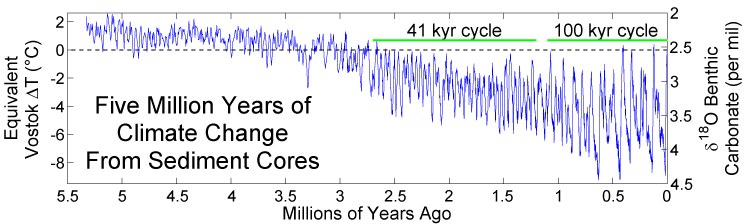
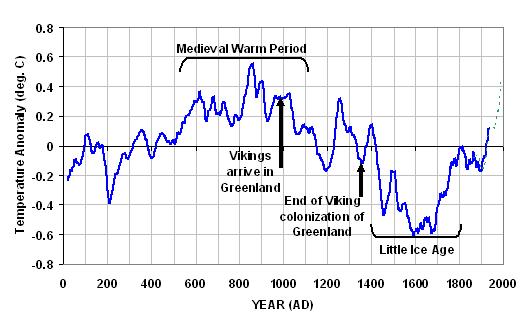
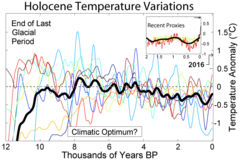
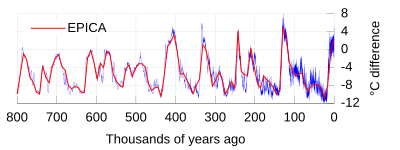
But a rational person might also consider that the earth was teeming with life when global temperatures were sharply higher than they are today, or are going to get in the next few centuries. Our current Ice-Age climate is something of an anomaly over the time that complex life has been established on the earth.
2000 years:
4000 years:

12000 years:
800,000 years:
5 million years: