African American
Related: About this forumThe Secret Network of Black Teachers Behind the Fight for Desegregation
Missed this a few months ago.For 25 years, the Emory University professor Vanessa Siddle Walker has studied and written about the segregated schooling of black children. In her latest book, The Lost Education of Horace Tate: Uncovering the Hidden Heroes Who Fought for Justice in Schools, Walker tells the little-known story of how black educators in the South—courageously and covertly—laid the groundwork for 1954’s Brown v. Board of Education and weathered its aftermath.
The tale is told primarily through the life of Horace Tate, an acclaimed Georgia classroom teacher, principal, and one-time executive director of the Georgia Teachers and Education Association (GTEA), an organization for black educators founded in 1878. Later in his career, he became the first African American to earn a Ph.D. from the University of Kentucky; at the time, Georgia still banned black students from state doctoral programs. Walker first met Tate in 2000. Over the course of the next two years, he told her about clandestine meetings among and outreach to influential black educators, lawyers, and community members tracing back to the 1940s. He also revealed black teachers’ secret and skillful organizing to demand equality and justice for African American children in Southern schools. After Tate’s death in 2002 at the age of 80, Walker continued a 15-year exploration, relying on Tate’s extensive archives to expose the full picture of how black educators mounted civil rights battles—in the years preceding and immediately following the Brown decision—to protect the interests of black children.
Walker: To overturn Plessy v. Ferguson—the 1896 Supreme Court case upholding the separate-but-equal doctrine—you have to have access to the people in the South. But if you’re in the NAACP’s national office in New York, how do you know who in the South will be a plaintiff? How do you launch a movement when you can’t really work well in the South because of the hostile climate? At the same time, black teachers in the South have data on school conditions and teaching resources and they know the plaintiffs, but they can’t let it be known that they’re part of the movement or they’ll lose their jobs. So it’s a perfect partnership. Black educators called themselves hidden provocateurs—these are the people figuring out, on a local level, how to provoke change and maneuver to get better facilities and more funding. To have it publicly known would undermine what they were trying to do. The generations of black people who followed learned the script that they wanted us to know.
Anderson: Black citizens who challenged Jim Crow segregation by rejecting racial subordination faced violence, intimidation, and economic ruin. Talk about the personal and emotional costs borne by black educators who were fighting for black children during the civil-rights era.
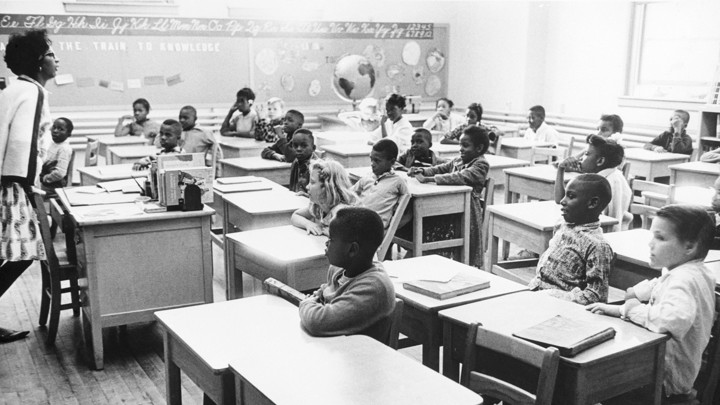
Walker: There are obvious losses—black teachers were fired and demoted. Wonderful black principals were put in charge of running school buses. They were humiliated because they had once been leaders in their communities. Some of them had to relocate and move north. But there are costs that we forget—like losing control over what black children learned.
The black educators taught math and science and everything else as best as they could with the limited resources that they had. You also saw the infusion of blackness in their classrooms. They were teaching black children how to be resilient in a segregated society. They seeded the civil-rights movement with this curriculum.
Those of us who reflect on the civil-rights era naturally think about people losing jobs and status. But to me just as important is understanding that they lost the chance to instill in another generation the ability to think about racial progress. We lost things that were foundational. We have to know the breadth of the costs, to understand both how we got to present-day conditions and how to think about moving forward.
 = new reply since forum marked as read
Highlight:
NoneDon't highlight anything
5 newestHighlight 5 most recent replies
= new reply since forum marked as read
Highlight:
NoneDon't highlight anything
5 newestHighlight 5 most recent replies
Hoyt
(54,770 posts)
JHan
(10,173 posts)
spicysista
(1,731 posts)
There are many unsung heroes in our history. Horace Tate was one of them. I've just added Professor Walker's book to my reading list. Thanks for sharing, JHan!


brer cat
(27,688 posts)My father was in charge of school consolidation in GA when they finally ended de jure segregation. It was a trying, very difficult task with emotions running very hot among white educators and parents.
Reading about this period through the eyes of black educators will be enlightening and no doubt troubling. The initial school integration in GA was a sham. All white private schools sprung up everywhere leaving the public schools essentially in de facto segregation even after the consolidation.
Thanks for posting this review, JHan.

The Polack MSgt
(13,822 posts)Always a learning experience JHan.
I appreciate your posts here, keeping the AA group active and still the most informative place around.

Kick in to the DU tip jar?
This week we're running a special pop-up mini fund drive. From Monday through Friday we're going ad-free for all registered members, and we're asking you to kick in to the DU tip jar to support the site and keep us financially healthy.
As a bonus, making a contribution will allow you to leave kudos for another DU member, and at the end of the week we'll recognize the DUers who you think make this community great.