Religion
Related: About this forumFrancis to faithful: Give up your riches to help the poor
First Palm Sunday Mass in St. Peter's celebrates service. Remember, he says, 'burial shrouds don't have pockets.'
By Stephen Rex Brown / NEW YORK DAILY NEWS
Christian joy "isn't born from possessing a lot of things,” he later added ...
Jesus "awakened so many hopes in the heart, above all among humble, simple, poor, forgotten people, those who don't matter in the eyes of the world," he said ...
http://www.nydailynews.com/news/world/pope-francis-pushing-poor-article-1.1297824?localLinksEnabled=false
 = new reply since forum marked as read
Highlight:
NoneDon't highlight anything
5 newestHighlight 5 most recent replies
= new reply since forum marked as read
Highlight:
NoneDon't highlight anything
5 newestHighlight 5 most recent replies

NYtoBush-Drop Dead
(490 posts)would listen... They all claim to be good christians, but really, not so much.

Deep13
(39,157 posts)
Deep13
(39,157 posts)
demosincebirth
(12,848 posts)Deep13
(39,157 posts)So in a practical sense, he did inherit those things for his perpetual use even if he cannot sell them outright. As far as what some argue are the obscene riches of the RC Church, perhaps this new guy might find himself in a position of authority to do something about it.
Anyway, I will withhold judgment to see how far these public demonstrations of humility go.
demosincebirth
(12,848 posts)with all it's "obscene" riches of the American people?
Deep13
(39,157 posts)The Pope is the ruler of his own nation state within the city the Rome. The Papal palace is enormous at over 160,000 sq. ft. of interior space compared to the 55,000 sq. ft. footprint of the White House. The President has to account for everything publicly and depends on Congressional authorization. The President really does not have much public property for his personal use and cannot keep it when he leaves sometime around noon, Jan. 20, 2017. Popes usually die in office. JP2 was there for decades. Also, the President is not pretending to live a spiritual, Christian life free from materialism.
But that's not really the point. The real point is the vast wealth of the RC Church in the form of real estate and artwork is not really being used for their purported mission.
hrmjustin
(71,265 posts)I think A lot of Roman Catholics would love to see the Vatican tone down a bit, and go simple. I see the pope is not going to live in the Apostolic Palace. He will move into a much more simple Apartment on the Vatican grounds. The fact is that he simply can not just sell everything but he can move money around and give it to the poor.
demosincebirth
(12,848 posts)goldent
(1,582 posts)This is a textbook case of a red herring...
Firstly, this "vast wealth" is much overstated. The Church does own some masterpieces. But it owns tons more that is interesting and academically important, but not that valuable commercially, and caring for this collection (much of it not on display) is not cheap.
"Selling off" the collection would be incredibly harmful to the artistic world. The value of the world's great museums is to protect and preserve their collections and not have pieces be sold hither and yon.
Finally, if the amount of money raised by selling off Church real estate and artwork would have any long term effect on the poor, then the problem of the poor would have been solved long long ago.
Anonymousecoview
(225 posts)I think this is a step in the right direction, away from Police State or Old School leadership

The Wielding Truth
(11,433 posts)
Igel
(37,734 posts)This while Francis was still in charge of the order.
Not as zealously as the Dominicanes. But inquisitors, looking into allegations of blasphemy and giving a chance for repentance--or turning the perps over to civilian authorities for nasty consequences.
Taking a multidimensional artefact like Xianity and reducing it to one dimension makes it unrecognizable. It varied by doctrine and by geography, by time and by enforcement. By structure and by emphasis. And by yet other things.
The Wielding Truth
(11,433 posts)demosincebirth
(12,848 posts)Deep13
(39,157 posts)The Spanish Inquisition at Toledo was not typical. For the most part they brought a standard rule of law to the rapidly expanding Christian empires of Spain and Portugal and oversight of local and otherwise unaccountable local officials. Searching for heretics usually meant explaining to uneducated people what the Church's view on this or that actually is.
markiv
(1,489 posts)his enlightenment from it will be a sight to behold

BeyondGeography
(41,244 posts)But I do appreciate this Pope's focus on the former. Maybe one of these centuries, the Church might get it right.
Deep13
(39,157 posts)We'll have to wait and see, I guess.
Voice for Peace
(13,141 posts)Deep13
(39,157 posts)skepticscott
(13,029 posts)And you don't even have to sell all you have, as Jesus commanded. Just sell all of the treasures in the Vatican Museum and use that money to do some real good (this is, if there's any left over after you own up to all of the sex abuse cases that your predecessors failed to, and settled all of those lawsuits). That's how you might start to gain credibility on this issue. While you and your cronies continue to live in opulence, surrounded by riches that you don't need, you have none.
demosincebirth
(12,848 posts)skepticscott
(13,029 posts)will be living in poverty, in accordance with his vow, right? Or he'll find some way to justify abandoning it, more likely...
demosincebirth
(12,848 posts)Bluenorthwest
(45,319 posts)before returning to the lavish Vatican residence? His Archbishops travel first class or by private charter when they come to Rome. There is no reason for that, but that's what they do. Even the Mahoney types with huge legal bills and scandal fly like princes and eat like kings. Hypocrisy and false faces.

struggle4progress
(127,391 posts)of his predecessor Pope Emeritus Benedict XVI to don black shoes, and spontaneously greeted onlookers as he entered a mass at a small Vatican parish ...
Thousands Pack St. Peter's Square for Pope Francis' Inaugural Mass
By MATTHEW JAFFE (@matthewbjaffe)
VATICAN CITY, March 19, 2013
He has already made himself known as the pope who takes the bus, pays his bills and wears his old shoes. Now Pope Francis has taken another step towards solidifying his image as the people's pontiff by announcing plans to celebrate a major pre-Easter ceremony in a youth detention centre ...
Pope Francis to wash feet of young inmates on Holy Thursday
Pope to wash feet of 12 young people in Casal del Marmo penal institute during afternoon mass on day before Good Friday
Lizzy Davies in Rome
Thursday 21 March 2013 11.34 EDT
... He showed his humbler style at his inaugural Mass on Tuesday, wearing simple white vestments, black lace-up shoes and a low modern mitre, or bishop's hat. The vestments of the cardinals attending the Mass were more decorated than his ...
Every day Pope Francis shows more contrasts with predecessor Benedict
Tom Heneghan
19 March 2013

TlalocW
(15,675 posts)I'm sure your slippers would fetch a nice price and feed a lot of people. Your various staffs, rods, crucifixes, rings, and other jewelry are probably some of the most valuable objects in the world and could feed a whole African country or two...
TlalocW

okasha
(11,573 posts)they're probably plaid terry scuffs from WalMart.
struggle4progress
(127,391 posts)
Pope Francis has opted for black shoes instead of traditional red
The Pope’s simplicity
Tuesday, March 19, 2013 by
Fr Mario Attard OFM Cap, San Ġwann
http://www.timesofmalta.com/articles/view/20130319/letters/The-Pope-s-simplicity.462103

Wolf Frankula
(3,860 posts)Wolf

No Vested Interest
(5,300 posts)"there's no luggage rack on the hearse."
hrmjustin
(71,265 posts)church.
Phillip McCleod
(1,837 posts)..always.. the 'humble, simple, poor, forgotten.. don't matter..'
i don't know that i believe any of that. nobody in 100 years or even 10 is going to remember the kardashians but occupy will go down in the history books.
it's this depiction of humanity as lowly and forsaken, powerless and in need of a father figure that i have always objected to. even in praising the poor, the pope can't help but patronize condescendingly.
yeah. no. not optimistic at all. very UN-optimistic and growing more pessimistic by the minute as otherwise sane people buy this bollocks.
Deep13
(39,157 posts)The medieval Church actually did enforce charitable obligations (there was no welfare system yet) and reciprocal obligations of the rich and powerful--not always consistently, but it did do it. The version of Christianity it preached was power through humility. Medieval society worshipped a penniless preacher who accepted humility to the degree of being tortured and killed, and through it he was the king of kings, a person of unimaginable power. So the Catholic image of humility, at least in theory, is one of power and virtue, and the nobility knew it. The reason so many nobles gave to the church or became monks is because they knew their lives were the antithesis of Christian virtue--they knew they were going to hell and it scared them. That's where the ecclesiastical power came from.
I am skeptical and will have to see if his actions match his rhetoric. His past in persecuting gays and obstructing the rights of women is not encouraging. So far, his outward signs (not actual policy) is encouraging. Francis of Assisi was the first beggar monk. Previously monks were personally poor, but their orders were rich. Francis made both poor, riding the wave of reforms that started in the 11th century. So far the new guy has eschewed the fancy clothes and cars of previous popes. He refused to sit on the papal throne. And he intends to give mass in a prison, washing the feet of 12 prisoners. If his real actions meet his symbolic message, it will be a significant rebuke to capitalism and a real C-change for one of the world's largest corporations.
But, I remain skeptical and will have to wait and see.

Thats my opinion
(2,001 posts)The first we might call juridical issues--gay rights, women priests, abortion and birth control, the nature of the Vatican establishment. The Catholic church moves very slowly--sometimes so slowly it is impossible to see any progress. When it takes a great leap forward, such as with John XXIII and Vatican II, there is an almost immediate pull back. I doubt if in the foreseeable future there will be any visible movement on married priests,women priest or gay rights, or sexual matters.
The second we might call matters of social justice. These have to do with economics, the poor, and the other issues highlighted in liberation theology. While the church also pulled back from moving boldly ahead on these issues, there was some residual understanding that they had to be addressed. Francis' acknowledgment that the poor had to be a priority of the church provides a crack in the conservative philosophy that has dominated the Vatican. Time will tell what progress can come from his new stance
okasha
(11,573 posts)is JPII's background in a USSR-dominated Poland. The state was very much the enemy of the church there, and anything associated with it, such as a Marxist reading of social justice, would not have been welcome to him. It's a truism that any institution subjected to outside pressure tends to dig in and become more conservative. Certainly that's been true in former Warsaw Pact countries and would have carried over into JPII's papacy.
Deep13
(39,157 posts)I understand modern Christianity sees them as separate, but I don't think any realistic assessment can. Even if they do not change their minds about reproductive, marriage, and who may be a priest issues, I would hope that they would stop focusing on those things as their major foci. Perhaps the election time display of crosses for aborted fetuses and embryos can be replaced with a message about economic justice.
Thats my opinion
(2,001 posts)It may be a false division and I would not make that distinction, but one that may resonate with that system. One of the rules of dialogue is to hear the definition in the way the "other" defines it.
okasha
(11,573 posts)that the juridical issues are matters that require a change in policy, while the social justice issues require only the carrying out of existing policy.
skepticscott
(13,029 posts)Do you seriously believe that, or do you just need that talking point to advance your apologetics?
locks
(2,012 posts)One time I was teaching 4th graders in Bible School. We learned all about St. Francis life, the order he started and their work with and for the poor. I called the local Franciscan house in Chicago and they graciously invited the children to visit. A brother in his habit and sandals talked to the children about how the friars lived, about their vows and work with the poor and showed them around. The children asked some questions and seemed to be satisfied with the answers. But when we got back to our church one child asked: if the brothers have to take vows of poverty and fast, why was he so fat? Though I wouldn't want a rude question, I kinda wished he had asked the brother to see what his answer would be. And I've always wanted to ask the pope why he dresses in designer robes, shoes and hats and why his church doesn't look anything like Jesus life or the early church. I hope this pope will lead his people out of wealth into "Christian joy."
Response to struggle4progress (Original post)
budini Message auto-removed
hrmjustin
(71,265 posts)Manifestor_of_Light
(21,046 posts)hrmjustin
(71,265 posts)did not exist.
Manifestor_of_Light
(21,046 posts)So it's up to you or somebody to prove that god or jesus existed.
There is no contemporaneous evidence he existed; the story about the census is complete bullshit; all the gospels were written some years after he died.
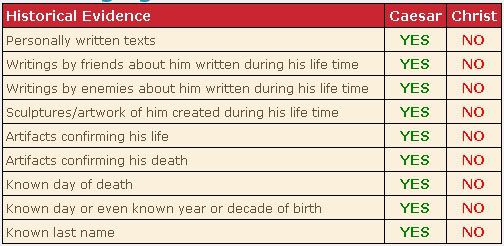
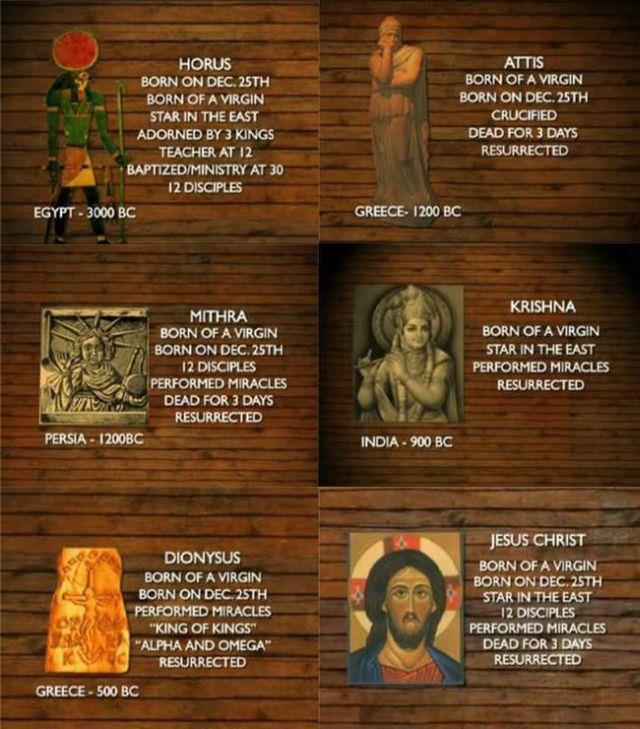
There's nothing unique about Jesus. All these other prior gods had the same characteristics:
hrmjustin
(71,265 posts)http://en.wikipedia.org/wiki/Historicity_of_Jesus
These are some links to read, but there is no 100% proof but a lot of history there is not 100% proof. As I sadi it is a matter of faith to me.
okasha
(11,573 posts)than there is for Alexander the Great. The «Jesus never existed » meme has the same credibility among historians that creationism does among scientists.

Act_of_Reparation
(9,116 posts)The problem with trite, superficially witty soundbites from anonymous internet sources is they are usually wrong, and cannot be deployed against anyone with a modicum of expertise in their respective system.
The oldest biographical account of Alexander the Great's life was written four hundred years after his death. Armchair apologists think this is awfully relevant to the argument of an historical Jesus because critics will often point out that the Gospels were written down well after the supposed life of Christ, by people who had never met the man. But a "biography" is not evidence of existence.
Real, physical evidence of Alexander the Great exists. He commanded legions of soldiers, conquered cities from Corfu to Karachi, and destroyed the Persian and Babylonian Empires. He left behind dynasties who ruled over the remains of his empire for generations after his death (The Ptolemies in Egypt, the Seleucids across the near east are of particular note). More than twenty cities bear his name. Unlike Jesus, Alexander is actually referenced by his contemporaries, in the writings of Ptolemy, Nearchus, Aristobulus, and Onesicritus.
If it sounds too good to be true, it's probably horseshit.
hrmjustin
(71,265 posts)Act_of_Reparation
(9,116 posts)... I'm saying the claim that there is more evidence for Jesus' existence than Alexander the Great's is demonstrable codswallop.
That said, I don't think proving the historicity of Jesus Christ is a particularly compelling argument for Christianity. Even if you were to prove, beyond a doubt, that a man named Jesus lived and died in 1st Century Judea, you're still stuck with an abject dearth of evidence supporting the claims made by the Gospels. Proof of Jesus' existence isn't ipso facto proof he was the son of deity.
Frankly, the argument is a dead end.
hrmjustin
(71,265 posts)I know it is not logical but i still believe it.
Thats my opinion
(2,001 posts)But neither of these are unassailable direct evidences.
hrmjustin
(71,265 posts)okasha
(11,573 posts)who refuses to call his book about Alexander a biography. In his own words:
More than twenty contemporaries wrote books on Alexander and not one of them survives. They are known by quotations from later authors, not one of whom preserved the original wording; these later authors are themselves only known from the manuscripts of even later copyists and in the four main sources these manuscripts are not complete. The more detailed history goes back to only one manuscript, whose text cannot be checked; another, much used, has often been copied illegibly. Alexander left no informal letter which is genuine beyond dispute and the two known extracts from his formal documents both concern points of politics. On the enemy side his name survives in a Lysian grave inscription, in Babylonian tablets on building work and astronomy and in Egyptian captions to temple dedications. (Alexander the Great, Penguin, p. 11.)
To which one might add that he was supposedly fathered by a god, was accorded divine status as Zeus-Amon himself, his assumed portraits bear a strong resemblance to the conventional depiction of Apollo, his lover was accorded the status of a divine hero, and somehow his teacher Aristotle in all his voluminous works never mentions him.
In short, every word of your post is something we take on faith about a man who has been demonstrably shrouded in myth.
Act_of_Reparation
(9,116 posts)You claim there is more evidence for an historical Jesus than there is for Alexander the Great.
Let's go through this line, by line, shall we?
And how many contemporaries wrote books on Jesus?
None.
Did the Evangelists cite their sources?
No.
Well, the New Testament certainly has this, and more.
Such as obvious contradictions between the four Gospels, and even more contradictions from Gospels not considered canon.
I would wager, that when put up against the historical "evidence" for Jesus, these four, incomplete copies are more consistent narratives.
Are our oldest surviving copies of the Gospels complete or legible?
No.
How many documents, formal or otherwise, accepted or supposed, were left behind by Jesus?
None.
Alexander's name has been found in Anatolia, Egypt, and Mesopotamia. Did any of Jesus' contemporaries bother to carve his name on a rock?
It would appear not.
Certainly, the specifics of Alexander's life are shrouded in myth and embellishment (and shitty Oliver Stone movies), but the actions ascribed to him left an indelible, measurable impact across multiple ancient civilizations. We know Phillip II of Macedon established the Hellenic League, and that the Hellenes overthrew the Persian and Babylonian Empires shortly after his death. Whether Philip's son was named Alexander or Bojangles is completely and utterly beside the point. Persia fell to the Greeks, under the command of somebody. Babylon fell to the Greeks, under the command of somebody. The Greeks marched to India, under the command of somebody.
These are measurable events, attributed to a man we know very little about.
Can the same be sad for the events described in the Gospels? Do we know Jesus walked on water like we know the Greeks defeated Darius III? Do we know Jesus gave the Sermon on the Mount, as we know the Greeks built a causeway of massive stones by which to lay siege to Tyre?
The specifics of the characters is only half of the issue. The Gospels describe not only an unverifiable person, but also unverifiable events. So, please. Spare us the false equivalencies and tu quoque nonsense.
It's tiresome.
hrmjustin
(71,265 posts)Now all that said do you think Jesus actually lived?
Act_of_Reparation
(9,116 posts)... as I'm not refuting Jesus' existence, but the groundless claim that there's more evidence for Jesus than Alexander the Great.
But, to entertain your question, I'm undecided on the matter. What we gleam from Josephus is this: a Jewish man named Yeshua was crucified in Jerusalem by Pontius Pilatus. As Yeshua was a staggeringly popular Jewish name, because Pontius Pilatus was notoriously vindictive and famously unpopular with the Jews, and because messianic cults were widespread in First Century Judea, that Pilatus would have crucified an "upstart" named Yeshua is statistically probable, in my own amateur opinion.
But again, I think it is irrelevant. Whether or not a man named Yeshua was crucified by Pontius Pilate does not prove this man was the Biblical Jesus. It wouldn't, ipso facto, support any claims made by adherents to Christianity.
Thats my opinion
(2,001 posts)When a boat goes by without being directly seen, one knows its passing by its wake. There is more evidence for Jesus' existence than anything else in all of Western history.
Act_of_Reparation
(9,116 posts)This demands qualification.
skepticscott
(13,029 posts)If the evidence for Jesus' existence is so overwhelming, why have there been so many "scholarly" debates about it? Is there more evidence for the existence of Jesus than for the existence of Prussia? Or Napoleon? Or Richard Nixon? Is there any need for pompous, NPR-ready debates about the existence of any of those? How many more thousands of examples proving how ridiculous your claim is would you like?
Seriously, Charles...please tell us you don't REALLY believe what you just said. Even people who think well of you here are face palming over that one.

Rhiannon12866
(262,052 posts)They regard him as a prophet. 
Manifestor_of_Light
(21,046 posts)Millions of people in ancient times believed that the earth was flat. That did not make it true.
The Catholic church believed the earth was the center of the solar system and the sun went around the earth. They executed Giordano Bruno for saying that, kept Galileo under house arrest, and imprisoned Johannes Kepler's mother for being a witch.
Because of their belief in the heliocentric Copernican system.
However, that did not make the earth-centric solar system true.
Got any real evidence, guys?
Manifestor_of_Light
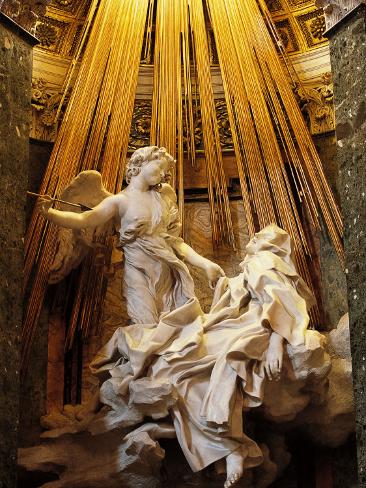
(21,046 posts)And gold jewelry and so forth.
The Ecstasy of Saint Theresa:

deucemagnet
(4,549 posts)I'm sure the poor will get the profits as soon as he can move it on eBay.

goldent
(1,582 posts)They said that we should not be wasting money on space exploration until we solved the problem of poverty in the US. Well, by that argument, we would still not have a satellite in orbit.
Deep13
(39,157 posts)For most orders, and I confess to knowing less about Jesuits than the medieval orders, a vow of poverty meant that the individual monks were poor--that is they had no property under their own personal control--but the monastery as a collectivity was rich. So even if the new guy has no personal assets, he may still live in vast opulence. Maybe he won't, but we'll see. The last guy did as did all the popes before him into the Middle Ages.
Mendicant, that is begging, orders started in the early 13th century with St. Francis and St. Clare (who actually knew each other). The mendicant orders believed that both the person and the order had to be poor, but they were the exceptions.