Science
Related: About this forumStudy: Stone spear tip made by earlier ancestor
By MALCOLM RITTER
Associated Press
Nov 15, 2012
NEW YORK (AP) —Scientists say they've found evidence that stone tips for spears were made much earlier than thought, maybe even created by an earlier ancestor than has been believed.
Both Neanderthals and members of our own species, Homo sapiens, used stone tips —a significant development that made spears more effective, lethal hunting weapons. The new findings from South Africa suggest that maybe they didn't invent that technology, but inherited it from their last shared ancestor, Homo heidelbergensis (hy-dil-ber-GEN-sis).
The researchers put the date of the South African stone tips at about half-a-million years ago —200,000 years earlier than other research has suggested.
The new study involved analyzing stone points, a bit less than 3 inches long on average, that had been excavated about 30 years ago. Scientists had previously estimated they were about 500,000 years old, but it wasn't clear whether they were used as spear tips or some other kind of tool, said Jayne Wilkins, a researcher at the University of Toronto and lead author of the new report.
More: http://www.usnews.com/science/news/articles/2012/11/15/study-stone-spear-tip-made-by-earlier-ancestor
 = new reply since forum marked as read
Highlight:
NoneDon't highlight anything
5 newestHighlight 5 most recent replies
= new reply since forum marked as read
Highlight:
NoneDon't highlight anything
5 newestHighlight 5 most recent replies
Flying Squirrel
(3,041 posts)

libodem
(19,288 posts)Interesting.

xchrom
(108,903 posts)xchrom
(108,903 posts)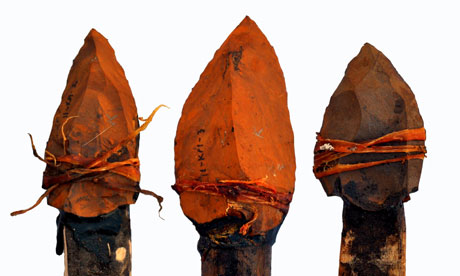
Cutting edge technology: early humans were lashing stone tips to wooden handles to make spears about 200,000 years earlier than we thought, research suggests. Photograph: Jayne Wilkins
The ancestors of humans were hunting with stone-tipped spears 500,000 years ago, according to a new study – around 200,000 years earlier than previously thought. This means that the technology must have been developed by an earlier species of human, the last common ancestor of both modern humans and Neanderthals.
The invention of stone-tipped spears was a significant point in human evolution, allowing our ancestors to kill animals more efficiently and have more regular access to meat, which they would have needed to feed ever-growing brains. "It's a more effective strategy which would have allowed early humans to have more regular access to meat and high-quality foods, which is related to increases in brain size, which we do see in the archaeological record of this time," said Jayne Wilkins, an archaeologist at the University of Toronto who took part in the latest research.
The technique needed to make stone-tipped spears, called hafting, would also have required humans to think and plan ahead: hafting is a multi-step manufacturing process that requires many different materials and skill to put them together in the right way. "It's telling us they're able to collect the appropriate raw materials, they're able to manufacture the right type of stone weapons, they're able to collect wooden shafts, they're able to haft the stone tools to the wooden shaft as a composite technology," said Michael Petraglia, a professor of human evolution and prehistory at the University of Oxford who was not involved in the research. "This is telling us that we're dealing with an ancestor who is very bright."
The use of spears for hunting has been dated back to at least 600,000 years ago, from sites in Germany, but the oldest spears are nothing more than sharpened sticks. The evidence for stone-tipped spears until now has been no more than 300,000 years old, from triangular stone tips found all over Africa, Europe and western Asia. "They're associated in Europe and Asia with Neanderthals and in Africa with humans and our nearest ancestors," said Wilkins. "Sometimes at these sites, they were used for other ways as well, sometimes for cutting or butchery or as knives or in processing hides or other materials."