Science
Related: About this forumFinally - an update on Comet ISON and what may be coming next
http://www.skyandtelescope.com/observing/highlights/193909261.html"November 29, 3:30 p.m. EST: A bold forecast."
"1. Since yesterday's 'resurrection,' the comet's overall dust output has clearly increased dramatically as compared with its pre-perihelion situation.
"2. Likewise, early yesterday the dust production appeared to consist almost exclusively of 'very heavy' dust particles. My impression this morning from the latest SOHO and STEREO images is that the comet is now experiencing a huge and ongoing dust release in a broad range particle sizes. If this continues, it is a very hopeful sign for visual observers in days to come.
"3. I've mentioned several times that 1962's Comet Seki-Lines is the one other modern, dynamically 'new,' truly sunskirting comet whose photometric behavior is known in some detail. It likewise experienced a strange 'disappearance' right about the time of an anticipated brightness surge at perihelion, which had been expected to bring it to naked-eye daylight visibility at around magnitude –7.
"4. A quick glance at ISON's appearance in the 12:30 UT SOHO image jogged my memory that it looks very much like another comet photo I saw long ago . . . of none other than Comet Seki-Lines! One of the earliest post-perihelion photos of Seki-Lines was one taken by, I believe, the great comet photographer of the 1960s and 70s, Alan McClure. It showed a strangely wedge-shaped, large, brilliant coma forming the beginnings of a huge, broad, tail created by an obviously wide range in dust-particle sizes. Sound familiar?:
________________snip____________________
still hoping night time viewers with dark skies can get something memorable out of this most rare comet!
 = new reply since forum marked as read
Highlight:
NoneDon't highlight anything
5 newestHighlight 5 most recent replies
= new reply since forum marked as read
Highlight:
NoneDon't highlight anything
5 newestHighlight 5 most recent replies

BlueToTheBone
(3,747 posts)When do you think it will be most visible and what direction should we be looking?

NRaleighLiberal
(61,910 posts)when these constellations are viewable in your area. Generally speaking, it is still very near the sun, so either in the east just before sunrise may be the best possibility in early December....I think we will get more updates once it is confirmed what remains.
See the chart here.
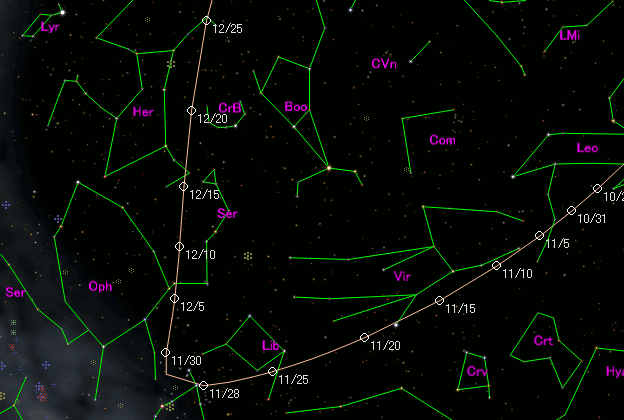

muriel_volestrangler
(106,599 posts)and that says the declination by midnight GMT Dec 23rd (the start of the week or so it's closest to Earth) is +38 degrees 56 minutes - just enough to make it circumpolar for me at about 51 degrees north, if I remember the meaning correctly (ie 90 degrees minus your latitude). By Dec 24th it's 42deg26'; Dec 25th 46 degrees. By Dec 26th it's 49deg37', which makes it just circumpolar for New York.
There's an online star chart here: http://www.fourmilab.ch/yoursky/cities.html where you can put in a major city, or your own latitude and longitude.
On edit: reading the full link in the OP, it looks like they don't expect dust and ice production for more than a week or so. Looks like I'm out of luck - too far north to see anything by then, even if I'm up at 5 in the morning.

BlueJazz
(25,348 posts)SheilaT
(23,156 posts)I know it had been predicted to be pretty bright right around Christmas, but I'm guessing this is going to greatly impact the brightness quotient.
NRaleighLiberal
(61,910 posts)It all depends upon what's remaining after the brush with the sun. Worth using the Google for updates over the next week or so.

Kick in to the DU tip jar?
This week we're running a special pop-up mini fund drive. From Monday through Friday we're going ad-free for all registered members, and we're asking you to kick in to the DU tip jar to support the site and keep us financially healthy.
As a bonus, making a contribution will allow you to leave kudos for another DU member, and at the end of the week we'll recognize the DUers who you think make this community great.