Science
Related: About this forum
A couple of beauties from Hubble (big images)
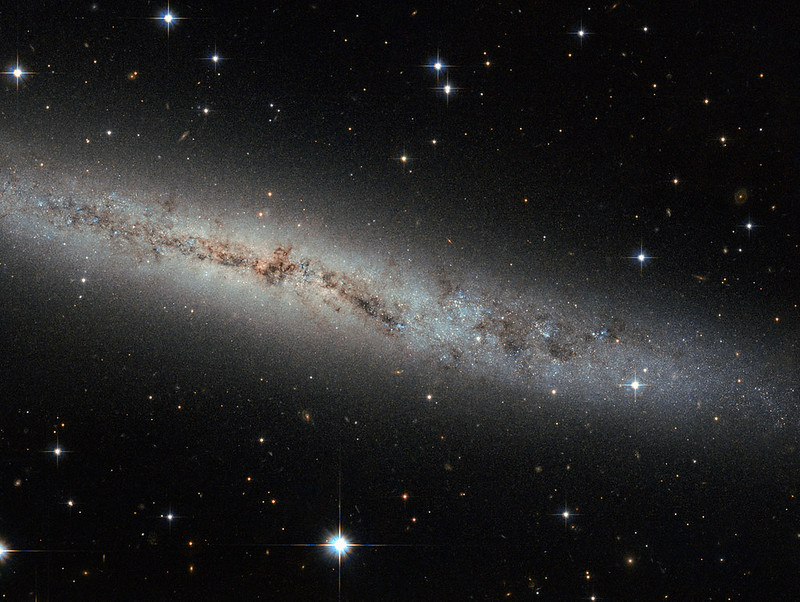
Located some 25 million light-years away, this new Hubble image shows spiral galaxy ESO 373-8. Together with at least seven of its galactic neighbors, this galaxy is a member of the NGC 2997 group. We see it side-on as a thin, glittering streak across the sky, with all its contents neatly aligned in the same plane.
We see so many galaxies like this — flat, stretched-out pancakes — that our brains barely process their shape. But let us stop and ask: Why are galaxies stretched out and aligned like this?
Try spinning around in your chair with your legs and arms out. Slowly pull your legs and arms inwards, and tuck them in against your body. Notice anything? You should have started spinning faster. This effect is due to conservation of angular momentum, and it’s true for galaxies, too.
This galaxy began life as a humungous ball of slowly rotating gas. Collapsing in upon itself, it spun faster and faster until, like pizza dough spinning and stretching in the air, a disc started to form. Anything that bobbed up and down through this disk was pulled back in line with this motion, creating a streamlined shape.
Angular momentum is always conserved — from a spinning galactic disk 25 million light-years away from us, to any astronomer, or astronomer-wannabe, spinning in an office chair.
Credit: NASA
http://www.flickr.com/photos/gsfc/11648639246/
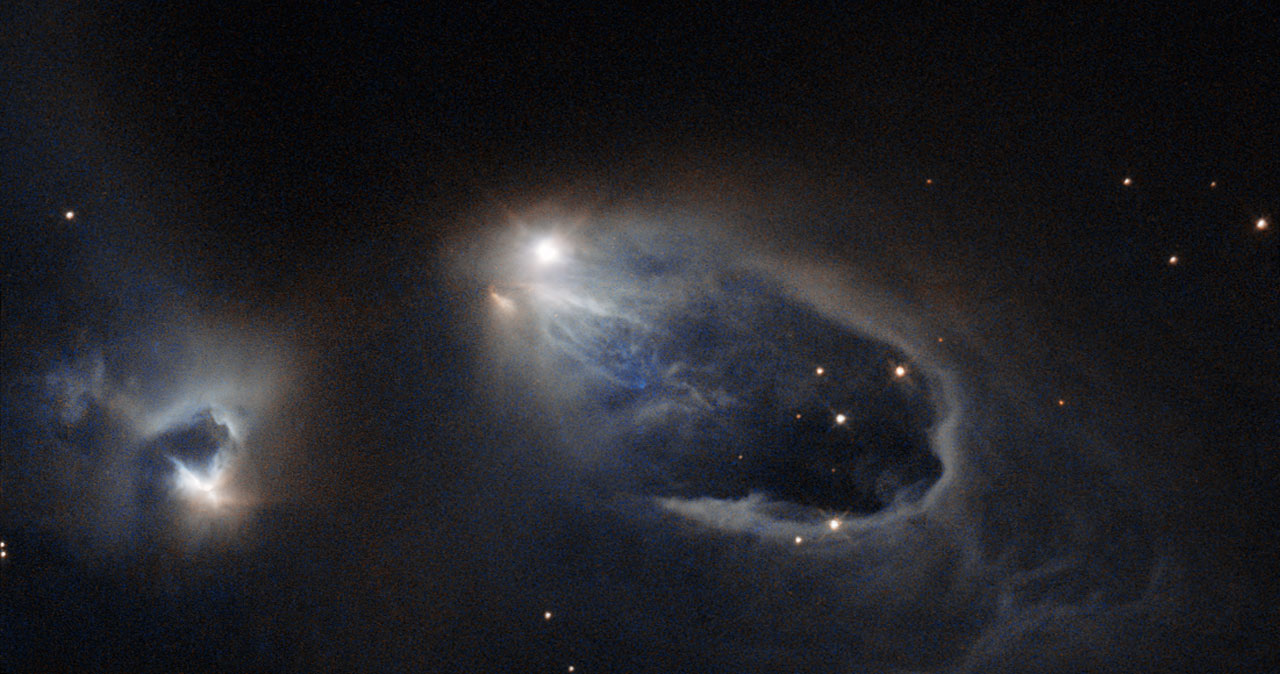
Look at the bright star in the middle of this image. It appears as if it just sneezed. This sight will only last for a few thousand years — a blink of an eye in the young star's life.
If you could carry on watching for a few years you would realize it's not just one sneeze, but a sneezing fit. This young star is firing off rapid releases of super-hot, super-fast gas, like multiple sneezes, before it finally exhausts itself. These bursts of gas have shaped the turbulent surroundings, creating structures known as Herbig-Haro objects.
These objects are formed from the star's energetic "sneezes." Launched due to magnetic fields around the forming star, these energetic releases can contain as much mass as our home planet, and cannon into nearby clouds of gas at hundreds of kilometers/miles per second. Shock waves form, such as the U-shape below this star. Unlike most other astronomical phenomena, as the waves crash outwards, they can be seen moving across human timescales of years. Soon, this star will stop sneezing, and mature to become a star like our sun.
This region is actually home to several interesting objects. The star at the center of the frame is a variable star named V633 Cassiopeiae, with Herbig-Haro objects HH 161 and HH 164 forming parts of the horseshoe-shaped loop emanating from it. The slightly shrouded star just to the left is known as V376 Cassiopeiae, another variable star that has succumbed to its neighbor's infectious sneezing fits; this star is also sneezing, creating yet another Herbig-Haro object — HH 162. Both stars are very young and are still surrounded by dusty material left over from their formation, which spans the gap between the two.
Credit: ESA/Hubble & NASA, Acknowledgement: Gilles Chapdelaine
http://www.flickr.com/photos/gsfc/11467249715/
 = new reply since forum marked as read
Highlight:
NoneDon't highlight anything
5 newestHighlight 5 most recent replies
= new reply since forum marked as read
Highlight:
NoneDon't highlight anything
5 newestHighlight 5 most recent replies

2naSalit
(103,811 posts)
cinnabonbon
(860 posts)I could stare at the second one for ages.

Auntie Bush
(17,528 posts)
hue
(4,949 posts)
Bernardo de La Paz
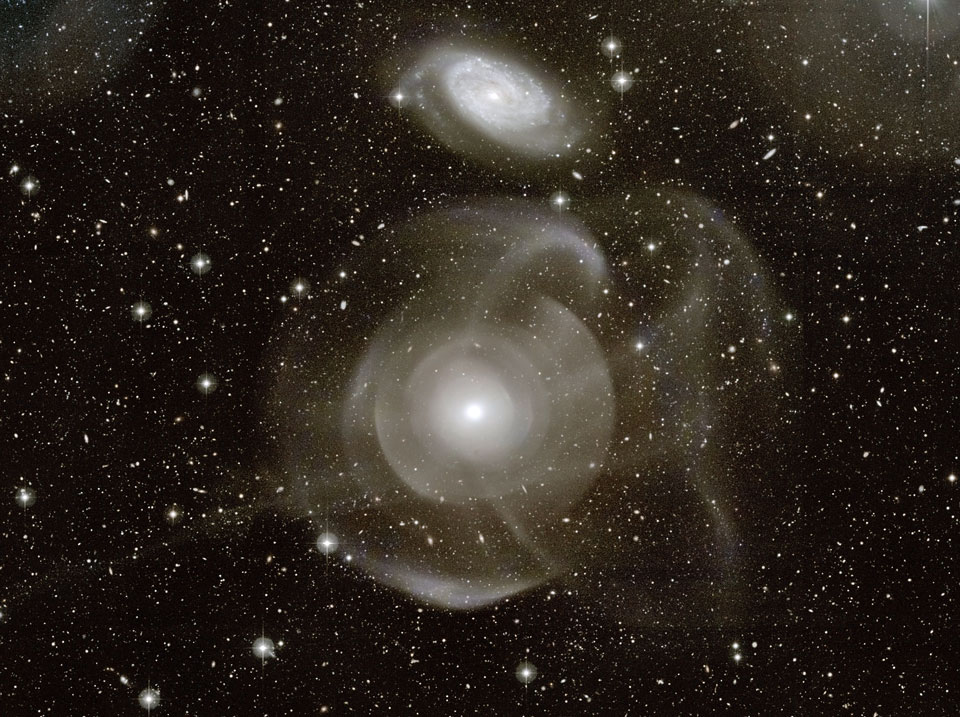
(60,320 posts)Astronomy Picture Of the Day:
http://apod.nasa.gov/apod/astropix.html
Here's today's picture in reduced form; go to the link for higher res.

Aldo Leopold
(687 posts)
7wo7rees
(5,128 posts)

yuiyoshida
(45,656 posts)

NastyRiffraff
(12,448 posts)But...but...The Earth is the center of the universe! And the Sun revolves around it. 
I love Hubble.
oldandhappy
(6,719 posts)Thank you, lots.
packman
(16,296 posts)There are more things in heaven and earth, Horatio,
Than are dreamt of in our philosophy.

Kick in to the DU tip jar?
This week we're running a special pop-up mini fund drive. From Monday through Friday we're going ad-free for all registered members, and we're asking you to kick in to the DU tip jar to support the site and keep us financially healthy.
As a bonus, making a contribution will allow you to leave kudos for another DU member, and at the end of the week we'll recognize the DUers who you think make this community great.