NASA's New Horizons Spacecraft Takes the Inside Course to Ultima Thule
From
http://pluto.jhuapl.edu/News-Center/News-Article.php?page=20181218
NASA's New Horizons Spacecraft Takes the Inside Course to Ultima Thule
Mission Team Sees No Moons or Rings Near Ultima, Opts for Primary Flyby Path
December 18, 2018
With no apparent hazards in its way, NASA's New Horizons spacecraft has been given a "go" to stay on its optimal path to Ultima Thule as it speeds closer to a Jan. 1 flyby of the Kuiper Belt object a billion miles beyond Pluto – the farthest planetary flyby in history.
After almost three weeks of sensitive searches for rings, small moons and other potential hazards around the object, New Horizons Principal Investigator Alan Stern gave the "all clear" for the spacecraft to remain on a path that takes it about 2,200 miles (3,500 kilometers) from Ultima, instead of a hazard-avoiding detour that would have pushed it three times farther out. With New Horizons blazing though space at some 31,500 miles (50,700 kilometers) per hour, a particle as small as a grain of rice could be lethal to the piano-sized probe.
The dozen-member New Horizons hazard watch team had been using the spacecraft's most powerful telescopic camera, the Long Range Reconnaissance Imager (LORRI), to look for potential hazards. The decision on whether to keep New Horizons on its original course or divert to a more distant flyby, which would have produced less-detailed data, had to be made this week since the last opportunity to maneuver the spacecraft onto another trajectory was today (Dec. 18).
New Horizons formed its hazard watch team in 2011 to prepare for its Pluto flyby, addressing concerns that Pluto's newly discovered small moons could spread dangerous debris across New Horizons' path. An intense search turned up no potential mission-ending risks; the team opted for the original flight plan and New Horizons safely carried out its historic exploration of the Pluto system in July 2015.
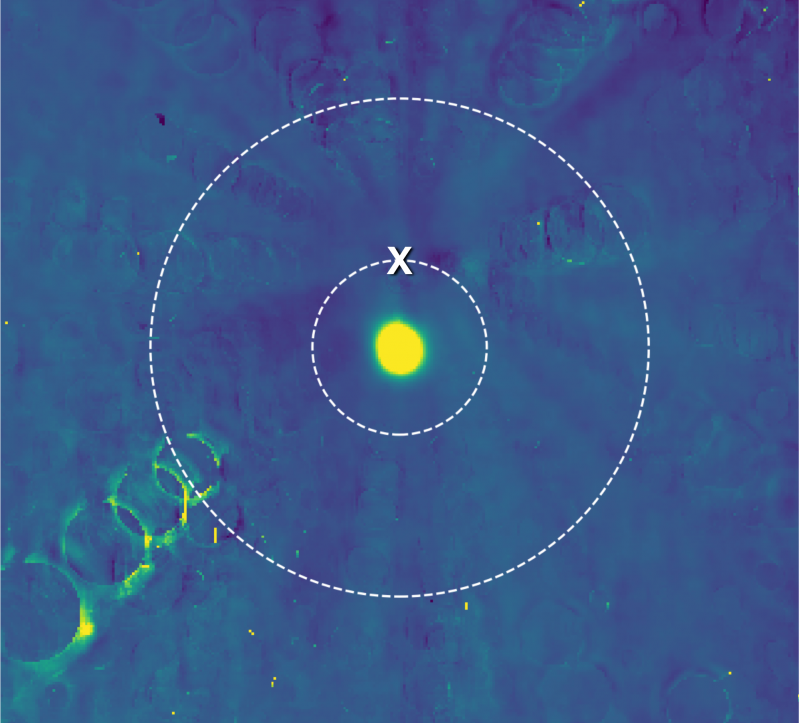 This image was made by combining hundreds images taken between August and mid-December by New Horizons' Long Range Reconnaissance Imager (LORRI). It has been colored using deep blue for the darkest regions and yellow for the brightest. Ultima Thule is the bright yellow spot in the middle. The two possible flyby distances for New Horizons are indicated by the two concentric circles. The mission has decided to fly along the closer path, toward the target point marked by an X. Individual images contain many background stars, but by combining images taken at different distances from Ultima Thule, most of the stars can be identified and removed. However, some of them leave behind traces, which can be seen as faint circles radiating away from the target point. Credit: NASA/Johns Hopkins Applied Physics Laboratory/Southwest Research Institute.
...
More at link.

 = new reply since forum marked as read