Science
Related: About this forumChinese Comparison: CO2 Emissions of Plug-In Hybrid and Gasoline Cars Based On Grid Power Sources.
The paper I'll discuss in this post is this one: Provincial Greenhouse Gas Emissions of Gasoline and Plug-in Electric Vehicles in China: Comparison from the Consumption-Based Electricity Perspective (Yu Gan, Zifeng Lu, Xin He, Chunxiao Hao, Yunjing Wang, Hao Cai, Michael Wang, Amgad Elgowainy, Steven Przesmitzki, and Jessey Bouchard, Environmental Science & Technology 2021 55 (10), 6944-6956)
My relationship with the automobile has always been problematic. I have always had the sense that I "needed" a car, despite a failed three year attempt - which I defined as a one man revolution against the internal combustion engine that was actually more motivated by poverty than ethics - to live by bicycle in Los Angeles whereupon I was in magnificent physical shape but late for everything and often injured by interactions with, um, automobiles.
I was already a man when I moved to Los Angeles. I didn’t grow up in that city which in those times was a paean to the car CULTure, and as such, a city featuring some of the worst air pollution on Earth. I grew up in one of the rapidly expanding suburbs on Long Island in what was called the "post-war era" while potato farms, pumpkin farms and marvelous oak forests with all kinds of interesting bugs, including but not limited to potato bugs, were being bulldozed to build vast stretches of ugly tract houses like the one in which I grew up.
I was in the lower middle class; my father was a laborer whose formal education ended with the 8th grade; my mother was slightly better educated, having left school in the 10th grade. In those times, if one was a veteran of the war – in those time there were wars and then there was the war - laborers with 8th grade educations could afford to buy a house under the "GI Bill," and my parents, who grew up in relative poverty in Brooklyn and Queens, were startled and giddy to learn that even they could afford to live in a house with a small yard, and a lawn, and a car, albeit, with the entire lifestyle absolutely dependent on owning and maintaining the latter.
I lived on the poor side of the concrete strip mall; the public school district I attended was largely attended by the children of engineers, scientists, airline pilots, lawyers and corporate executives; my school peers lived in a world I could not even imagine. On my side of the concrete strip the local neighborhood kids in our tract house development were basically motor heads, adolescents whose life goals included owning a muscle car, say a Corvette, or an Oldsmobile 442, and driving up and down strips with loud engines in screeching stars and stops with a skinny girl in the passenger seat who chewed gum, wore a leather jacket, rolled the window down to yell out to her friends and talked “dirty.”
Although I never felt quite comfortable with my school friends who always seemed to know far more about education than I did, I wasn’t really all that comfortable with the motor head life either; I never learned to work a wrench quite as well as everyone else. Nevertheless my feeling of security was very much tied up in my father’s 30 mile commute to his union job as a warehouse worker which in turn depended on the status of the “clutch,” the “carburetor,” the “transmission,” the “tires”, the “rings”…these vague words spoken in whispers by my parents whenever one of these mysterious devices were at risk of failure defined my whether or not I could live in my home or not.
I cannot claim to have been a total rebel against my culture. As a teenager, as was traditional in the culture in which I grew up, I reached that milestone of “getting a license,” whereupon I somehow managed to acquire a car of my own, around which my life revolved in every aspect, going to work, attending classes when I was able, and a sex life involving drive-in movie theaters, dark side roads and the back seat of the Pontiac with the 350 cubic inch engine and seat belts, which in my day, people loved to avoid using.
Later, my nascent sense of being “an environmentalist” grew out of the car, I think, my first car trips to Big Sur and to Yosemite, and to the Sonoran deserts.
Yosemite…
John Muir’s Yosemite…
A little known and little appreciated fact: John Muir founded the Sierra Club to save the Hetch Hetchy valley from the O'Shaughnessy Dam – his efforts failed, although he did not live to see the consequences of his failure. Today the O’Shaughnessy Dam provides water for San Francisco and so called “renewable energy” for California, converting the Valley, which is probably now filled with silt with covered by layers of calcium carbonate and other salts, into a kind of underwater industrial park. By extension, therefore, one could argue that the founder of the Sierra Club opposed so called “renewable energy,” at least in the case where it destroyed precious wilderness.
Today, in New Jersey and almost certainly elsewhere, the Sierra Club is in favor turning wilderness into industrial parks. The head of the Sierra Club in New Jersey is advocating for converting the continental shelf here into an industrial park for wind turbines, all of which will be landfill within 25 years of their construction. I once encountered this guy at a “march for science” that turned out, somewhat to my disgust, to be a “march for ‘renewable energy’,” and it was claimed, “truth.”
Truth…
We live in the age of the celebration of lies, including those we tell ourselves.
The word “environmentalist” has become a loaded term, almost to the point of meaninglessness. Even an awful human being like say, Robert F. Kennedy Jr. can be declared by our easily confused media, an “environmentalist.” An awful organization of bourgeois scientifically illiterate consumers like Greenpeace can be declared by the media to be an “Environmental Organization,” just as the modern Sierra Club that wants to tear up marine ecosystems and forests to convert them into industrial parks can be called an “Environmental Organization.”
I contend, and I may be wrong about this, feel free to disagree, that one cannot really be an environmentalist unless one really understands technology and its implications and it’s real effects on the environment, particularly when one advocates for substituting one system for another. In recent decades, there have been serious science and engineering modeling tools, that involve a technique that is called “Life Cycle Analysis” or “LCA.” I know thisI have made it my life’s private work to understand how things actually work. This, of course, is a process of disillusionment, particularly when is confronted with the rhetoric of organizations like Greenpeace and the Sierra Club, rhetoric which is often presented and embraced blindly and assumed, rather glibly to have an aura of “truth,” so much so that one can attend a “March for Science” and listen to a fool from the New Jersey Sierra club drone on about how wonderful it would be to have diesel powered barges and cranes install wind turbines featuring coal derived steel posts anchored in coal derived concrete, that will shed polymers into the water for 25 years, generate a little electricity, then need be disassembled by diesel powered barges and cranes and transferred to diesel trucks to be hauled away to landfills.
If one isn’t disillusioned when one nears the end of one’s life, one has not really lived, nor has anyone really learned anything. (John Muir lived.) There’s a lot of hand waving and chanting that goes on when environmental issues, a lot of rote assumptions never belabored with critical thinking, a lot of heads in the sand, particularly with respect with the issue of energy flows, the inviolable laws of thermodynamics, in particular the first law, which states that in a normal chemical reaction energy is neither created nor destroyed, and the second law, which states that energy conversions from one form to another involves entropy, the loss of energy to heat.
This post is thus about the fantasy – one I’ve always wanted to believe but cannot make myself believe – that there is such a thing as a “green car,” a car that is harmless, or nearly so, to the environment, a car that will render the planet “sustainable” while simultaneously allowing for the car CULTure to persist. Although I am a hypocrite, as I depend on owning a car, I cannot avoid the moral conclusion that my lifestyle, dependent as it is on the car CULTure is destroying the future.
History will not forgive us, nor should it.
Mostly the idea of the “green car” involves the fantasy that electricity is “green,” that it magically arrives out of a magic wall socket that’s connected to “green” infrastructure. Electricity, as the bulk of it continues to be produced is a thermodynamically degraded form of energy; it is not primary energy as much as people want to treat it as such. Coal generated electricity is not dead, not even close to being dead, according to the International Energy Agency, the IEA: Global coal demand in 2021 is set to exceed 2019 levels and approach its 2014 peak
...Coal demand is on course to rise 4.5% in 2021, with more than 80% of the growth concentrated in Asia. China alone is projected to account for over 50% of global growth. Coal demand in the United States and the European Union is also rebounding, but is still set to remain well below pre-crisis levels. The power sector accounted for only 50% of the drop in coal-related emissions in 2020. But the rapid increase in coal-fired generation in Asia means the power sector is expected to account for 80% of the rebound in 2021...
One can worship pictures of wind turbines in a little home temple as much as one wishes, but the reality is that the so called "renewable energy" industry on which in this century trillions of dollars have been squandered is worse than useless at addressing climate change since it produces far more wishful thinking and complacency than it does energy.
China...
China releases more carbon dioxide than any nation on Earth, albeit it that it lags far behind the United States in carbon dioxide releases on a per capita basis. It would appear, or it certainly does to me, that Americans think that the Chinese should agree to live either in poverty or at a lower standard of living than Americans so Americans can declare themselves "green." The reality is that the United States has more dangerous natural gas in rocks subject to fracking than China does, and when much of this ground rock is permanently destroyed, leaching God-knows-what toxic chemicals and elements into ground water forever after the gas is gone, there will be hell to pay.
History will not forgive us, nor should it.
Let's be clear about something OK? American wealth was built on the legacy of human slavery on one hand, and coal on the other. It's far more than slightly disingenuous for us to wag fingers at China for building their economy on coal, particularly when they are on the forefront of building new nuclear reactors and we are not.
Of course Chinese coal is destroying the world, but we set it to bleeding...
Nine years ago a paper was published in the same journal as was cited at the outset showing that in China, where there was, at that time, 100 million electric vehicles, albeit mostly electric scooters and electric bikes, the air pollution associated with electric cars was actually worse than that caused by gasoline driven cars: Electric Vehicles in China: Emissions and Health Impacts (Shuguang Ji, Christopher R. Cherry, Matthew J. Bechle, Ye Wu, and Julian D. Marshall Environmental Science & Technology 2012 46 (4), 2018-2024). (I commented on that paper briefly at the time elsewhere, where my comments on energy and the environment were, um, unappreciated since they conflicted with what people wanted to hear, which was that so called "renewable energy" would save the world. It didn't save the world; it isn't saving the world; it won't save the world.
The paper cited at the outset, something of an update of the 2012 paper, but on a much more detailed level, accounting for regional effects, is not about pure electric vehicles per se, but about plug in hybrid cars.
From the introduction to the paper:
While electricity generation and consumption are generally balanced at the national level, significant gaps exist at the provincial level because of interprovincial electricity transfers, making the consumption-based perspective important for the life-cycle analysis (LCA) of provincial electricity and PEV operation. In China, due to the spatially imbalanced economic development and uneven distribution of energy supply and demand, electricity generated from inland provinces is transferred to coastal areas to support the rapid economic development there.(13) As of 2019, China has the world’s highest voltage and longest electricity transmission lines.(14) Because electricity consumed in a province is a blend of electricity generated in itself and electricity transferred from other provinces, the frequent interprovincial electricity transmission could lead to significant differences between generation-based and consumption-based electricity characteristics at the provincial level...
...Accurate analysis of provincial variability in the GHG emission intensity of PEV operation should be conducted from a consumption perspective with considerations of complete electricity transmission. Figure 1 shows the electricity generation and transmission among provinces in China in 2017. Apparently, all provinces are interconnected in the grid network through direct and indirect electricity transmission. For instance, the characteristic of electricity consumed in the province of Hebei is affected by not only the electricity generated in Hebei but also electricity transferred from its directly connected provinces (e.g., Inner Mongolia, Shanxi, Shaanxi, Shandong, etc.), and these directly connected provinces further receive electricity from other provinces through different levels of indirect electricity transmissions. Therefore, a network-based modeling approach that takes into account both direct and indirect electricity transmissions completely should be used to accurately quantify the characteristics of consumption-based electricity.(21,22)
The abbreviations for different kinds of cars used, and different analytical settings in this introduction are carried throughout the paper. They can also be accessed in the abstract, which is open sourced and readily available.
Figure 1:
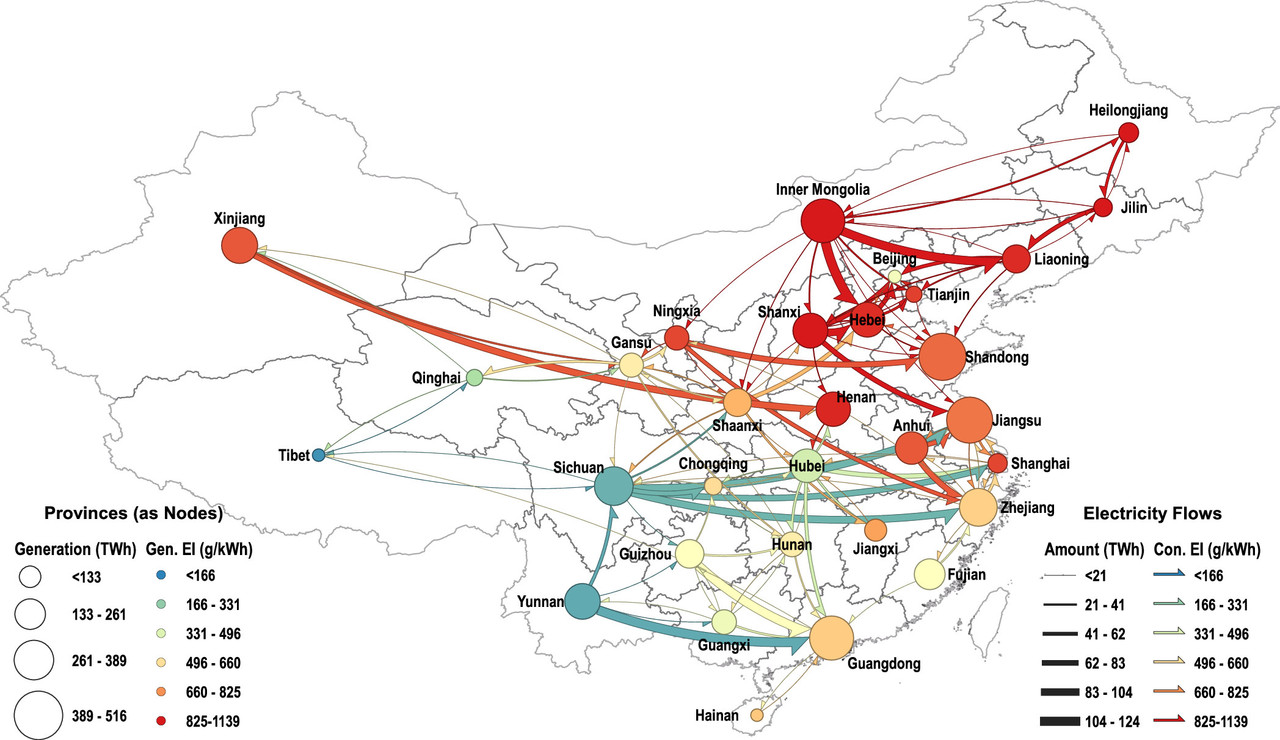
The caption:
An important factor in this analysis is the curb weight, abbreviated "CW," of the plug in vehicles used in China, brands of which do not significantly differ than those sold in the US:
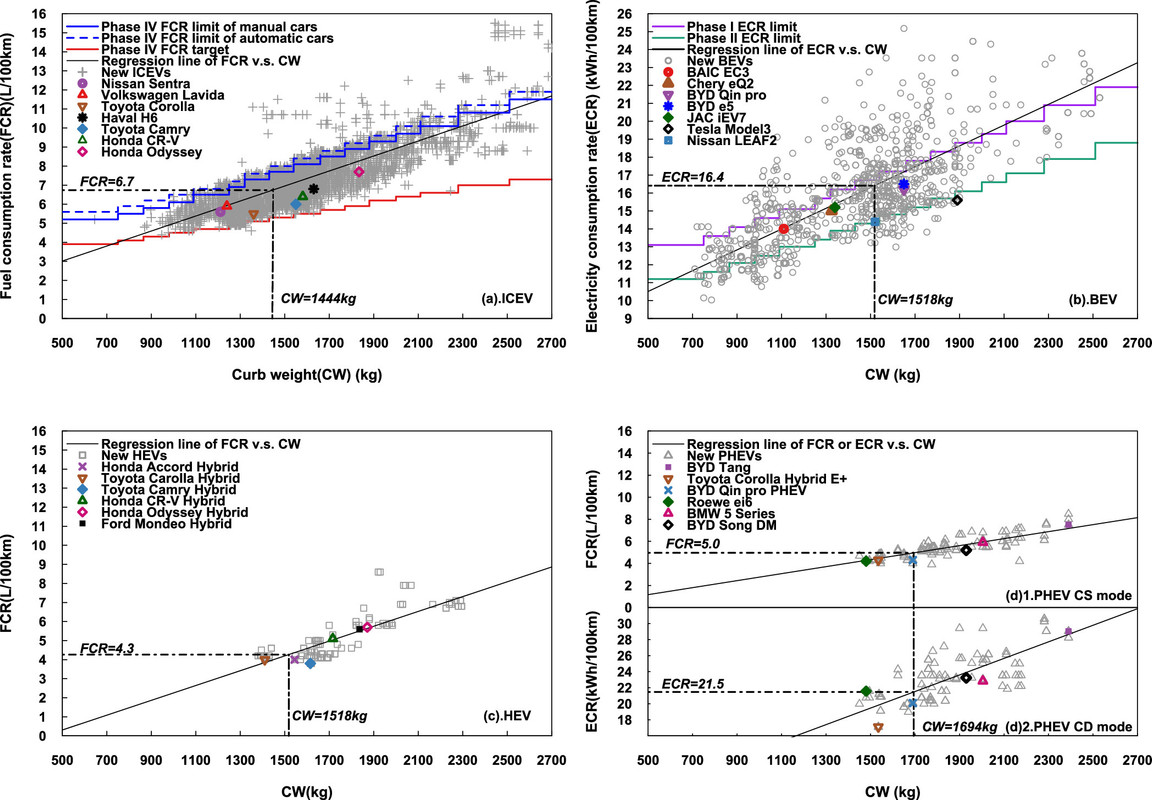
The caption:
The authors then launch into some matrix algebra to describe how they have modeled various effects connected with transmission, temperature, etc...
We used the quasi input–output (QIO) model developed by Qu et al.(21,22) to simulate the interprovincial electricity transmission and then calculate the provincial GHG emission intensities for electricity consumption. In the QIO model, each provincial power grid is treated as a node. At the equilibrium of electricity supply and demand, the electricity generated in the province i (i.e., gi) plus the electricity imported from other provinces equals the electricity consumed in the province i (i.e., ci) plus the electricity exported to other provinces. Thus, the total electricity flow in the province i (xi) can be expressed as
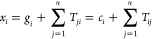
where Tij and Tji represent the total amount of electricity transferred from province i to j and from province j to i, respectively; and n is the number of provinces. For convenience, we let x, g, and c denote the 1 by n vectors that represent the total electricity flows, generation, and consumption, respectively, of all provinces, and the n by n matrix T represents the electricity transfers among provinces, that is
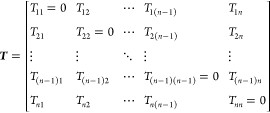
This motivates a cranky old man comment from me about "these kids today:"
"These kids today" are better than we ever were. OK, boomer? I have huge respect for them and feel enormous guilt for the problems we are leaving for them, all unsolved.
Temperature corrections to address thermodynamic considerations:
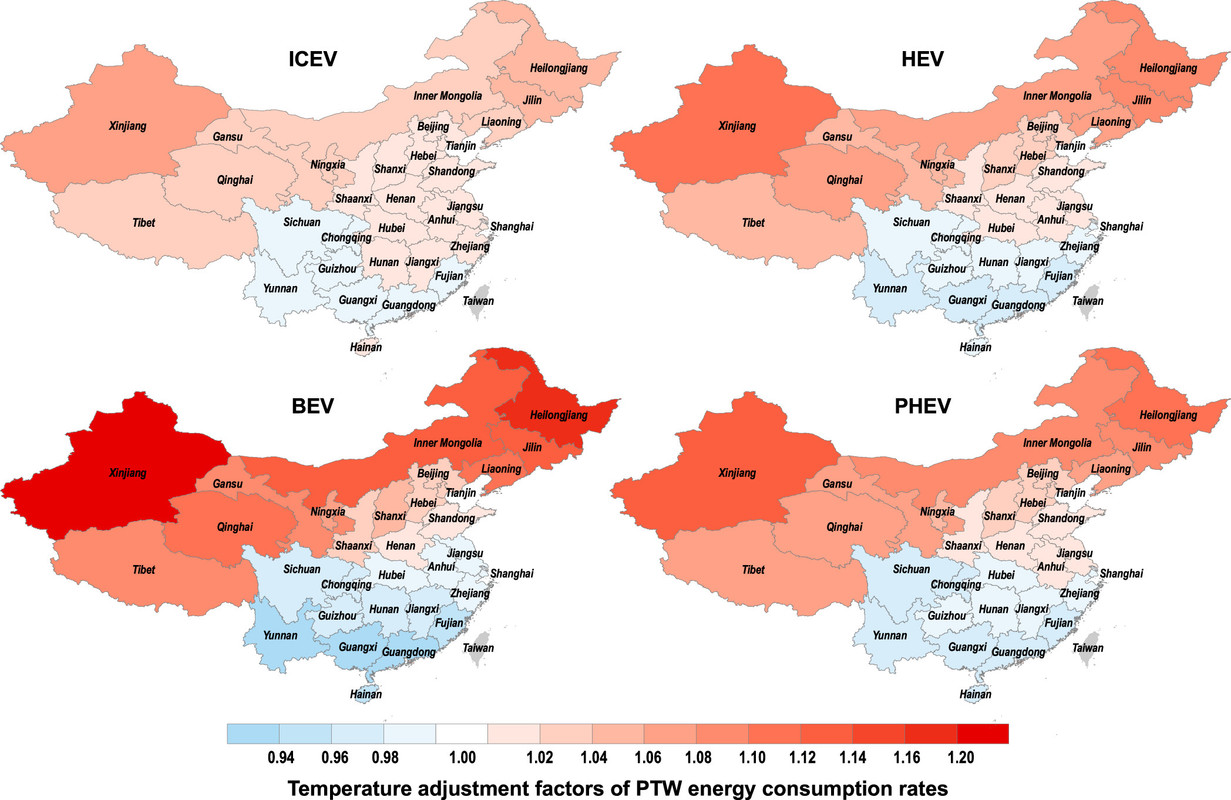
The caption:
Electricity sources and the presence of vehicles consuming it:
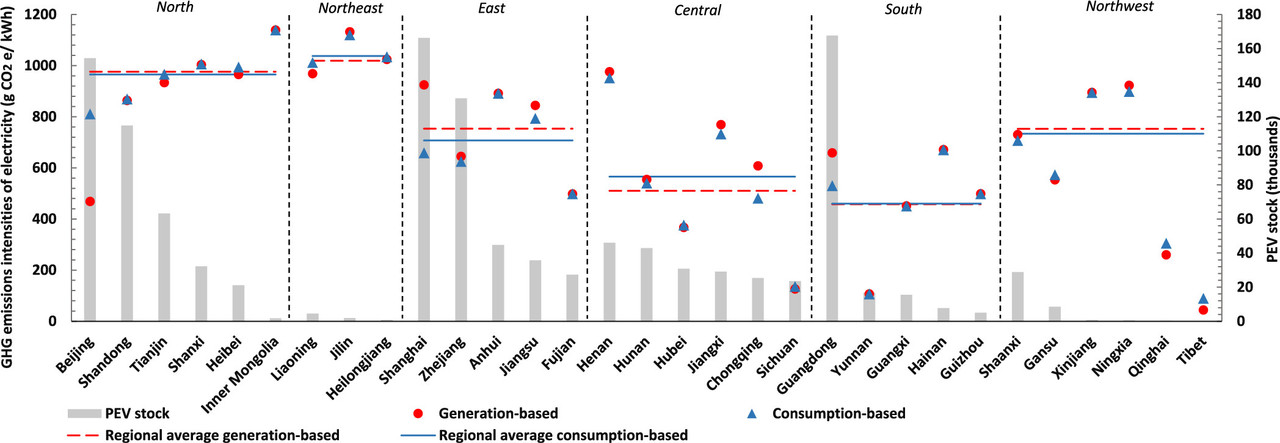
The caption:
The money shots, in the first note the differences in scale on the y-axis:
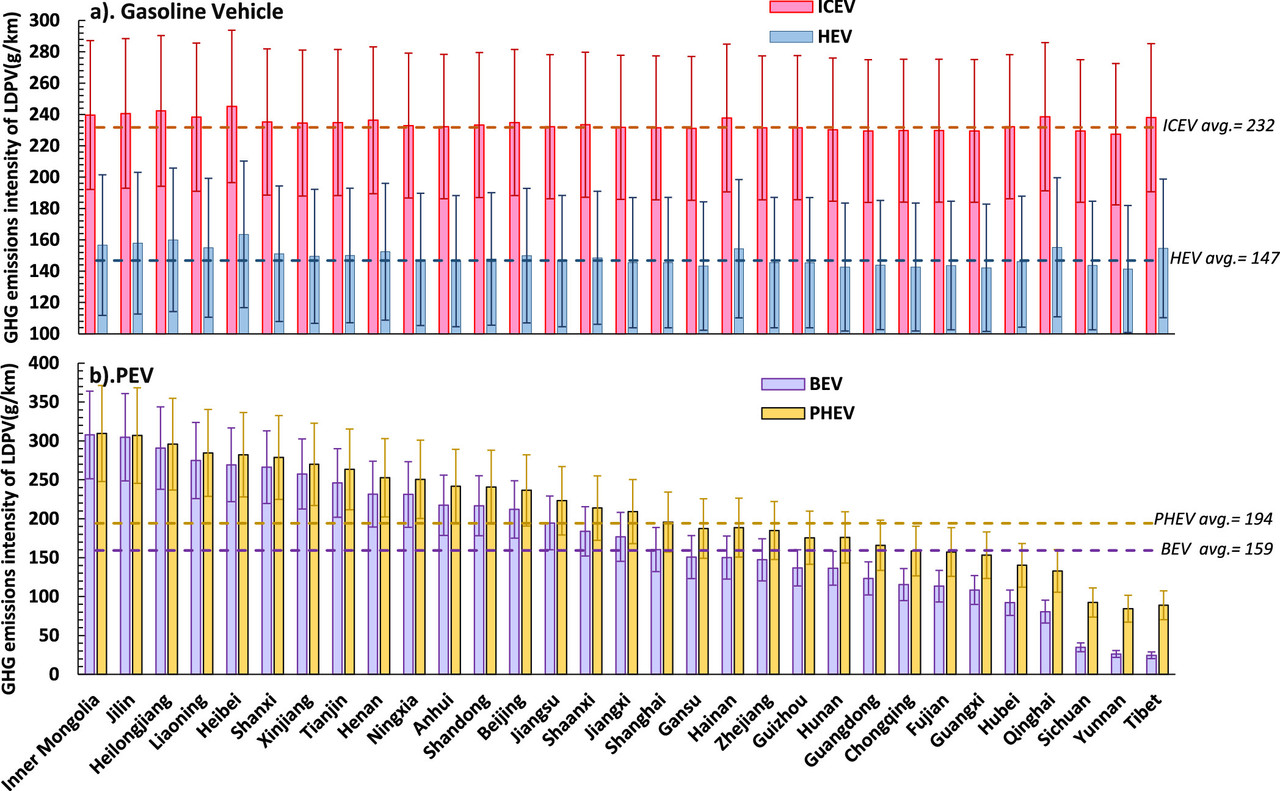
The caption:
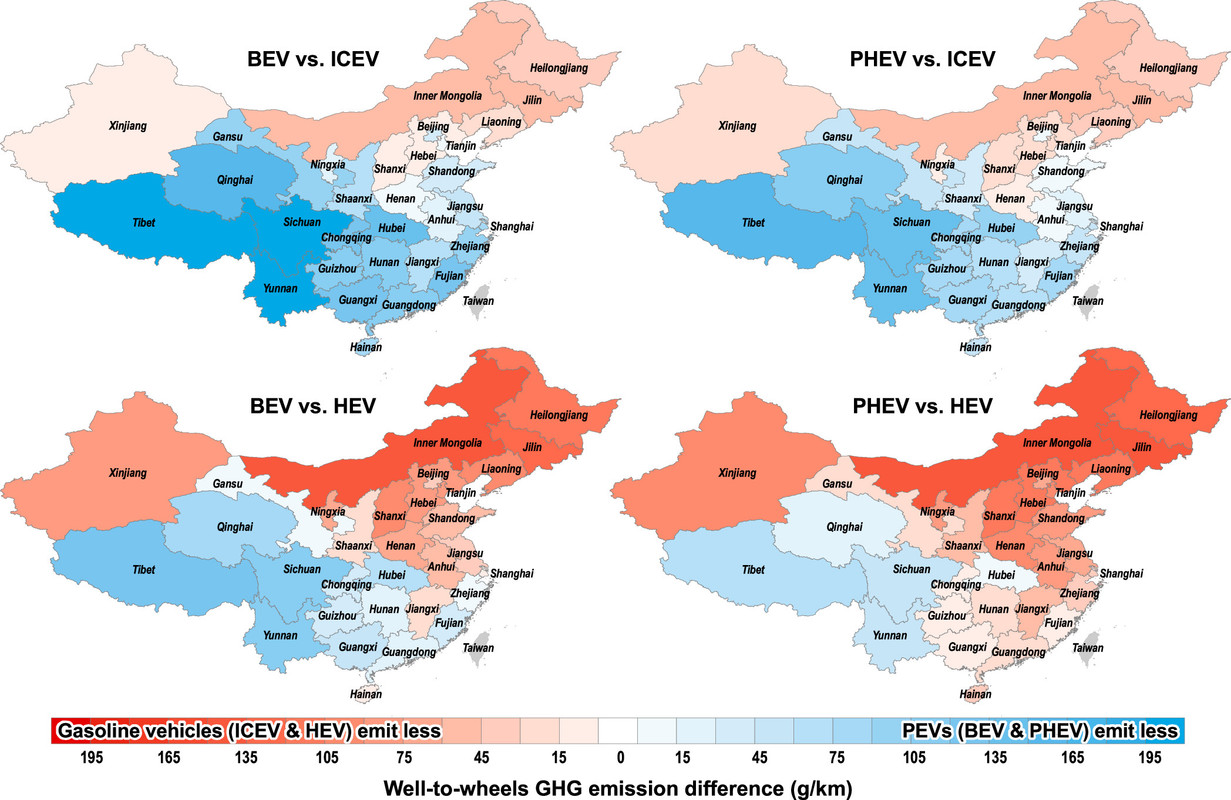
The caption:
Clearly in some places gasoline vehicles are cleaner than electric powered vehicles. This is almost certainly true elsewhere in the world, including the United States. It's another place to peel away glib "green" rhetoric.
We have hit concentrations of the dangerous fossil fuel waste carbon dioxide of 420 ppm this year. I may alone in being terrified by this, but I am terrified.
Some criticism of Chinese government policy in the concluding remarks:
The present study quantifies WTW GHG emission intensities of gasoline and PEVs in China. In contrast to most of the previous LCA studies, the present study is conducted at the province level and from an electricity consumption perspective to take into account the provincial variation in electricity generation mix, electricity transmission among provinces, and ambient temperature. WTW GHG comparison of gasoline and PEVs vary significantly among provinces, implying the importance of making province-specific policies for vehicular GHG emission reduction on a life-cycle basis.
Particularly, to achieve the goal of reducing GHG emissions of LDPVs, the timeline and levels of PEV promotion strategies should be differentiated by province. China has implemented multiple PEV promotion policies nationwide, including subsidies for PEV purchase,(2,3) tax exemptions for PEV purchase and usage,(2,3,5) and super credits for PEV production in the accounting of Corporate Average Fuel Consumption.(4)...
...Recently, China committed to achieving carbon neutrality by 2060. To achieve this ambitious goal, major transitions have been proposed in the power sector from fossil-based sources to nuclear and renewable power and in the on-road transportation sector from petroleum-based ICEVs to electric vehicles. The consumption-based emission accounting methodology developed in this work can help quantify the GHG emission reductions in the terminal energy sectors (e.g., the on-road transportation) at the provincial level due to the emission reduction and energy structure transition in the upstream processes (e.g., the power sector). It can be also used to evaluate environmental impacts of the province-specific strategies in electric grid development and PEV deployment...
A flaw in the paper (in my view, whether this is even close to a majority view, as I am unafraid of moving against the popular view, follows with the de rigueur obeisance to the solar fantasy:
This allegedly "phenomenal growth" amounts to less than 0.2 exajoules of increase energy output on a planet consuming more than 600 exajoules of energy per year, and there is zero evidence that this energy was available when it was actually needed, for example when cars needed to be charged at night or when it was snowing.
The study did not consider the embodied energy of batteries:
I trust you've had a pleasant Memorial day weekend.
 = new reply since forum marked as read
Highlight:
NoneDon't highlight anything
5 newestHighlight 5 most recent replies
= new reply since forum marked as read
Highlight:
NoneDon't highlight anything
5 newestHighlight 5 most recent replies

caraher
(6,365 posts)I think the real transportation tragedy in China (brought on by increased wealth and a desire to emulate the Western lifestyle) has been the growth in cars in their cities, regardless of the energy source (be it gasoline, coal or the sun). Bikes just make so much more sense in areas with high population density. I do appreciate your consistent denunciation of car CULTure. The bicycle is the most energy efficient transportation mode available, and the health benefits are another huge plus (or would be if it weren't for the dangers posed by car cultists negligently navigating their land cruisers - and now, distracted by their phones).
Also... nice to have the analysis, but hardly a surprise given their energy mix.

NNadir
(38,644 posts)...criticize them for wanting to emulate ours.
If it is tragic for them to want our lifestyle, it follows that it is equally tragic for us to have this lifestyle.
I absolutely agree that the bicycle is the most efficient and sustainable form of transportation there is, and as the second older (2012) paper to which I referred in the OP indicated, the most popular form of modern transportation in China is an electric scooter/bike.
We can suggest that the Chinese return to biking when we adapt it ourselves.
In presenting this paper, we may contrast their statements of reality with our willingness to lie to ourselves.
Here at DU it is taken for granted that it is an unabashed evil to criticize EV dogma, and unquestioned that EV's are "green!"
It is not true that if a Republican says leaves are green that they are therefore blue.
They are no such thing. The electric vehicle is simply switching one environmental disaster for another, just as the gasoline vehicle solved the urban problem of horse manure in the streets by substituting air that kills people.
The batteries for these devices, as I recently pointed out in this space (A dead battery dilemma) are not sustainable - there are not enough ores of cobalt and nickel to displace the world's gasoline cars) and as this honest analysis - far more honest than the rote electric car worship that flies around here and in the general public space - shows, the benefits in terms of climate are either marginal or non-existent.
The United States built its now fading industrial might on coal. Now we want to wag our fingers at China for doing the same thing.
I wish coal were really dead; I wish China didn't run on it. But we not on any kind of moral footing to lecture them; I fully understand why they would resent us for doing so.
They have at least a rational approach to phasing out dangerous fossil fuels. They are currently building more nuclear reactors than any other nation on Earth. They have built and run high temperature test reactors, and they are coupling them to thermochemical reactors.
We seem to think that our dangerous natural gas driven power system - particularly with our wind and solar lipstick on the gas pig - makes on morally superior. Every damned generation that lives on this continent will pay for our short term self gratification.
Our energy mix is abysmal. At one point, we lead the world in nuclear energy production. Now our reactors are being shut, and complete morons are cheering for this outcome.
Looking at the current state of affairs, I would argue that the Chinese are well within their rights to find us to be appalling hypocrites.
Now, I at least confess I'm a hypocrite. I live in a suburb, and I drive a car. However I'm not going to pretend that if I drive a plug in Prius that I'm a good guy. I'd still be a bad guy who is annoyingly advertising that I am otherwise.
caraher
(6,365 posts)It's just unfortunate.

hunter
(40,895 posts)In my poverty I learned how to keep cars running.
Once upon a time I replaced the head gasket of my Toyota station wagon in a K-mart parking lot.
Late 'seventies early 'eighties I drove all over the western U.S.A. and Baja Mexico in that car.
At times I lived in that car as well. With all my tools.
I took my first driver's test in an Volkswagen van. My parents are artists. Of course they drove a Volkswagen van.
The DMV examiner looked at me like I was a freak. I don't remember for certain, but I may have been wearing violet pants. Certainly my hair was long and confusing to people who needed to know if I was a boy or a girl.
My first serious girlfriend was an engineer attracted to the heroin waif look which I naturally achieved without the heroin. She could show me off to her parents as the guy she was going to marry.
I never showed her off to my parents because I was pretty sure they would have told me I was going wrong.
Praise be to God that marriage did not happen, a match made in hell, the David Lynch version of My Big Fat Greek Wedding without the Greek.
She married someone else, a woman who had tried to kill herself in my bathtub. If I ever get some kind of gold star fast pass at the Pearly Gates it's for making that match.
My wife and I met teaching science in the big city.
Back to cars...
When I was driving all over the place gasoline was essentially free. I'd get jobs paying eight to ten dollars an hour. I could fill the tank of my car working an hour. I could get a warped engine head milled flat with a day's work.
That car culture was awesome.
As a rabid environmentalist my secret vice is Jay Leno's Garage...
He talks about Ralph Nader in this video.
Ralph Nader is an asshole.