General Discussion
In reply to the discussion: McConnell and Ryan say Food Stamp Program needs to end [View all]
appalachiablue
(44,063 posts)credited to Ag Secy. Henry Wallace during the 1930s Depression Era, and FOOD STAMPS first initiated during the Kennedy administration in 1961 to a West Virginia couple.
Times have changed radically in the last 40 years with the steady deterioration of govt. assistance systems for those in need and the relentless, deliberate pumping of distorted information about safety net recipients, govt. services and real agendas.
Lacking some 'miracle' intervention to lessen the painful impact of this drastic new legislative movement, the country will experience a mass assault on the working and middle classes, esp. in many Red States, with brutal conditions and casualties not seen in generations. Understatement.
My grandparents and parents survived during very hard times, the Spanish Flu Epidemic of 1918-19, polio and the lack of antibiotics. They also lived through the Great Depression and World War II. My father was one of 8 children, 10 originally, whose Appalachian parents made sure they made it. To see the country come to this is incomprehensible and a nightmare..
---------------
Supplemental Nutrition Assistance Program (SNAP)
- A SHORT HISTORY OF SNAP
Last Published: 11/28/2017
The idea for the first FSP is credited to various people, most notably Secretary of Agriculture Henry Wallace and the program's first Administrator Milo Perkins. The program operated by permitting people on relief to buy orange stamps equal to their normal food expenditures; for every $1 worth of orange stamps purchased, 50 cents worth of blue stamps were received. Orange stamps could be used to buy any food; blue stamps could only be used to buy food determined by the Department to be surplus.
Over the course of nearly 4 years, the first FSP reached approximately 20 million people at one time or another in nearly half of the counties in the U.S.--peak participation was 4 million--at a total cost of $262 million. The first recipient was Mabel McFiggin of Rochester, New York; the first retailer to redeem the stamps was Joseph Mutolo; and the first retailer caught violating the program was Nick Salzano in October 1939. The program ended "since the conditions that brought the program into being--unmarketable food surpluses and widespread unemployment--no longer existed."
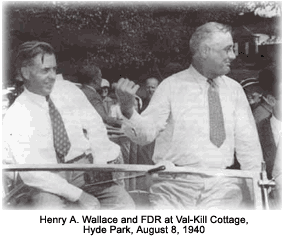
- Henry A. Wallace, US Vice Pres. (1940-1945), Sec. of Agriculture (1933-1940), SNAP Program, New Deal Progressive.
- PILOT FOOD STAMP PROGRAM - May 29, 1961-1964
The 18 years between the end of the first FSP and the inception of the next were filled with studies, reports, and legislative proposals.
Prominent Senators actively associated with attempts to enact an FSP during this period were: Aiken, La Follette, Humphrey, Kefauver, and Symington. From 1954 on, Congresswoman Leonor K. Sullivan strove unceasingly to pass food stamp program legislation. On Sept. 21, 1959, P.L. 86-341 authorized the Secretary of Agriculture to operate a food stamp system through Jan. 31, 1962.
The Eisenhower Administration never used the authority. However, in fulfillment of a campaign promise made in West Virginia, President Kennedy's first Executive Order called for expanded food distribution and, on Feb. 2, 1961, he announced that food stamp pilot programs would be initiated. The pilot programs would retain the requirement that the food stamps be purchased, but eliminated the concept of special stamps for surplus foods. A Department spokesman indicated the emphasis would be on increasing the consumption of perishables. Isabelle Kelley, who was part of the four-person team that designed the new program, became its first director and the first woman in USDA to head an action program.
>>Mr. and Mrs. Alderson Muncy of Paynesville, West Virginia, were the first food stamp recipients on May 29, 1961. They purchased $95 in food stamps for their 15-person household. In the first food stamp transaction, they bought a can of pork and beans at Henderson's Supermarket. By January 1964, the pilot programs had expanded from eight areas to 43 (40 counties, Detroit, St. Louis, and Pittsburgh) in 22 States with 380,000 participants.
http://www.nytimes.com/1979/10/20/archives/first-food-stamp-families-remember-1961-eight-test-programs-first.html
More: https://www.fns.usda.gov/snap/short-history-snap
Edit history
Recommendations
0 members have recommended this reply (displayed in chronological order): = new reply since forum marked as read
Highlight:
NoneDon't highlight anything
5 newestHighlight 5 most recent replies
RecommendedHighlight replies with 5 or more recommendations
= new reply since forum marked as read
Highlight:
NoneDon't highlight anything
5 newestHighlight 5 most recent replies
RecommendedHighlight replies with 5 or more recommendations