Welcome to DU!
The truly grassroots left-of-center political community where regular people, not algorithms, drive the discussions and set the standards.
Join the community:
Create a free account
Support DU (and get rid of ads!):
Become a Star Member
Latest Breaking News
Editorials & Other Articles
General Discussion
The DU Lounge
All Forums
Issue Forums
Culture Forums
Alliance Forums
Region Forums
Support Forums
Help & Search
General Discussion
In reply to the discussion: Trump has been invited to meet Kim Jong Un [View all]
Dennis Donovan
(31,059 posts)14. Does the shitgibbon know that NK STILL holds a commissioned US Navy ship hostage???
https://en.wikipedia.org/wiki/USS_Pueblo_(AGER-2)#Pueblo_incident
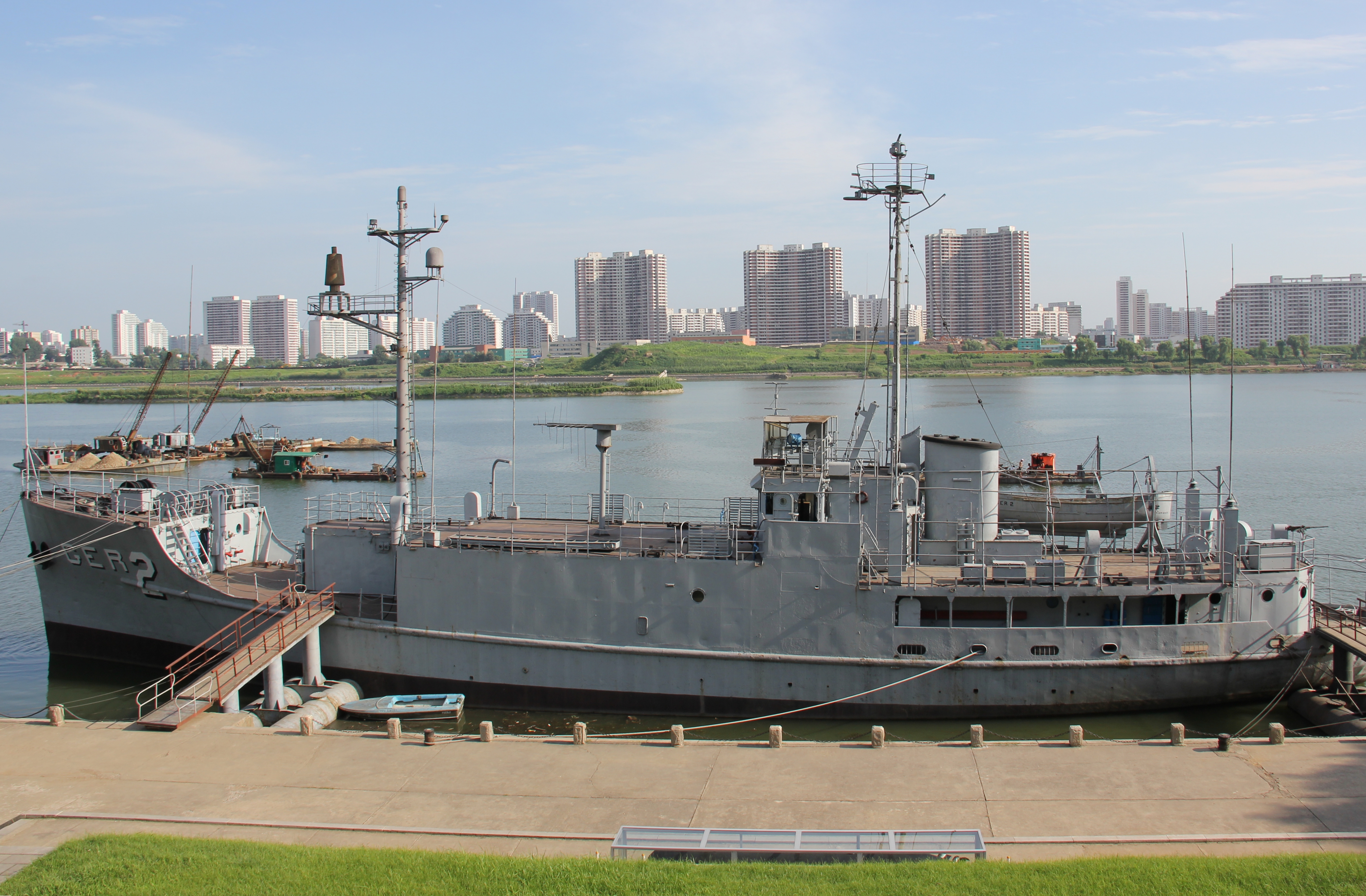
Pueblo incident
On 5 January 1968, Pueblo left U.S. Navy base Yokosuka, Japan, in transit to the U.S. naval base at Sasebo, Japan; from there she left on 11 January 1968, headed northward through the Tsushima Strait into the Sea of Japan. She left with specific orders to intercept and conduct surveillance of Soviet Navy activity in the Tsushima Strait and to gather signal and electronic intelligence from North Korea.[8] The declassified SIGAD for the National Security Agency (NSA) Direct Support Unit (DSU) from the Naval Security Group (NSG) on Pueblo during the patrol involved in the incident was USN-467Y.[9] AGER (Auxiliary General Environmental Research) denoted a joint Naval and National Security Agency (NSA) program.[10]
At 17:30 on 20 January 1968, a North Korean modified SO-1 class Soviet style submarine chaser passed within 4,000 yards (3.7 km) of Pueblo, which was about 15.4 nautical miles (28.5 km) southeast of Mayang-do at a position 39°47'N and 128°28.5'E.[11]
In the afternoon of 22 January 1968, the two North Korean fishing trawlers Rice Paddy 1 and Rice Paddy 2 passed within 30 yards (27 m) of Pueblo. That day, a North Korean unit made an assassination attempt in the "Blue House" executive mansion against the South Korean President Park Chung-hee, but the crew of Pueblo were not informed.[11]
According to the American account, the following day, 23 January, Pueblo was approached by a submarine chaser and her nationality was challenged; Pueblo responded by raising the U.S. flag. The North Korean vessel then ordered Pueblo to stand down or be fired upon. Pueblo attempted to maneuver away, but was considerably slower than the submarine chaser. Several warning shots were fired. Additionally, three torpedo boats appeared on the horizon and then joined in the chase and subsequent attack.[11]
The attackers were soon joined by two MiG-21 fighters. A fourth torpedo boat and a second submarine chaser appeared on the horizon a short time later. The ammunition on Pueblo was stored belowdecks, and her machine guns were wrapped in cold weather tarpaulins. The machine guns were unmanned, and no attempt was made to man them. An NSA report quotes the sailing order:
(...) Defensive armament (machine guns) should be stowed or covered in such manner so that it does not cause unusual interest by surveyed units. It should be used only in the event of a threat to survival (...)
and notes
In practice, it was discovered that, because of the temperamental adjustments of the firing mechanisms, the .50-caliber machine guns took at least ten minutes to activate. Only one crew member, with former army experience, had ever had any experience with such weapons, although members of the crew had received rudimentary instructions on the weapons immediately prior to the ship's deployment.[11]
Reported positions of USS Pueblo
North Korean chart showing where they say they captured USS Pueblo
U.S. Navy authorities and the crew of Pueblo insist that before the capture, Pueblo was miles outside North Korean territorial waters. North Korea says the vessel was well within North Korean territory. The mission statement allowed her to approach within a nautical mile (1,852 m) of that limit. North Korea, however, describes a 50-nautical-mile (93 km) sea boundary even though international standards were 12 nautical miles (22 km) at the time.[12]
The North Korean vessels attempted to board Pueblo, but she was maneuvered to prevent this for over two hours. A submarine chaser then opened fire with a 57 mm cannon, killing one member of the crew. The smaller vessels fired machine guns into Pueblo, which then signaled compliance and began destroying sensitive material. The volume of material on board was so great that it was impossible to destroy it all. An NSA report quotes Lieutenant Steve Harris, the officer in charge of Pueblo's Naval Security Group Command detachment:
(...) we had retained on board the obsolete publications and had all good intentions of getting rid of these things but had not done so at the time we had started the mission. I wanted to get the place organized eventually and we had excessive numbers of copies on board (...)
and concludes
Only a small percentage of the total classified material aboard the ship was destroyed.
Radio contact between Pueblo and the Naval Security Group in Kamiseya, Japan, had been ongoing during the incident. As a result, Seventh Fleet command was fully aware of Pueblo's situation. Air cover was promised but never arrived. The Fifth Air Force had no aircraft on strip alert, and estimated a two to three-hour delay in launching aircraft. USS Enterprise was located 510 nautical miles (940 km) south of Pueblo, yet her four F-4B aircraft on alert were not equipped for an air-to-surface engagement. Enterprise's captain estimated that 1.5 hours (90 minutes) were required to get the converted aircraft into the air.[11]
Pueblo followed the North Korean vessels as ordered, but then stopped immediately outside North Korean waters. She was again fired upon, and a sailor, fireman Duane Hodges, was killed. The ship was finally boarded at 05:55 UTC (2:55 pm local)[13] by men from a torpedo boat and a submarine chaser. Crew members had their hands tied and were blindfolded, beaten, and prodded with bayonets. Once Pueblo was in North Korean territorial waters, she was boarded again, this time by high-ranking North Korean officials.[citation needed]
The first official confirmation that the ship was in North Korean hands came five days later, 28 January 1968. Two days earlier a flight by a CIA A-12 Oxcart aircraft from the Project Black Shield squadron at Kadena, Okinawa flown by pilot Ronald Layton made three high altitude high speed flights over North Korea. When the aircraft's films were processed in the United States they showed Pueblo to be in the Wonsan harbor area surrounded by two North Korean vessels.[14]
There was dissent among government officials in the United States, regarding how to handle the situation. Congressman Mendel Rivers suggested that President Johnson issue an ultimatum for the return of Pueblo on penalty of nuclear attack, while Senator Gale McGee said the United States should wait for more information and not make "spasmodic response[s] to aggravating incidents".[15] According to Horace Busby, Special Assistant to President Johnson, the president's "reaction to the hostage taking was to work very hard here to keep down any demands for retaliation or any other attacks upon North Koreans", worried that rhetoric might result in the hostages being killed.[16]
Although American officials at the time assumed the seizure of Pueblo had been directed by the Soviet Union, it has emerged in recent years that North Korea acted alone and the incident actually harmed North Korea's relations with most of the Eastern Bloc.[17]
Pueblo incident
On 5 January 1968, Pueblo left U.S. Navy base Yokosuka, Japan, in transit to the U.S. naval base at Sasebo, Japan; from there she left on 11 January 1968, headed northward through the Tsushima Strait into the Sea of Japan. She left with specific orders to intercept and conduct surveillance of Soviet Navy activity in the Tsushima Strait and to gather signal and electronic intelligence from North Korea.[8] The declassified SIGAD for the National Security Agency (NSA) Direct Support Unit (DSU) from the Naval Security Group (NSG) on Pueblo during the patrol involved in the incident was USN-467Y.[9] AGER (Auxiliary General Environmental Research) denoted a joint Naval and National Security Agency (NSA) program.[10]
At 17:30 on 20 January 1968, a North Korean modified SO-1 class Soviet style submarine chaser passed within 4,000 yards (3.7 km) of Pueblo, which was about 15.4 nautical miles (28.5 km) southeast of Mayang-do at a position 39°47'N and 128°28.5'E.[11]
In the afternoon of 22 January 1968, the two North Korean fishing trawlers Rice Paddy 1 and Rice Paddy 2 passed within 30 yards (27 m) of Pueblo. That day, a North Korean unit made an assassination attempt in the "Blue House" executive mansion against the South Korean President Park Chung-hee, but the crew of Pueblo were not informed.[11]
According to the American account, the following day, 23 January, Pueblo was approached by a submarine chaser and her nationality was challenged; Pueblo responded by raising the U.S. flag. The North Korean vessel then ordered Pueblo to stand down or be fired upon. Pueblo attempted to maneuver away, but was considerably slower than the submarine chaser. Several warning shots were fired. Additionally, three torpedo boats appeared on the horizon and then joined in the chase and subsequent attack.[11]
The attackers were soon joined by two MiG-21 fighters. A fourth torpedo boat and a second submarine chaser appeared on the horizon a short time later. The ammunition on Pueblo was stored belowdecks, and her machine guns were wrapped in cold weather tarpaulins. The machine guns were unmanned, and no attempt was made to man them. An NSA report quotes the sailing order:
(...) Defensive armament (machine guns) should be stowed or covered in such manner so that it does not cause unusual interest by surveyed units. It should be used only in the event of a threat to survival (...)
and notes
In practice, it was discovered that, because of the temperamental adjustments of the firing mechanisms, the .50-caliber machine guns took at least ten minutes to activate. Only one crew member, with former army experience, had ever had any experience with such weapons, although members of the crew had received rudimentary instructions on the weapons immediately prior to the ship's deployment.[11]
Reported positions of USS Pueblo
North Korean chart showing where they say they captured USS Pueblo
U.S. Navy authorities and the crew of Pueblo insist that before the capture, Pueblo was miles outside North Korean territorial waters. North Korea says the vessel was well within North Korean territory. The mission statement allowed her to approach within a nautical mile (1,852 m) of that limit. North Korea, however, describes a 50-nautical-mile (93 km) sea boundary even though international standards were 12 nautical miles (22 km) at the time.[12]
The North Korean vessels attempted to board Pueblo, but she was maneuvered to prevent this for over two hours. A submarine chaser then opened fire with a 57 mm cannon, killing one member of the crew. The smaller vessels fired machine guns into Pueblo, which then signaled compliance and began destroying sensitive material. The volume of material on board was so great that it was impossible to destroy it all. An NSA report quotes Lieutenant Steve Harris, the officer in charge of Pueblo's Naval Security Group Command detachment:
(...) we had retained on board the obsolete publications and had all good intentions of getting rid of these things but had not done so at the time we had started the mission. I wanted to get the place organized eventually and we had excessive numbers of copies on board (...)
and concludes
Only a small percentage of the total classified material aboard the ship was destroyed.
Radio contact between Pueblo and the Naval Security Group in Kamiseya, Japan, had been ongoing during the incident. As a result, Seventh Fleet command was fully aware of Pueblo's situation. Air cover was promised but never arrived. The Fifth Air Force had no aircraft on strip alert, and estimated a two to three-hour delay in launching aircraft. USS Enterprise was located 510 nautical miles (940 km) south of Pueblo, yet her four F-4B aircraft on alert were not equipped for an air-to-surface engagement. Enterprise's captain estimated that 1.5 hours (90 minutes) were required to get the converted aircraft into the air.[11]
Pueblo followed the North Korean vessels as ordered, but then stopped immediately outside North Korean waters. She was again fired upon, and a sailor, fireman Duane Hodges, was killed. The ship was finally boarded at 05:55 UTC (2:55 pm local)[13] by men from a torpedo boat and a submarine chaser. Crew members had their hands tied and were blindfolded, beaten, and prodded with bayonets. Once Pueblo was in North Korean territorial waters, she was boarded again, this time by high-ranking North Korean officials.[citation needed]
The first official confirmation that the ship was in North Korean hands came five days later, 28 January 1968. Two days earlier a flight by a CIA A-12 Oxcart aircraft from the Project Black Shield squadron at Kadena, Okinawa flown by pilot Ronald Layton made three high altitude high speed flights over North Korea. When the aircraft's films were processed in the United States they showed Pueblo to be in the Wonsan harbor area surrounded by two North Korean vessels.[14]
There was dissent among government officials in the United States, regarding how to handle the situation. Congressman Mendel Rivers suggested that President Johnson issue an ultimatum for the return of Pueblo on penalty of nuclear attack, while Senator Gale McGee said the United States should wait for more information and not make "spasmodic response[s] to aggravating incidents".[15] According to Horace Busby, Special Assistant to President Johnson, the president's "reaction to the hostage taking was to work very hard here to keep down any demands for retaliation or any other attacks upon North Koreans", worried that rhetoric might result in the hostages being killed.[16]
Although American officials at the time assumed the seizure of Pueblo had been directed by the Soviet Union, it has emerged in recent years that North Korea acted alone and the incident actually harmed North Korea's relations with most of the Eastern Bloc.[17]
Edit history
Please sign in to view edit histories.
Recommendations
0 members have recommended this reply (displayed in chronological order):
33 replies
 = new reply since forum marked as read
Highlight:
NoneDon't highlight anything
5 newestHighlight 5 most recent replies
RecommendedHighlight replies with 5 or more recommendations
= new reply since forum marked as read
Highlight:
NoneDon't highlight anything
5 newestHighlight 5 most recent replies
RecommendedHighlight replies with 5 or more recommendations
= new reply since forum marked as read
Highlight:
NoneDon't highlight anything
5 newestHighlight 5 most recent replies
RecommendedHighlight replies with 5 or more recommendations
As to the dash issue... I suspect it is on the sites side and there is no solution.
herding cats
Mar 2018
#32
Does the shitgibbon know that NK STILL holds a commissioned US Navy ship hostage???
Dennis Donovan
Mar 2018
#14