Welcome to DU!
The truly grassroots left-of-center political community where regular people, not algorithms, drive the discussions and set the standards.
Join the community:
Create a free account
Support DU (and get rid of ads!):
Become a Star Member
Latest Breaking News
Editorials & Other Articles
General Discussion
The DU Lounge
All Forums
Issue Forums
Culture Forums
Alliance Forums
Region Forums
Support Forums
Help & Search
General Discussion
In reply to the discussion: Remember the piles of wedding rings taken from holocaust victims [View all]
riversedge
(82,294 posts)42. love that pic
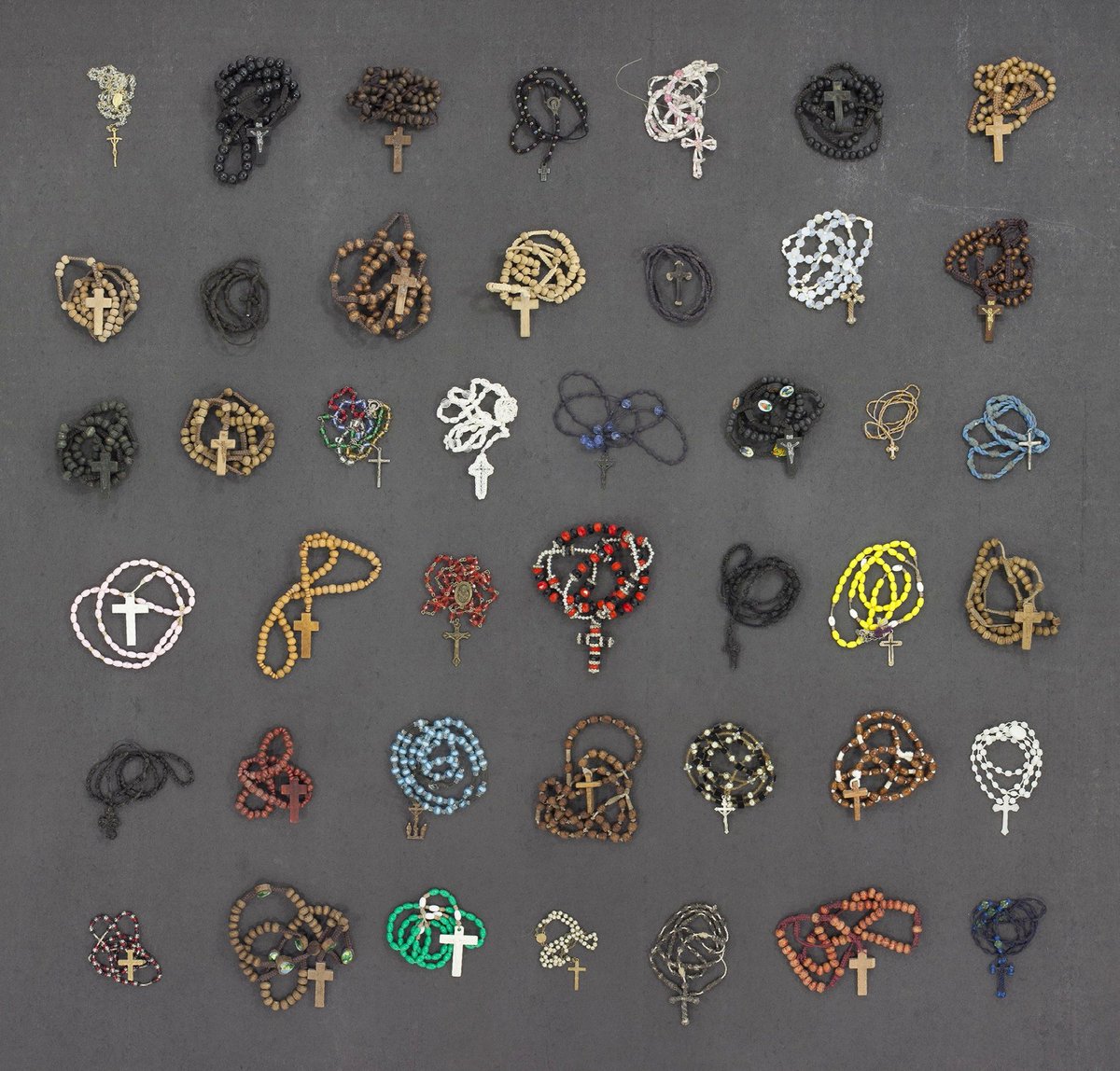
A Janitor Preserves the Seized Belongings of Migrants
https://www.newyorker.com/culture/photo-booth/a-janitors-collection-of-things-confiscated-from-migrants-in-the-desert
By Peter C. Baker
March 12, 2017
When migrants are apprehended, Customs and Border Protection agents dispose of personal-hygiene items such as toilet paper during intake.
THOMAS KIEFER / INSTITUTE
Tom Kiefer was a Customs and Border Protection janitor for almost four years before he took a good look inside the trash. Every day at work—at the C.B.P. processing center in Ajo, Arizona, less than fifty miles from the border with Mexico—he would throw away bags full of items confiscated from undocumented migrants apprehended in the desert. One day in 2007, he was rummaging through these bags looking for packaged food, which he’d received permission to donate to a local pantry. In the process, he also noticed toothbrushes, rosaries, pocket Bibles, water bottles, keys, shoelaces, razors, mix CDs, condoms, contraceptive pills, sunglasses, keys: a vibrant, startling testament to the lives of those who had been detained or deported. Without telling anyone, Kiefer began collecting the items, stashing them in sorted piles in the garages of friends. “I didn’t know what I was going to do,” he told me recently. “But I knew there was something to be done.”
Kiefer, who is now fifty-eight, had moved to Ajo from Los Angeles, in 2001, hoping to simplify his life, purchase a home, and focus on his passion: taking pictures. (Previously, he’d been a collector and dealer of antique cast-iron bed frames, and, before that, a graphic designer.) He took the C.B.P. job, in 2003, for purely practical reasons: it paid ten dollars and forty-two cents an hour, and it seemed unlikely to steal mental space away from his photography projects. Now he began photographing his C.B.P. collection in his studio, arranging and rearranging items, sometimes putting a single stuffed animal or T-shirt in the frame, more often capturing like with like: dozens of roll-on deodorant sticks, hundreds of nail clippers. Today, he has taken hundreds of photographs of objects he brought home from the processing center. Together they make up “El Sueño Americano” (“The American Dream”), an ongoing project that, thanks to its unconventional perspective on U.S. migrant policies, has launched Kiefer into a photography career he’s dreamed of for decades.
Spending time with the confiscated items—collecting them, curating them, looking at them, photographing them—changed Kiefer’s relationship to his job. Before, he’d been punching the clock so that he could get back to photography; now he felt awakened to hundreds of human dramas playing out around him during each shift. He’d always known, technically, about the C.B.P.’s strict confiscation policies, which were posted on bilingual signs and applied to all items classified as either “non-essential” or “potentially lethal.” But he hadn’t spent much time thinking about these policies, and he hadn’t realized how broadly they were applied, or just how many of the confiscated items—including cell phones and wallets, many still containing I.D.s, prepaid debit cards, and cash—were ending up in the trash, never to be returned. Increasingly, Kiefer felt uncomfortable at work: angry at the system that employed him, sad for the people being “processed,” and afraid that he would be caught making off with government property. But he kept sneaking out what he could, kept building his piles, and kept taking pictures, which at first he showed to no one.
Many of the photographs that make up “El Sueño Americano” are clean and bright, even exuberant: a radiant sea of toothpaste tubes and toothbrushes, all pointed in the same direction, like a swarming Pop-art school of fish; a plastic quilt of condoms, their multi-hued wrappers advertising a cornucopia of brands, flavors, and designs. These lively objects can seem incongruent with the gravity of their backstories. “I have been criticized—by some art-world people—for making pictures about the migrant experience that don’t speak directly to the grimy extremities of risking your life to cross the border,” Kiefer said. A striking contrast to “El Sueño Americano” is the work of John Moore, who has also photographed the everyday property carried by migrants—items not confiscated but found on their dead bodies and encased in plastic bags held at a forensics lab in Arizona. But Kiefer sees his project as a counterweight to C.B.P.’s dehumanizing practices, which yank everyday objects from the contexts that imbued them with meaning. He hopes not just to draw people’s attention to those practices but also to evoke the value the objects must have once had to their owners. “I’m doing something different,” he told me. “I’m presenting these deeply personal objects in a way that is reverential and respectful.”.....................................................
Edit history
Please sign in to view edit histories.
Recommendations
0 members have recommended this reply (displayed in chronological order):
85 replies
 = new reply since forum marked as read
Highlight:
NoneDon't highlight anything
5 newestHighlight 5 most recent replies
RecommendedHighlight replies with 5 or more recommendations
= new reply since forum marked as read
Highlight:
NoneDon't highlight anything
5 newestHighlight 5 most recent replies
RecommendedHighlight replies with 5 or more recommendations
= new reply since forum marked as read
Highlight:
NoneDon't highlight anything
5 newestHighlight 5 most recent replies
RecommendedHighlight replies with 5 or more recommendations
So you really believe the people in this thread condemning the administration responsible
Ms. Toad
Jun 2018
#44
Amazing that Obama was NOT POTUS in 2005, isn't it? I'm not sure why someone (not you)...
Hekate
Jun 2018
#77
Why the ignorant hatred? US Conference of Catholic Bishops was among the first to condemn this
Hekate
Jun 2018
#80
Who's throwing anything in your face?I provided the full list as printed in the LA Times that day...
Hekate
Jun 2018
#83
And the confiscating of rosaries is done by "our very christian AG" who supports his
pazzyanne
Jun 2018
#12
I understand that. But sometimes there are things more important than optics.
pazzyanne
Jun 2018
#36
What "rule" or crap allows, if at all, them to confiscate personal items?
Bernardo de La Paz
Jun 2018
#8
Most personal items are confiscated and held for 30 days pursuant to a regulation
Ms. Toad
Jun 2018
#46
"Most personal items are confiscated and held for 30 days pursuant to a regulation."
pazzyanne
Jun 2018
#50
The difference is that items taken are to be cataloged and returned to the owner.
olegramps
Jun 2018
#35
Simple. Return them of give them or their replacement value. I don't demand anything other from both
olegramps
Jun 2018
#59
Agreed, he began collecting these items in 2007. ICE has been hyper-agressive since it was formed.
haele
Jun 2018
#51
Why would they confiscate rosaries? This will not go over well w/the Catholic Church.
Honeycombe8
Jun 2018
#14
This morning a discussion panel was dealing with the question of where are the girls and babies.
pazzyanne
Jun 2018
#34
Step up Catholic church and regain some moral high ground - you know you need to.
NoMoreRepugs
Jun 2018
#19
Please edit this post to include the dates these collections of images were taken
Ms. Toad
Jun 2018
#30
I assume they're still taking these religious objects and icons from refugees and migrants.
bigtree
Jun 2018
#38
Thank you for your insightful post that supports the purpose of the pictures.
pazzyanne
Jun 2018
#55