Welcome to DU!
The truly grassroots left-of-center political community where regular people, not algorithms, drive the discussions and set the standards.
Join the community:
Create a free account
Support DU (and get rid of ads!):
Become a Star Member
Latest Breaking News
Editorials & Other Articles
General Discussion
The DU Lounge
All Forums
Issue Forums
Culture Forums
Alliance Forums
Region Forums
Support Forums
Help & Search
General Discussion
In reply to the discussion: Please stop using the words 'food insecure' [View all]
TheBlackAdder
(29,981 posts)24. Got it. Adding from the USDA, definitions and graphics
.
Ranges of Food Security and Food Insecurity
In 2006, USDA introduced new language to describe ranges of severity of food insecurity. USDA made these changes in response to recommendations of an expert panel convened at USDA's request by the Committee on National Statistics (CNSTAT) of the National Academies. Although new labels were introduced, the methods used to assess households' food security remained unchanged, so statistics for 2005 to now are directly comparable with those for earlier years. The following labels define ranges of food security:
Food Security
High food security (old label=Food security): no reported indications of food-access problems or limitations.
Marginal food security (old label=Food security): one or two reported indications—typically of anxiety over food sufficiency or shortage of food in the house. Little or no indication of changes in diets or food intake.
Food Insecurity
Low food security (old label=Food insecurity without hunger): reports of reduced quality, variety, or desirability of diet. Little or no indication of reduced food intake.
Very low food security (old label=Food insecurity with hunger): reports of multiple indications of disrupted eating patterns and reduced food intake.
.
.
The CNSTAT panel also recommended that USDA make a clear and explicit distinction between food insecurity and hunger:
Food insecurity—the condition assessed in the food security survey and represented in USDA food security reports—is a household-level economic and social condition of limited or uncertain access to adequate food.
Hunger is an individual-level physiological condition that may result from food insecurity.
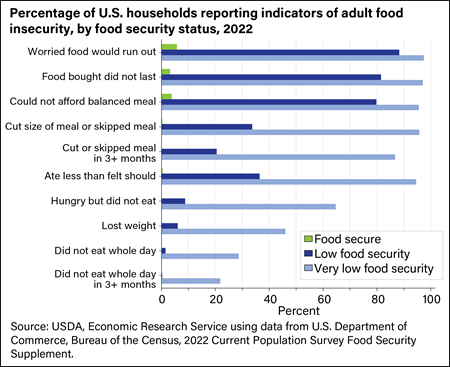
The defining characteristic of very low food security is that, at times during the year, food intake of household members is reduced and their normal eating patterns are disrupted because the household lacks money and other resources for food. Very low food security is characterized in terms of the conditions that households in this category typically reported in the annual survey.
97 percent reported having worried that their food would run out before they got money to buy more.
96 percent reported that the food they bought just did not last, and they did not have money to get more.
94 percent reported that they could not afford to eat balanced meals.
97 percent reported that an adult had cut the size of meals or skipped meals because there was not enough money for food; 89 percent reported that this had occurred in 3 or more months.
96 percent reported that they had eaten less than they felt they should because there was not enough money for food.
69 percent reported that they had been hungry but did not eat because they could not afford enough food.
48 percent reported having lost weight because they did not have enough money for food.
36 percent reported that an adult did not eat for a whole day because there was not enough money for food; 29 percent reported that this had occurred in 3 or more months.
All households without children that were classified as having very low food security reported at least six of these conditions, and 70 percent reported seven or more. Food-insecure conditions in households with children followed a similar pattern.
https://www.ers.usda.gov/topics/food-nutrition-assistance/food-security-in-the-us/definitions-of-food-security.aspx

.
Edit history
Please sign in to view edit histories.
Recommendations
0 members have recommended this reply (displayed in chronological order):
97 replies
 = new reply since forum marked as read
Highlight:
NoneDon't highlight anything
5 newestHighlight 5 most recent replies
RecommendedHighlight replies with 5 or more recommendations
= new reply since forum marked as read
Highlight:
NoneDon't highlight anything
5 newestHighlight 5 most recent replies
RecommendedHighlight replies with 5 or more recommendations
= new reply since forum marked as read
Highlight:
NoneDon't highlight anything
5 newestHighlight 5 most recent replies
RecommendedHighlight replies with 5 or more recommendations
"Food insecurity" doesn't sound pretty at all. It's a vivid descriptor of the problem.
WhiskeyGrinder
Nov 2020
#5
Sadly, the premise of this OP has the effect of marginalizing what Food-Insecurity actually is.
NurseJackie
Nov 2020
#9
Yes. Insecure is too WEAK of a word. Perhaps UNSTABLE, UNPREDICTABLE or VOLATILE are stonger.
TheBlackAdder
Nov 2020
#11
Maybe because it doesn't always fit what people like you think it looks like?
sweetloukillbot
Nov 2020
#23
It's called "grasping for straws" and a profound lack of understanding of the fact that...
NurseJackie
Nov 2020
#38
People are not starving. They face food insecurity. There is a difference.
WhiskeyGrinder
Nov 2020
#33
Would you wait in line for 10 hours to get a bag of potatoes and various staples?
judesedit
Nov 2020
#88
They are suffering, but they are not starving. They are experiencing food insecurity.
WhiskeyGrinder
Nov 2020
#90
Well sure. Children and the very old can be starved by abusive caretakers.
WhiskeyGrinder
Nov 2020
#92
"Food Insecurity" is the kind of term you develop when you're trying to study and solve the problem.
Gidney N Cloyd
Nov 2020
#35
For Black Friday I signed up to give a recurring monthly donation to Second Harvest Heartland
NickB79
Nov 2020
#43
"Food insecure" is corporatespeak to cloud the harm of maldistribution systems from farm to table.
ancianita
Nov 2020
#46
Naah. It's a useful term that puts the problem in context for further discussion.
MrModerate
Nov 2020
#62
It's just a matter of time before murder victims are referred as "life insecure"
Snake Plissken
Nov 2020
#76