Welcome to DU!
The truly grassroots left-of-center political community where regular people, not algorithms, drive the discussions and set the standards.
Join the community:
Create a free account
Support DU (and get rid of ads!):
Become a Star Member
Latest Breaking News
Editorials & Other Articles
General Discussion
The DU Lounge
All Forums
Issue Forums
Culture Forums
Alliance Forums
Region Forums
Support Forums
Help & Search
General Discussion
Showing Original Post only (View all)
Why Conservatives Want to Cancel the 1619 Project [View all]
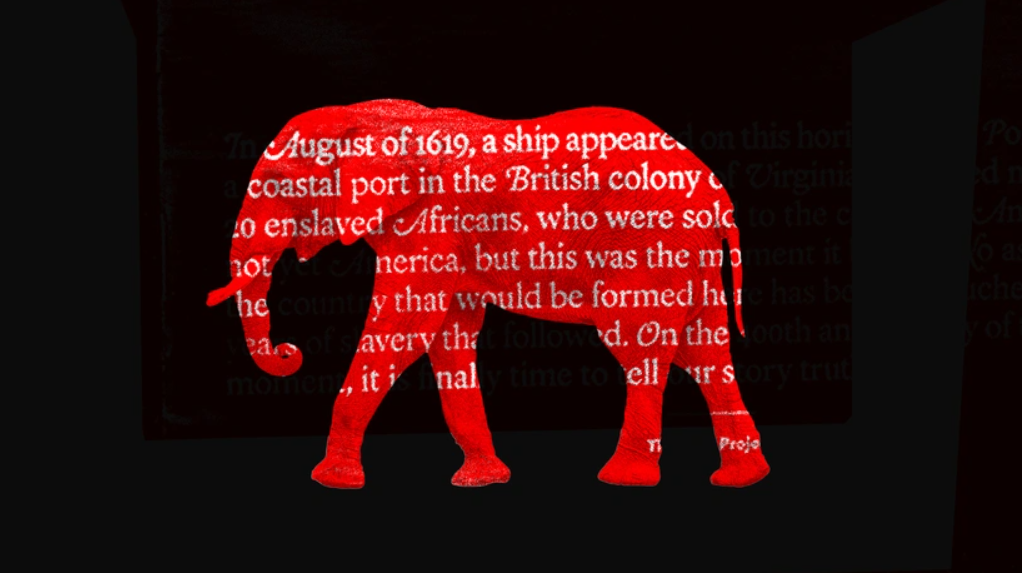
Objections to the appointment of Nikole Hannah-Jones to an academic chair are the latest instance of conservatives using the state to suppress ideas they consider dangerous.
https://www.theatlantic.com/ideas/archive/2021/05/why-conservatives-want-cancel-1619-project/618952/
Nikole Hannah-Jones is an award-winning Black journalist. She is also one of the developers of the 1619 Project, a journalistic examination of slavery’s role in shaping the American present. Last year, that work won her a Pulitzer Prize. Now it appears to have cost her a tenured chair at the University of North Carolina’s Hussman School of Journalism. The news outlet NC Policy Watch reported on Monday that the university’s dean, chancellor, and faculty had backed Hannah-Jones’s appointment to the Knight Chair in Race and Investigative Journalism, a tenured professorship, after a “rigorous tenure process at UNC.” But in an extraordinary move, the board of trustees declined to act on that recommendation. Hannah-Jones was instead offered a five-year, nontenured appointment following public and private pressure from conservatives. Notably, other Knight Chairs at the journalism school have been tenured on its professional track, which acknowledges “significant professional experience” rather than traditional academic scholarship. Hannah-Jones’s Pulitzer and MacArthur genius grant surely qualify. One anonymous trustee told NC Policy Watch that “the political environment made granting Hannah-Jones tenure difficult, if not impossible.” A statement from the Foundation for Individual Rights in Education noted that “if it is accurate that this refusal was the result of viewpoint discrimination against Hannah-Jones, particularly based on political opposition to her appointment, this decision has disturbing implications for academic freedom.”
If you’ve taken recent debates about free speech and censorship at face value, you might find Hannah-Jones’s denial of tenure deeply confusing. For the past five years, conservatives have been howling about the alleged censoriousness of the American left, in particular on college campuses. But the denial of tenure to Hannah-Jones shows that the real conflict is over how American society understands its present inequalities. The prevailing conservative view is that America’s racial and economic inequalities are driven by differences in effort and ability. The work of Hannah-Jones and others suggests instead that present-day inequalities have been shaped by deliberate political and policy choices. What appears to be an argument about re-examining history is also an argument about ideology—a defence of the legitimacy of the existing social order against an account of its historical origins that suggests different policy choices could produce a more equitable society. The 1619 Project is a particularly powerful part—but not the cause—of a Black Lives Matter–inspired re-evaluation of American history that began in the waning years of the Obama administration. Many Americans were struggling to understand how a nation that had elected a Black president could retain deep racial disparities not only in the rate of poverty, access to education, and health care, but also in matters of criminal justice and political power. The election of Donald Trump, a president who understood American citizenship in religious and ethnonationalist terms, accelerated that process of re-evaluation.
Like all the works this period of re-evaluation has produced, the 1619 Project has its flaws—although fewer than its most fanatical critics would admit. But the details of its factual narrative were not what conservatives found most objectionable. Rather, they took issue with the ideological implications of its central conceit: that America’s true founding moment was the arrival of African slaves on America’s shores. Hannah-Jones’s conservative detractors cast this claim as an argument that America is a fundamentally and irredeemably racist country—indeed, as NC Policy Watch notes, a columnist at the right-wing James G. Martin Center complained that the 1619 Project “seeks to reframe American history as fundamentally racist.” A different columnist at the same organization fumed that “young people—the white ones, at least—are even taught to hate themselves for the unforgivable sins of their ancestors.” The idea that ugly aspects of American history should not be taught, for fear that students—white students in particular—might draw unfavourable conclusions about America, is simply an argument against teaching history at all. In truth, the animating premise of the 1619 Project is more threatening to the right—the idea that America can indeed be redeemed, by rectifying racial imbalances created by government policy.
The fight to define the American past is not new. In the middle of the 20th century, a massive conservative backlash erupted in California against a textbook co-written by the celebrated Black American historian John Hope Franklin. In it, Franklin offered a very different rendition of Black history from the one found in generations of American textbooks that hewed to doctrines of white supremacy and portrayed people of colour in ways that were overtly racist or, at best, paternalistic. Franklin’s re-evaluation of American history was, like Hannah-Jones’s, related to a national movement for Black rights. The civil-rights movement of the mid-20th century was concurrent with the academy’s re-evaluation of the Reconstruction era, whose attempts at building a genuine multiracial democracy in the South had until then been portrayed by most white scholars as a tragic mistake. Martin Luther King Jr. referred to the historian C. Vann Woodward’s The Strange Career of Jim Crow as the “historical bible” of the movement, by which he simply meant it showed that segregation had been the product of political choices rather than an inevitability. New choices could be made. The tone of the textbook Franklin co-authored, Land of the Free, remained “resolutely patriotic,” as Joseph Moreau wrote in his account of the conflict in his book Schoolbook Nation. But this was not sufficient for the textbook’s opponents, who, Moreau wrote, believed that “history teaching existed to cultivate patriotism” and that the “debunking of historical myths or premature attempts to furnish young people with painful truths could not be countenanced.”
snip
5 replies
 = new reply since forum marked as read
Highlight:
NoneDon't highlight anything
5 newestHighlight 5 most recent replies
= new reply since forum marked as read
Highlight:
NoneDon't highlight anything
5 newestHighlight 5 most recent replies
= new reply since forum marked as read
Highlight:
NoneDon't highlight anything
5 newestHighlight 5 most recent replies