General Discussion
In reply to the discussion: Another fabulous Friday Afternoon Challenge: Art “Happens!” [View all]
Tansy_Gold
(18,167 posts)Whether it DOES or not is another.
And then the third question is does it succeed.
In fact, I wrote a paper on it a few years ago --
"The picture is political: Art and the power of disempowerment."
(Remember, I told you I'd taken a couple of "art appreciation" courses, though my major is sociology.)
Picasso's "Guernica" is certainly political. Virtually all of Sue Coe's is political. Kathe Kollwitz. Goya's "Third of May, 1808."

And so I wrote:
. . . The pictures shocked. The lush-shadowed Renaissance light on women’s faces, the forceful fountain of blood from the man’s throat. Strength in the female figures, determination without hesitation, without fear. Exquisite skill from the artist’s hand, unexpected. Later, the head in the basket like a ripe melon or fresh loaf of bread, the glances over the shoulders, the sword held comfortably with an eerie familiarity.
Artemisia Gentileschi painted five aspects of the biblical story of Judith, the beautiful and wealthy widow who did God’s bidding and saved her people from the tyrant Holofernes. But Artemisia’s Judith looks nothing like an obedient handmaiden; she challenges conventional notions as much today as she did in 1614. She dares assert woman as strength, woman as actor, woman as victor.
And then I closed the paper with
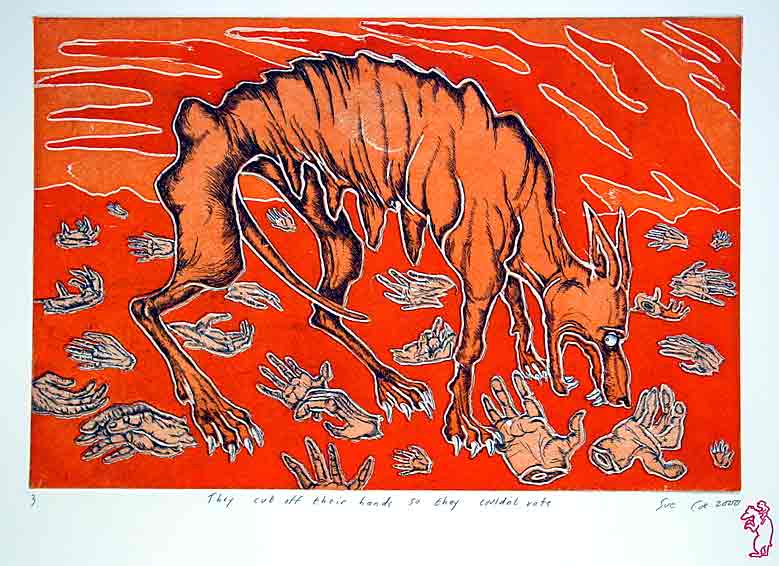
The picture shocks. The pun is on the Fauves, the beast in the livid color. Wolf-mother, starving even as she provides suckle to those who are gone. Hands, the tool of the human, guillotined by the inhuman. Rights – and lefts – severed.
The image comes to us as a whole. Worth far more than a thousand words, it strikes us visually and viscerally. We can turn away, but we cannot erase. If we do not turn away, we may think. We may explore. We may learn who the artist is and what she or he has meant to convey. But first we must look, and many of us choose not to.
Instead we take our art in manageable portions that do not disturb, do not shock, do not make us think that we are wrong or that they make us wrong. We look at Guernica and we do not understand. We see the pieces and parts, the dismembered and the disembodied, and we do not know that this is reality. We cannot know, we cannot allow ourselves to know. To know is to become part of the horror, the truth, the awful and terrible and hideous. They, who wield the power to have and to hold, cannot let us see the horror that they make of and for us, for then we would see the horror that they are and we might turn the power against them.
And even we who do know and do see, we are afraid, for they still wield the power. We do not yet know how to grasp Judith’s sword, but we must learn, or it will sever our hands.
Edit history
Recommendations
0 members have recommended this reply (displayed in chronological order): = new reply since forum marked as read
Highlight:
NoneDon't highlight anything
5 newestHighlight 5 most recent replies
RecommendedHighlight replies with 5 or more recommendations
= new reply since forum marked as read
Highlight:
NoneDon't highlight anything
5 newestHighlight 5 most recent replies
RecommendedHighlight replies with 5 or more recommendations