General Discussion
In reply to the discussion: Covid infections are up by 68%, over the past two weeks, in my county [View all]
BumRushDaShow
(172,854 posts)and am so sorry to hear of your nightmare with this disease. 
I know I have posted over and over and over here that the mechanism for how this virus attaches to cells and then replicates is unique in terms of WHERE it can attach - i.e., places that have what are called "ACE2 receptors". These are located not just in the respiratory system but also in the renal system (kidneys) in the gastric system (including intestines), in the circulatory system including on the heart, and the neural system including the brain.
If you have a high enough load where some manage to get to those organs, you can be screwed. 
I did read an article last week with some research that has uncovered some things about what might be happening with the inflammation responses that can cause more severe impacts. I had posted the below (in part) in a different thread last week - https://www.democraticunderground.com/?com=view_post&forum=1014&pid=2903945
And regarding "inflammation" - I literally read an article today based on a recent study done by Harvard with a fascinating discovery about what might be happening with the disparate inflammatory responses -
Inflammatory Insights
Study reveals how COVID-19 triggers severe immune response
By NANCY FLIESLER | Boston Children’s April 6, 2022 Research
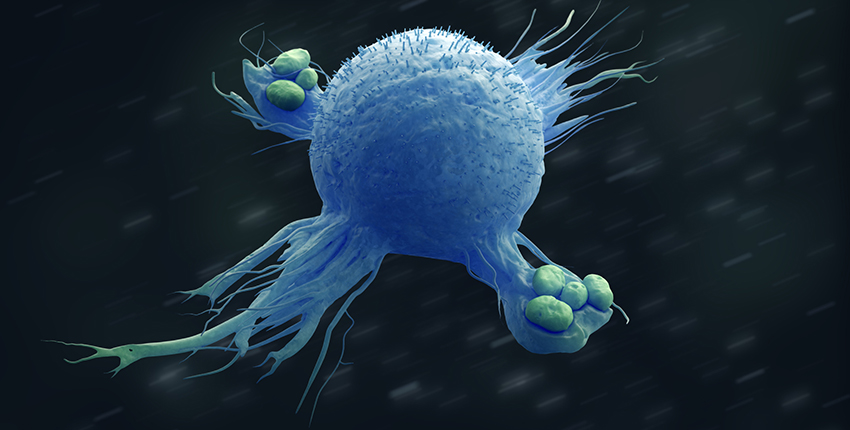
Illustration of a macrophage battling bacteria. Image: urfingus/iStock/Getty Images Plus
This article is part of Harvard Medical School’s continuing coverage of COVID-19.
A study led by researchers at Harvard Medical School and Boston Children’s Hospital explains for the first time why COVID-19 causes severe inflammation in some people, leading to acute respiratory distress and multi-organ damage. Surprisingly, the study also finds that antibodies that people develop when they contract COVID-19 sometimes lead to more inflammation, while antibodies generated by mRNA COVID-19 vaccines seem not to. Findings were published April 6 in Nature. The team was led by Judy Lieberman, HMS professor of pediatrics at Boston Children’s; Caroline Junqueira, HMS research associate in pediatrics at Boston Children’s; and Michael Filbin, HMS assistant professor of emergency medicine at Massachusetts General Hospital.
“We wanted to understand what distinguishes patients with mild versus severe COVID-19,” said Lieberman. “We know that many inflammatory markers are elevated in people with severe disease, and that inflammation is at the root of disease severity, but we hadn’t known what triggers the inflammation.”
Fiery death of immune cells
The investigators analyzed fresh blood samples from patients with COVID-19 coming to the emergency department at Mass General. They compared these with samples from healthy people and from patients with other respiratory conditions. They also looked at lung autopsy tissue from people who had died from COVID-19. They found that SARS-CoV-2 can infect monocytes—immune cells in the blood that act as sentinels or early responders to infection—as well as macrophages, similar immune cells in the lungs. Once infected, the team found, both types of cells die a fiery death called pyroptosis that releases an explosion of powerful inflammatory alarm signals. “In the infected patients, about 6 percent of blood monocytes were dying an inflammatory death,” said Lieberman. “That’s a large number to find, because dying cells are rapidly eliminated from the body.”
Examining the lung tissue from people who died from COVID-19, they found that about a quarter of the macrophages in the tissue were dying. When the researchers studied the cells for signs of SARS-CoV-2, they found that about 10 percent of monocytes and 8 percent of lung macrophages were infected. The fact that monocytes and macrophages can be infected with SARS-CoV-2 was a surprise, since monocytes don’t carry ACE2 receptors, the classic entry portal for the virus, and macrophages have low amounts of ACE2. Lieberman thinks SARS-CoV-2 infection of monocytes might have previously been missed in part because researchers often study frozen blood samples, in which dead cells do not show up.
More: https://hms.harvard.edu/news/inflammatory-insights
Here's a link to the "Nature" mag publication - https://www.nature.com/articles/s41586-022-04702-4
Basically what they discovered is that COVID-19 obviously "attaches" and replicates in specific areas of the body that have what they call ACE2-receptors (which appear all over the body - not just the respiraratory system but also on the kidneys, in the digestive system, in the circulatory and neural systems - which helped to explain all the different symptoms that people might present with). But this latest research found that the virus can ALSO attach to certain "canary in the coal mine" immune cells that have none of those receptors, and although the virus can use those types of cells to replicate with, the attachment is weak and not optimal, so instead, if it does attach, it basically sets up a near-catastrophic set of processes that just destroys those cells, and doing so releases chemicals in the body that cause inflammation.
They said that they hadn't discovered this phenomena earlier because the samples that they were testing were often stored frozen and thus any traces of the now-destroyed monocytes or macrophages, would not be picked up.

Edit history
Recommendations
0 members have recommended this reply (displayed in chronological order): = new reply since forum marked as read
Highlight:
NoneDon't highlight anything
5 newestHighlight 5 most recent replies
RecommendedHighlight replies with 5 or more recommendations
= new reply since forum marked as read
Highlight:
NoneDon't highlight anything
5 newestHighlight 5 most recent replies
RecommendedHighlight replies with 5 or more recommendations