Welcome to DU!
The truly grassroots left-of-center political community where regular people, not algorithms, drive the discussions and set the standards.
Join the community:
Create a free account
Support DU (and get rid of ads!):
Become a Star Member
Latest Breaking News
Editorials & Other Articles
General Discussion
The DU Lounge
All Forums
Issue Forums
Culture Forums
Alliance Forums
Region Forums
Support Forums
Help & Search
General Discussion
Showing Original Post only (View all)
Capital Ideas: Two books on the history of capitalism provide lessons for how to tame it. [View all]

https://prospect.org/2026/04/03/apr-2026-magazine-capital-ideas-beckert-cassidy-reviews/

Credit: Illustration by Lindsay Ballant
Capitalism: A Global History
By Sven Beckert
Penguin Press
Capitalism and Its Critics: A History: From the Industrial Revolution to AI
By John Cassidy
Farrar, Straus and Giroux
The wreckage of the postwar economy of broad prosperity, intensified by the Democratic embrace of neoliberalism by Presidents Carter, Clinton, and Obama, created the backlash that led directly to Donald Trump. Why did the highly regulated and egalitarian capitalism established by the New Deal slip its political moorings? Is there something inherent in capitalism that defeats democratic efforts to housebreak it? Or was the turn to neoliberalism that began in the 1970s mainly the result of bad leadership and bad luck? As a reader of the Prospect, you will have some thoughts on these questions. If you’ve studied political economy, your views may be informed by Smith or Marx, Veblen or Gramsci, Keynes or Polanyi.
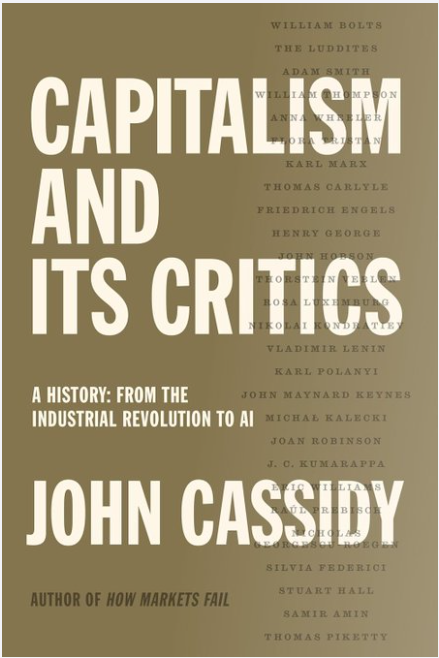
Some of the classics on capitalism are witty and compelling, while others are dense and daunting. If you didn’t get around to reading them in the original, you can curl up with two superb recent books, John Cassidy’s Capitalism and Its Critics and Sven Beckert’s Capitalism: A Global History. Cassidy, The New Yorker’s lead writer on economic topics, has written the more concise book of the two, though it clocks in at 518 pages. The book is entirely accessible to a lay reader, and a pleasure to read a few chapters at a time. Even if you thought you were pretty familiar with Marx or Keynes, I guarantee that you will learn something new. Other names will likely be new to you, as they were to me (and I thought I knew this literature pretty well). My generation used to call books like this a pony—an elegant cheat sheet. It will spare you from reading tens of thousands of pages of the originals, and make you feel very well-read indeed. It may even stimulate you to read some of the originals yourself.

Beckert writes his own grand history, at almost 1,100 pages. An economic historian best known for his Pulitzer finalist Empire of Cotton, Beckert provides more detail than most readers will want, except as a reference work. There are plenty of what my book club calls skip-’ems. But if you have mastered the art of skim reading, Beckert is also well worth your time. Beckert begins with small islands of pre-capitalist commercialism, such as the port city of Aden on the Red Sea in the 12th century. In ports like this, “a new kind of trader rose to prominence—traders who did not travel with their goods.” These traders, “the world’s first capitalists” in Beckert’s telling, “demonstrated that large profits could be had from controlling flexible, fungible capital,” using “market-based exchanges.” Until about 1600, these small islands of capitalist exchange were contained in a larger sea of dominant feudal, church, and monarchic economic relations. Capitalist merchants operated at the sufferance of pre-capitalist rulers.

What caused capitalism to take over? Beckert cites the breakdown of hereditary monarchies, worker shortages caused by plagues, and the riches that capitalists provided, coupled with the monarchs’ insatiable need for new resources in an era marked by incessant wars. For both Beckert and Cassidy, the key drivers of the capitalist breakout were imperial conquest and slavery. Cassidy invokes Adam Smith, a stringent critic of the 18th-century capitalists who worked hand in glove with European governments to plunder Asia and Africa. They did so via state-protected monopolies such as the Dutch East India Company and the British East India Company. In South America, the prime mover was the Spanish crown. “At the particular time the discoveries were made,” Smith said, “the superiority of force happened to be so great on the side of the Europeans that they were enabled to commit with impunity every sort of injustice in those remote countries.”
snip
1 replies
 = new reply since forum marked as read
Highlight:
NoneDon't highlight anything
5 newestHighlight 5 most recent replies
= new reply since forum marked as read
Highlight:
NoneDon't highlight anything
5 newestHighlight 5 most recent replies
= new reply since forum marked as read
Highlight:
NoneDon't highlight anything
5 newestHighlight 5 most recent replies