Welcome to DU!
The truly grassroots left-of-center political community where regular people, not algorithms, drive the discussions and set the standards.
Join the community:
Create a free account
Support DU (and get rid of ads!):
Become a Star Member
Latest Breaking News
Editorials & Other Articles
General Discussion
The DU Lounge
All Forums
Issue Forums
Culture Forums
Alliance Forums
Region Forums
Support Forums
Help & Search
General Discussion
In reply to the discussion: New Report: Solar could provide 100% of world's energy needs by 2050 using only 1% of world's land [View all]green for victory
(591 posts)61. Solar Two was a start
now it's mothballed
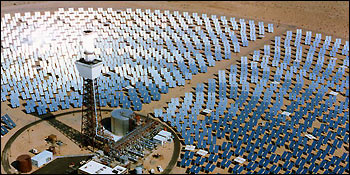
Solar Two
One of Solar Two's heliostats is shown in 2003 with the solar power tower in the background
In 1995 Solar One was converted into Solar Two, by adding a second ring of 108 larger 95 m² (1,000 ft²) heliostats around the existing Solar One, totaling 1926 heliostats with a total area of 82,750 m² (891,000 ft²). This gave Solar Two the ability to produce 10 megawatts—enough to power an estimated 7,500 homes.[1]
Solar Two used molten salt, a combination of 60% sodium nitrate and 40% potassium nitrate, as an energy storage medium instead of oil or water as with Solar One. This helped in energy storage during brief interruptions in sunlight due to clouds.[1] The molten salt also allowed the energy to be stored in large tanks for future use such as night time—Solar Two had sufficient capacity to continue running for up to three hours after the sun had set.
Solar Two was decommissioned in 1999, and was converted by the University of California, Davis, into an Air Cherenkov Telescope in 2001, measuring gamma rays hitting the atmosphere. Its name is now C.A.C.T.U.S..[2] Solar Two's 3 primary participants were Southern California Edison (SCE), the Los Angeles Department of Water and Power (LADWP), and the U.S. Department of Energy (DOE).
"We're proud of Solar Two's success as it marks a significant milestone in the development of large-scale solar energy projects," said then U.S. Energy Secretary Bill Richardson.
"This technology has been successfully demonstrated and is ready for commercialization. From 1994 to 1999, the Solar Two project demonstrated the ability of solar molten salt technology to provide long-term, cost effective thermal energy storage for electricity generation.", Boeing
On November 25, 2009, after 10 years of not producing any energy, the Solar Two tower was demolished[1] The mothballed site was levelled and returned to vacant land by Southern California Edison. All heliostats and other hardware were removed.
http://en.wikipedia.org/wiki/The_Solar_Project
http://costofwar.com/
Edit history
Please sign in to view edit histories.
Recommendations
0 members have recommended this reply (displayed in chronological order):
132 replies
 = new reply since forum marked as read
Highlight:
NoneDon't highlight anything
5 newestHighlight 5 most recent replies
RecommendedHighlight replies with 5 or more recommendations
= new reply since forum marked as read
Highlight:
NoneDon't highlight anything
5 newestHighlight 5 most recent replies
RecommendedHighlight replies with 5 or more recommendations
= new reply since forum marked as read
Highlight:
NoneDon't highlight anything
5 newestHighlight 5 most recent replies
RecommendedHighlight replies with 5 or more recommendations
New Report: Solar could provide 100% of world's energy needs by 2050 using only 1% of world's land [View all]
FourScore
Jan 2013
OP
Luckily we've sold them plenty of weapons so when their economies go to shit...
progressoid
Jan 2013
#12
1% of the land we have now or 1% of what will be left after the ice caps melt?
Motown_Johnny
Jan 2013
#4
I think that could be done but it would be more like WWII level of societal effort
Fumesucker
Jan 2013
#14
Roofs? Parking lots? and then of course vacant land. A lot here, a lot there in parts of
JDPriestly
Jan 2013
#86
There's a lot of unused land in the US right now. We could make this work if we wanted to.
MessiahRp
Jan 2013
#109
People who think solar energy is unrealistic do not live in Arizona, New Mexico or Southern
JDPriestly
Jan 2013
#89
But you put the panels on roofs and buildings and parking lots as well as desert land.
JDPriestly
Jan 2013
#90
We will probably need to do some of each. Homes, schools and desert solar ranches.
JDPriestly
Jan 2013
#116
And not only that, if one of the worlds volcanoes erupts, solar efficiencies could/will plummet.
RC
Jan 2013
#48
Electric cars would help store the power and keep the grid going at night. Also don't forget wind.
rightsideout
Jan 2013
#42
Everybody knows computers will be better and cheaper next year, does that inhibit
PoliticAverse
Jan 2013
#79
Daily Kos diarist got it wrong; not 'worldwide', in selected locations
muriel_volestrangler
Jan 2013
#51
Shhh! Don't upset the nukers with such ideas. It doesn't fit into the future of life on
leveymg
Jan 2013
#54
While the US was executing the PNAC plan, Germany became the leader in PV
green for victory
Jan 2013
#58
"I do not think we have a long time before we all realize that this needs to be top priority"
green for victory
Jan 2013
#67
Except they will never be allowed to build it because of a few endangered species
n2doc
Jan 2013
#68
Possibilities aren't necessarily realities. Fossil fuels remain most profitable.
joshcryer
Jan 2013
#77
Actually, less than 1/10 of 1% of the planet. 0.08% with 20% efficient modules.
NYC_SKP
Jan 2013
#80
But we only need to cover 1% of the oceans with oil slicks to do it with oil'
grahamhgreen
Jan 2013
#94
The global economy CAN work that way if enough international cooperation gets underway.
randome
Jan 2013
#103
check out the solar towers here- going up in AZ and TX, i think. pretty f'in cool!
farminator3000
Jan 2013
#118