General Discussion
In reply to the discussion: Bee venom kills HIV!!! [View all]
bvar22
(39,909 posts).. in the Ouachita Mountains of central Arkansas.
There are successful BeeKeepers in Montana and Minnesota.
Surviving the Winter is one of the biggest issues,
and the biggest problem there is making sure they have enough stored food to last the Winter.
The Bees are great at taking care of themselves,
but they sometimes need a little help,
and experience and Common Sense is the best teacher.
We moved from Minneapolis to to our new home in the Fall of 2006, and started our BeeKeeping adventure that Winter,
Neither Starkraven nor myself had had any hands-on experience with bees.
During that first Winter, Starkraven researched bees (mostly online), and purchased a "Starter Kit" and two hive bodies online. She assembled the hives during the Winter, and in the Spring, the bees arrived via US Mail.
The postmaster of the small rural Post Office called us at 7AM,
and strongly encouraged us to get those Bees out of his Post Office ASAP.
My Wife introduce the Bees to their new home.
While she did everything according to the Book and wore a full Bee Suit,
it WAS very stressful. I took photos from a distance with a telephoto lens and shouted encouragement.
She must have done everything right, because the Bees decided to stay,
and we still keep bees from that original line.
As time and Seasons passed, we both became more and more fascinated with these insects, and took a course offered by the State, and later joined our local BeeKeepers Association.
While the bees are hearty and very good at taking care of themselves, they sometimes need some help.
We were lucky, and blundered through the first year on online research and love, but taking a course and joining the BeeKeepers Association has been invaluable, and we highly recommend it to anyone considering bees.
Our bees are very gentle (Italian/All Stars). We always wear protective hoods and gloves and use a smoker, but rarely put on the full suit. We do get stung on rare occasions (through the gloves or jeans), but it is no big deal anymore. I am considering trying BeeSting therapy for some arthritis in my hands .
We have gotten very comfortable with the bees, and inspect the hives every couple of weeks during the Spring/Summer. It takes about 10 minutes per hive. During the Winter, we rarely open the hives. ...only enough to make sure they have food (sugar water).
Our colonies are about 20 yards from the backdoor, visible from the house. There are plenty of bees around our house and gardens, but they have never caused a problem with us or our pets. Neither of us has been stung outside of messing with the hives.
There are many websites that offer full starter kits online.
I believe we ordered our original kits from Dadant,
but are setting up the jigs to build our own equipment,
which is relatively easy with basic carpentry skills and tools.
Here is some info based on our own experience we keep handy for anyone thinking about Bees.
We strongly recommend the following suggestions:
1) Check in with you County Extension.
They are very helpful. There are some regulations concerning transportation, registration, and inspection, and there may be some local ordinances. They are a great resource for latest research and new methods, pest & disease control. They can facilitate state hive inspections.
We generally avoid government agencies where ever possible, and have never voluntarily registered anything, but we make an exception for our bees. The benefits FAR outweigh any downside.
2)Join you local Beekeepers Association.
These are some of the most laid back people you will ever meet. Starkraven and myself are not joiners, but we look forward to our monthly meetings with the "bee people". This is another valuable resource for local information concerning pests, honey flows, equipment and disreputable operators. You can also pick up some hands-on experience working around hives.
Make no mistake...it is scary opening a hive the first time.
You will also be able to pick up some free localized bees from you local bee keepers. (Healthy colonies EXPAND, and many local bee keepers have all they want and are more than happy to give them away).
3)Always use new equipment
There are some very persistent pests and diseases that can be transmitted through the equipment. Used equipment abounds at some very attractive prices.
It is not worth the risk in my opinion. If you join the local association, some will offer you old equipment for FREE, but we always politely turn it down.
New Equipment is very reasonable, and there are many wholesalers and retailers online.
4)Do NOT to use flower scented deodorant or fabric softeners.
You would think this is Common Sense, but we found out the hard way.
5)Do NOT feed your bees Corn Syrup
There is no verifiable science to support this suggestion.
It is our personal preference. Corn is NOT a natural Bee Food.
Many BeeKeepers DO use Corn Syrup. It is cheap, the bees seem to like it, and the chemistry seems OK.
We refuse to use it, and will continue to do so until there is 100% proof that GM contamination absolutely can NOT
be transmitted to our Bees through Corn Syrup.
We use only 100% Cane Sugar to make our food solution,
and then only use it when necessary.
We strongly recommend the above suggestions.
Our fascination with our Bees continues to grow.
The more we learn,
the more fascinated we become.
This is a wonderful site about BeeKeeping:
http://www.bushfarms.com/beesnewbees.htm
We don't always agree with him,
but love his attitude about Bees,
and his approach to natural BeeKeeping.
So far, we have adhered to more conventional methods,
but will try a Top Bar hive soon, maybe this season.
The End Product is beautiful,
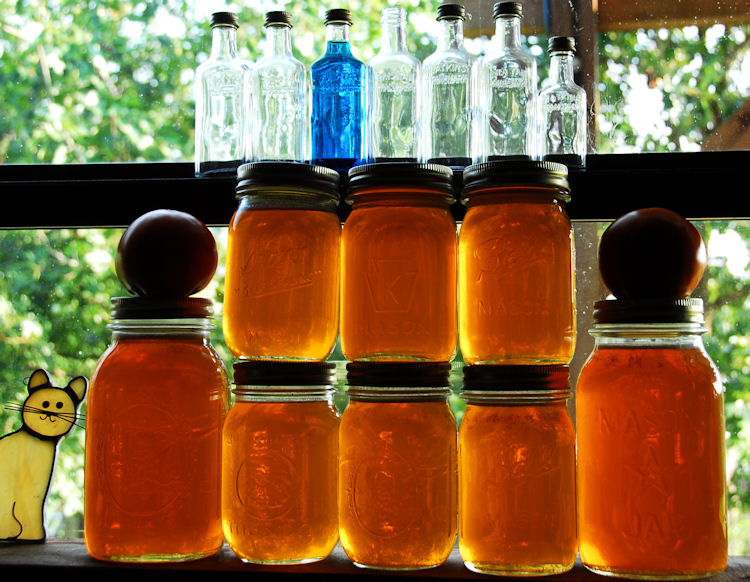
....and you will have the satisfaction and security of KNOWING
that your Honey is 100% Pure, Natural Honey,
and NOT Corn Syrup that has been reprocessed through a Bee.
We keep two colonies, and both have made it through our mild Winter with high populations.
We observed them taking pollen into the hives last week,
a sign of early Spring. We would like to expand to 4 colonies this year,
and, so far, things look good for that.
Here are some photos and text I've posted in the Rural/Farm group.
There are several other BeeKeepers at DU, but they seem to come and go.
http://www.democraticunderground.com/1182412
http://www.democraticunderground.com/1182619
If you have an inclination to do this,
please Follow Your Bliss.
Our experience with our Bees has been one of the most fascinating and rewarding adventures we have had since we Took-the-Leap in 2006.
Remember to have fun, and good luck.

Edit history
Recommendations
0 members have recommended this reply (displayed in chronological order): = new reply since forum marked as read
Highlight:
NoneDon't highlight anything
5 newestHighlight 5 most recent replies
RecommendedHighlight replies with 5 or more recommendations
= new reply since forum marked as read
Highlight:
NoneDon't highlight anything
5 newestHighlight 5 most recent replies
RecommendedHighlight replies with 5 or more recommendations