They'd been working on some iteration of the concept from back in the fifties and sixties, though.
The idea came from the Germans, pre-WW2.

http://en.wikipedia.org/wiki/Bell_XV-3
The XV-3 was first flown on 11 August 1955. Although it was limited in performance, the aircraft successfully demonstrated the tiltrotor concept, accomplishing 110 transitions from helicopter to airplane mode between December 1958 and July 1962. The XV-3 program ended when the remaining aircraft was severely damaged in a wind tunnel accident on 20 May 1966.[1] The data and experience from the XV-3 program were key elements used to successfully develop the Bell XV-15, which later paved the way for the V-22 Osprey.[2]
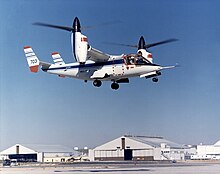
This is the one I saw:

...NASA selected the Bell 301 for further development, and a contract for further R&D was issued on 31 July 1973. Extensive engineering and testing took the next four years to complete the development of the aircraft. The first of two Bell XV-15s, tail number N702NA, first flew on 3 May 1977. After minimal flight tests at the Bell test facility, the aircraft was moved to NASA Ames Research Center in Mountain View, California, where it was then mounted in the large Ames wind tunnel and tested extensively in various simulated flight environments.
For the U.S. Department of Defense Joint-service Vertical take-off/landing Experimental (JVX) aircraft program, Bell Helicopter and Boeing Vertol teamed to submit a bid for an enlarged version of the XV-15 in 1983. The Bell Boeing team received a preliminary design contract that year, which lead to the V-22 Osprey.[2]
http://en.wikipedia.org/wiki/Bell_XV-15