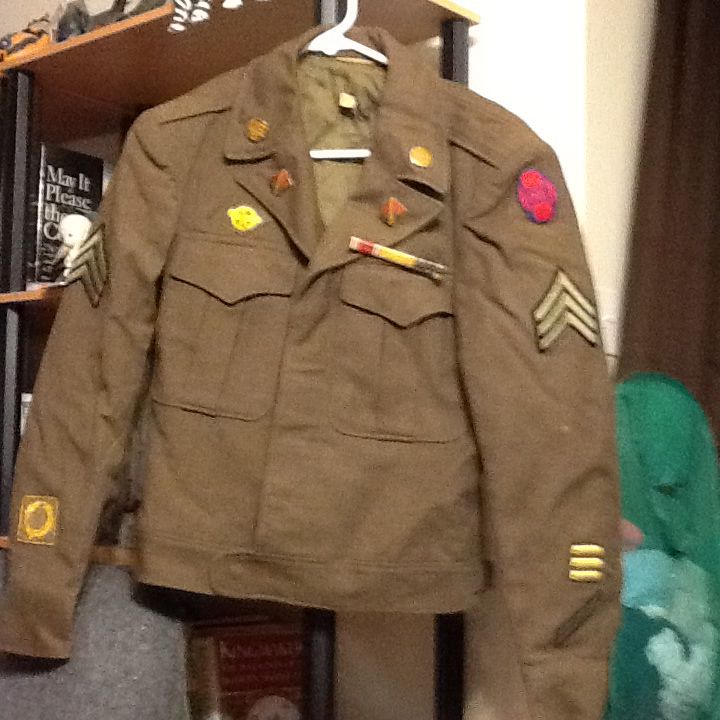
Today would be my Daddy's 96th birthday.I learned about his WWII experiences from his Army jacket: [View all]
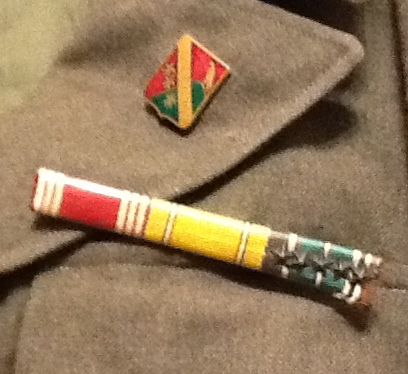
The yellow ribbon is the Army Defense Medal Ribbon
The red Ribbon is the Good Conduct Medal Ribbon
The green and brown ribbon is the European - African - Middle Eastern Campaign Medal Ribbon
The European - African - Middle Eastern Campaign Medal Ribbon has 5 battle stars for being in these 5 major engagements in the ETO during WWII:
Normandy
Northern France
Rhineland
Ardennes-Alsace
Central Europe
Old Hickory -The 30th Infantry Division(represented by the patch on his upper left sleeve)
The green and red crest represents the 113th Field Artillery Batallion.
<snip>
On 12 February 1944, the 30th Infantry Division sailed for Europe, and settled on the south coast of England to participate in further training for the coming invasion of the Continent "at some time in the future".
In June of 1944, after being fully trained and prepared for the greatest invasion of all times, the 30th Infantry Division started crossing the English Channel to France on 6 June, D-Day, to replace some of the units of the 29th Infantry Division which had become almost immediately lost during the initial attack of the invasion, and then the balance of the Division went into the beaches of Normandy, Omaha Beach on D plus 4, the 10th of June and up through the 15th, and was almost immediately committed into combat against the experienced German Army.
During combat, the 30th Infantry Division was known as the "Workhorse of the Western Front". It was also familiarly known as "Roosevelt's SS Troops", so named by the German High Command because of the consistent vigor and terrific pressure the 30th Infantry Division brought to bear on Hitler's 'elite' 1st SS Division. The German 'elite' 1st SS Division was the main force of resistance just prior to the breakthrough at St. LO, and again at Mortain, which the 30th Infantry Division literally tore to shreds, thereby allowing Gen. George Patton's armored forces of the U.S. Third Army to go forward and race across France, thereby shortening the war by many months. The German 1st SS Division was then reorganized over the next few months, and was again faced by the 30th Infantry Division in the "Battle of the Bulge", during the great Ardennes-Alsace Offensive, near Malmedy, Belgium, during the winter of 1944-45. Again the 30th Infantry Division tore to shreds this 'elite' enemy division, which was never again to return to battle.
<snip>
http://www.30thinfantry.org/history.shtml
I learned one other thing from his jacket. It fit me perfectly in my senior year of high school. From that, I realized how small many of the service members were then.

 = new reply since forum marked as read