Welcome to DU!
The truly grassroots left-of-center political community where regular people, not algorithms, drive the discussions and set the standards.
Join the community:
Create a free account
Support DU (and get rid of ads!):
Become a Star Member
Latest Breaking News
Editorials & Other Articles
General Discussion
The DU Lounge
All Forums
Issue Forums
Culture Forums
Alliance Forums
Region Forums
Support Forums
Help & Search
General Discussion
In reply to the discussion: What would society look like if men were not in charge? [View all]
Zorra
(27,670 posts)53. A Matriarchal Society in the age of Globalization Juchitán/Southern Mexico
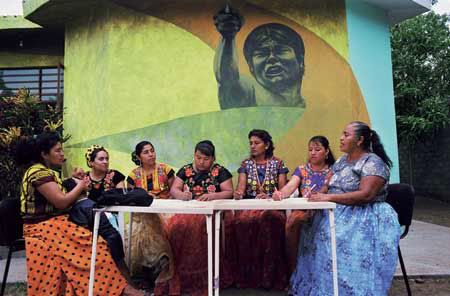
A Matriarchal Society in the age of Globalization Juchitán/Southern Mexico
Juchitán, the town of women
The women of Juchitán, of the Isthmus of Tehuantepec, are famous throughout the nation of Mexico because of their beauty and their economic power. Something of this power could be felt in the recent film about the world famous painter Frida Kahlo, who had her Mexican roots in this area. In this country whose character is stamped by "Machismo", the Latino male superiority, one often hears it said "Juchitán is run by women's rule." In Mexico a man is teasingly called a "Teco" (derived from Juchiteco) when he displays supposedly un-masculine softness in the dispute between the sexes. "Teca" is the name for a woman who is proud and energetic and able to prevail. This reflects the ethnic character of women in Juchitán quite well.
snip---
There is quite a rigid division of labour in Juchitán along the line of the two basic sexes of women and men. Labour defines the sex to a great degree. One could almost get the impression that the rigidity in the sexual division of labour serves mainly the definition of further sexual identities and not so much that of man and woman. The mushes, mostly homosexual men who define themselves as women, do women's work and refuse to do men's work, thus defining their sexual identity through their work. It is similar with the marimachas, women who live with other women and take the male part in the relationship. The sexual practices themselves are rather secondary in view of the social sex assignment. The sexual partner of a mushe is not seen as a mushe, or as homosexual, but simply as a man. The same holds for the partner of a marimacha. If same sex partners do not assign themselves through their work as - biologically antidromic – a third or fourth sex, then sexual contact is rather sporadic and is not an issue in the wider society. What we call bi-sexuality has a very high occurrence in Juchitán.
The rather rigid sex based division of work is a protection for women from a sort of hostile take-over. In this way the position of trader and market-woman is undeniably women's domain.
Thus the economy of Juchitán is solidly in women's hands, which proves furthermore, and rather contrary to Marxist views, the importance of the circulation sphere for the whole of the economy. Both men and women are convinced that women are better at buying and selling and handling money. For this reason farmers and fishermen prefer to deliver their products to the women rather then to large trading organisations which would take the raw materials out of the region. Thanks to the special relationship between the sexes in Juchitán processing happens in the region and with this comes added product value. The man who works as a labourer in the nearby crude oil refinery delivers his complete income to the woman, for her to manage it. In this way a self-contained, women-centred economy of a very special quality has developed. (more)
Juchitán, the town of women
The women of Juchitán, of the Isthmus of Tehuantepec, are famous throughout the nation of Mexico because of their beauty and their economic power. Something of this power could be felt in the recent film about the world famous painter Frida Kahlo, who had her Mexican roots in this area. In this country whose character is stamped by "Machismo", the Latino male superiority, one often hears it said "Juchitán is run by women's rule." In Mexico a man is teasingly called a "Teco" (derived from Juchiteco) when he displays supposedly un-masculine softness in the dispute between the sexes. "Teca" is the name for a woman who is proud and energetic and able to prevail. This reflects the ethnic character of women in Juchitán quite well.
snip---
There is quite a rigid division of labour in Juchitán along the line of the two basic sexes of women and men. Labour defines the sex to a great degree. One could almost get the impression that the rigidity in the sexual division of labour serves mainly the definition of further sexual identities and not so much that of man and woman. The mushes, mostly homosexual men who define themselves as women, do women's work and refuse to do men's work, thus defining their sexual identity through their work. It is similar with the marimachas, women who live with other women and take the male part in the relationship. The sexual practices themselves are rather secondary in view of the social sex assignment. The sexual partner of a mushe is not seen as a mushe, or as homosexual, but simply as a man. The same holds for the partner of a marimacha. If same sex partners do not assign themselves through their work as - biologically antidromic – a third or fourth sex, then sexual contact is rather sporadic and is not an issue in the wider society. What we call bi-sexuality has a very high occurrence in Juchitán.
The rather rigid sex based division of work is a protection for women from a sort of hostile take-over. In this way the position of trader and market-woman is undeniably women's domain.
Thus the economy of Juchitán is solidly in women's hands, which proves furthermore, and rather contrary to Marxist views, the importance of the circulation sphere for the whole of the economy. Both men and women are convinced that women are better at buying and selling and handling money. For this reason farmers and fishermen prefer to deliver their products to the women rather then to large trading organisations which would take the raw materials out of the region. Thanks to the special relationship between the sexes in Juchitán processing happens in the region and with this comes added product value. The man who works as a labourer in the nearby crude oil refinery delivers his complete income to the woman, for her to manage it. In this way a self-contained, women-centred economy of a very special quality has developed. (more)
I've spent time in Juchitan, it's an interesting place, and I may go live there for awhile at some point.
Edit history
Please sign in to view edit histories.
Recommendations
0 members have recommended this reply (displayed in chronological order):
72 replies
 = new reply since forum marked as read
Highlight:
NoneDon't highlight anything
5 newestHighlight 5 most recent replies
RecommendedHighlight replies with 5 or more recommendations
= new reply since forum marked as read
Highlight:
NoneDon't highlight anything
5 newestHighlight 5 most recent replies
RecommendedHighlight replies with 5 or more recommendations
= new reply since forum marked as read
Highlight:
NoneDon't highlight anything
5 newestHighlight 5 most recent replies
RecommendedHighlight replies with 5 or more recommendations
I see where you are coming from - but many of our values are gendered, which makes this discussion
el_bryanto
May 2014
#4
Right, but if women were "in charge," would gentleness still be seen as a feminine value?
Brickbat
May 2014
#8
That sorta depends. Are the 75% mostly Michelle Bachmann or Elizabeth Warren? -nt
Liberal Veteran
May 2014
#2
Scandinavia has also had a history of women staying at home for months while most men were gone.
haele
May 2014
#39
The Iroquois, from whom we got the Senate and House representation system was mostly matriarchal
KurtNYC
May 2014
#31
What immediately comes to my mind is - the whole idea of empathy would not be sneered at so readily.
calimary
May 2014
#24
Not like this. But a good read, anyway, is Herland by Charlotte Perkins Gilman
ancianita
May 2014
#54