Welcome to DU!
The truly grassroots left-of-center political community where regular people, not algorithms, drive the discussions and set the standards.
Join the community:
Create a free account
Support DU (and get rid of ads!):
Become a Star Member
Latest Breaking News
Editorials & Other Articles
General Discussion
The DU Lounge
All Forums
Issue Forums
Culture Forums
Alliance Forums
Region Forums
Support Forums
Help & Search
General Discussion
In reply to the discussion: LBJ was bullied into VietNam war same way they are bullying Obama now... [View all]
Octafish
(55,745 posts)40. Sort of like JFK's admin was an interruption in service to the Dogs of War Inc.
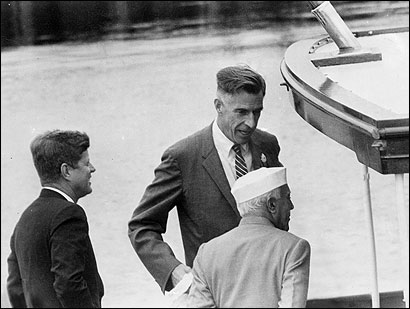
Galbraith and Vietnam
by RICHARD PARKER
The Nation, March 14, 2005 issue
In the fall of 1961, unknown to the American public, John F. Kennedy was weighing a crucial decision about Vietnam not unlike that which George W. Bush faced about Iraq in early 2002--whether to go to war. It was the height of the cold war, when Communism was the "terrorist threat," and Ho Chi Minh the era's Saddam Hussein to many in Washington. But the new President was a liberal Massachusetts Democrat (and a decorated war veteran), not a conservative Sunbelt Republican who claimed God's hand guided his foreign policy. JFK's tough-minded instincts about war were thus very different. Contrary to what many have come to believe about the Vietnam War's origins, new research shows that Kennedy wanted no war in Asia and had clear criteria for conditions under which he'd send Americans abroad to fight and die for their country--criteria quite relevant today.
But thanks also in part to recently declassified records, we now know that Kennedy's top aides--whatever his own views--were offering him counsel not all that different from what Bush was told forty years later. Early that November, his personal military adviser, Gen. Maxwell Taylor, and his deputy National Security Adviser, Walt Rostow, were on their way back from Saigon with a draft of the "Taylor report," their bold plan to "save" Vietnam, beginning with the commitment of at least 8,000 US troops--a down payment, they hoped, on thousands more to follow. But they knew JFK had no interest in their idea because six months earlier in a top-secret meeting, he had forcefully vetoed his aides' proposed dispatch of 60,000 troops to neighboring Laos--and they were worried about how to maneuver his assent.
Harvard economist John Kenneth Galbraith, then Ambassador to India, got wind of their plan--and rushed to block their efforts. He was not an expert on Vietnam, but India chaired the International Control Commission, which had been set up following French withdrawal from Indochina to oversee a shaky peace accord meant to stabilize the region, and so from State Department cables he knew about the Taylor mission--and thus had a clear sense of what was at stake. For Galbraith, a trusted adviser with unique back-channel access to the President, a potential US war in Vietnam represented more than a disastrous misadventure in foreign policy--it risked derailing the New Frontier's domestic plans for Keynesian-led full employment, and for massive new spending on education, the environment and what would become the War on Poverty. Worse, he feared, it might ultimately tear not only the Democratic Party but the nation apart--and usher in a new conservative era in American politics.
Early that November, just as Taylor and his team arrived back in Washington, Galbraith arrived from New Delhi for the state visit of Prime Minister Nehru. Hoping to gain a quick upper hand over Taylor and his mission, he arranged a private luncheon for Kennedy and Nehru at the Newport estate of Jacqueline Kennedy's mother and stepfather. No one from the State Department--to Secretary of State Dean Rusk's great consternation--was invited, save Galbraith. Ten days earlier, Galbraith, in one of his back-channel messages, had shared with Kennedy his growing concerns about Vietnam. From India, he'd played a role in defusing the Laos situation that spring, but over the summer, the Berlin crisis had sent a sharp chill through relations with the Soviets, with the risks of nuclear confrontation for a time all too real. About this, Galbraith now told the President:
Although at times I have been rather troubled by Berlin, I have always had the feeling that it would be worked out. I have continued to worry far, far more about South Viet Nam. This is more complex, far less controllable, far more varied in the factors involved, far more susceptible to misunderstanding. And to make matters worse, I have no real confidence in the sophistication and political judgment of our people there.
This was advice Kennedy was hearing from no one else in his Administration, but clearly welcomed.
CONTINUED...
http://www.johnkennethgalbraith.com/index.php?display=10&page=articles
No guy. No problem.
Edit history
Please sign in to view edit histories.
Recommendations
0 members have recommended this reply (displayed in chronological order):
54 replies
 = new reply since forum marked as read
Highlight:
NoneDon't highlight anything
5 newestHighlight 5 most recent replies
RecommendedHighlight replies with 5 or more recommendations
= new reply since forum marked as read
Highlight:
NoneDon't highlight anything
5 newestHighlight 5 most recent replies
RecommendedHighlight replies with 5 or more recommendations
= new reply since forum marked as read
Highlight:
NoneDon't highlight anything
5 newestHighlight 5 most recent replies
RecommendedHighlight replies with 5 or more recommendations
LBJ was bullied into VietNam war same way they are bullying Obama now... [View all]
randys1
Jun 2014
OP
no way. Watch the movie "The Fog of War". No one "bullied" Johnson. he lied about the gulf of
lostincalifornia
Jun 2014
#4
Read the Pentagon Papers, Daniel Ellsberg, and I think you may change your mind
lostincalifornia
Jun 2014
#14
I understand, but LBJ was not a person who allowed himself to be pressured. He passed the civil
lostincalifornia
Jun 2014
#13
Wow. I really think things would have been different if Bobby had a chance. Actually the country
lostincalifornia
Jun 2014
#34
So much trauma. LBJ was sworn into office with Jackie Kennedy in her bloody dress by his side:
freshwest
Jun 2014
#36
And we see a steady chorus about PBO being weak because he refuses to take on Bush's job.
freshwest
Jun 2014
#28
I was lucky, I got called up for my physical but was able to get out because of high blood pressure
lostincalifornia
Jun 2014
#9
Yes, I remember Dan Rather with the body counts and a lot of coverage on Vietnam.
freshwest
Jun 2014
#32
I agree with your assessment. It still is being done in our name though
lostincalifornia
Jun 2014
#33
"Bullied"? I think it's called "assassinating his immediate predecessor." LBJ got the message.
WinkyDink
Jun 2014
#7
If there's a hell, McNamara is there, and Kissinger is headed there the second he dies.
nomorenomore08
Jun 2014
#24
Sort of like JFK's admin was an interruption in service to the Dogs of War Inc.
Octafish
Jun 2014
#40
John Michael Dunn...the guy made general and left an oral history of his time in Saigon...
Octafish
Jun 2014
#49
"Hey, Hey, LBJ, how many kids did you kill today?" He wanted the anti-commie PR.
Tierra_y_Libertad
Jun 2014
#46
maybe we should elect a president who won't be bullied. after all, he didn't let
Doctor_J
Jun 2014
#50