Welcome to DU!
The truly grassroots left-of-center political community where regular people, not algorithms, drive the discussions and set the standards.
Join the community:
Create a free account
Support DU (and get rid of ads!):
Become a Star Member
Latest Breaking News
Editorials & Other Articles
General Discussion
The DU Lounge
All Forums
Issue Forums
Culture Forums
Alliance Forums
Region Forums
Support Forums
Help & Search
General Discussion
Showing Original Post only (View all)
“A very ugly blame game”: How Great Recession is affecting people in totally unexpected ways [View all]
http://www.salon.com/2014/06/30/a_very_ugly_blame_game_how_great_recession_is_affecting_people_in_totally_unexpected_ways/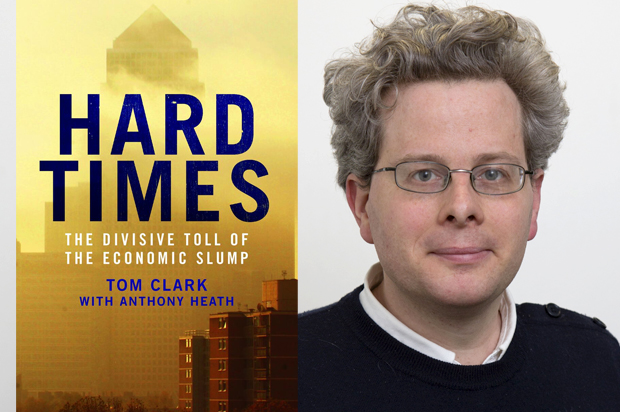
***SNIP
Earlier this week, Salon called up Tom Clark, a journalist for the Guardian, to discuss these societal harms and “Hard Times: The Divisive Toll of the Economic Slump,” the new book he co-wrote with University of Manchester sociologist Anthony Heath about the subject. We also touched on the economics of inequality and how the political right in the U.S. and the U.K. has tried to divert attention away from their destructive economic policies and shift the blame instead onto the so-called 47 percent, the very people most harmed by the Great Recession. Our conversation is below, and has been edited for clarity and length.
What was it that made you want to write this book?
Some years ago now, I studied economic history at university and I could see what was unfolding from 2008 onwards was something that, in some ways but not in others, was eerily reminiscent of the Great Depression and the great social disruption that we remember in popular memory from that time, and I just thought that to be alive in these times, to be living through these times, it would be fascinating to try and make sense of it in the way [that], on a fiction front in America, we remember “The Grapes of Wrath.” (Here in the U.K., we remember a book called “The Road to Wigan Pier” by George Orwell.) … A little while after the recession, I thought, “It’s gonna take time for the impressions and the consequences of this huge financial event that we keep hearing about in the media to become clear.” And having read about what happened last time around [during the Great Depression], it could also be [worthwhile], trying to make sense of what happened this time around in real time.
All right, well, here’s a big question, but: What is happening “this time around”?
Goodness, yes, it’s probably as well to try and narrow that down. One thing I deliberately try to do — and I think this comes with, you know, having looked at the Great Depression and having taken a long view — is note that societies have got a bit poorer, ut they’re very rich societies by the international standard or by any historical standard … Really, they should, one would have thought — certainly people in the 1930s looking forward to this time — would have expected that this [kind of economic damage] is something that comes and goes by the time societies have grown this rich and this technologically advanced as well. That by this time, this is something we really should’ve been able to take on the chin, should’ve been able to manage without huge disruption …
We should’ve been able to do that, but, in practice — and I think this goes down to America and Britain being such unequal societies — we weren’t able to do so. We find that there had been very grave consequences in terms of social engagement — particularly in Britain. We find that there’s great consequences in terms of mental well-being, which are at least as marked, perhaps more marked, in the United States than they seem to be in Britain. And we find that there are consequences too —certainly more suggestively, but there’s still a lot to convince me — in terms of family relationships and how people get on with their nearest and dearest. All of these things that we like to think that money shouldn’t be able to buy — friends, family, community — all of these things have been tainted by the social fallout of Great Recession. Not, I think, because it’s a rich society that’s got a bit poorer, but because it’s a society that’s left so many people with so little for so long during the good times, that there’s a large chunk of society down at the bottom-end that really can’t afford to get a bit poorer, even if the average person could.
5 replies
 = new reply since forum marked as read
Highlight:
NoneDon't highlight anything
5 newestHighlight 5 most recent replies
= new reply since forum marked as read
Highlight:
NoneDon't highlight anything
5 newestHighlight 5 most recent replies
= new reply since forum marked as read
Highlight:
NoneDon't highlight anything
5 newestHighlight 5 most recent replies
“A very ugly blame game”: How Great Recession is affecting people in totally unexpected ways [View all]
xchrom
Jun 2014
OP
The Oligarchs, Corporations And Banks Own And Control The Politicians That Own And Control Us
cantbeserious
Jun 2014
#1