General Discussion
In reply to the discussion: Right-wing obstruction could have been fought: An ineffective and gutless presidency’s legacy [View all]
bigtree
(94,701 posts). . . I didn't find any that went beyond his dismissal of the degree of republican obstructionism and his strange and curious belief that the President of the United States could do much more economically than propose budgets and sign (or veto) the legislation Congress sends him. In all of the criticism there's an unspoken belief that there's some autocratic lever the President has, or should use to allocate our tax dollars that would make the differences he wants to see.
There's the unspoken belief in this article that the President is capable of shaming the republican opposition into some sort of epiphany and cause them to do the things that this president and our party has already convinced the majority of the public they should.
Absent from Frank's criticisms are any mention at all of proposal after proposal, harangue after harangue over the years from President Obama; perhaps to satisfy his conclusion that the President could have responded "more aggressively to the Great Recession or by pounding relentlessly on the theme of middle-class economic distress."
I don't fault Frank for not acknowledging the almost countless occasions where the president has rhetorically defended the middle-class (which would disprove his claims). I am surprised, though, that he doesn't seem to make the point here that talk doesn't automatically equate with action.
But, let's take his point about the President's response to the 'Great Recession,' which is, arguably, the most prescient event in this presidency, and which defined and affected almost all of this presidency's economic policy.
President Barack Obama’s 2009 economic stimulus bill was passed in Congress during the first month of his Administration and received opposition from all but three Congressional Republicans.
The American Recovery and Reinvestment Act” was passed and enacted in February of 2009 and contained approximately $800 billion in stimulus programs, tax cuts and tax incentives to help the economy, which at the time was losing almost one million jobs a month.
In the CBO report, “Estimated Impact of the American Recovery and Reinvestment Act on Employment and Economic Output from July 2011 Through September 2011,” a breakdown by year shows that the ARRA created or saved from 5 million to 25.4 million jobs from March 2009 through September 2011, as follows: (http://www.cbo.gov/ftpdocs/125xx/doc12564/11-22-ARRA.pdf )
2009:a low estimate of .9 million jobs to a high estimate of 3.6 million jobs
2010:a low estimate of 2.6 million jobs to a high estimate of 13.2 million jobs
2011:a low estimate of 1.5 million jobs to a high estimate of 8.6 million jobs
CBO estimated that ARRA’s policies had the following effects in the third quarter of calendar year 2011 compared with what would have occurred otherwise:
--They raised real (inflation-adjusted) gross domestic product (GDP) by between 0.3 percent and 1.9 percent,
--They lowered the unemployment rate by between 0.2 percentage points and 1.3 percentage points,
--They increased the number of people employed by between 0.4 million and 2.4 million, and
--They increased the number of full-time-equivalent (FTE) jobs by 0.5 million to 3.3 million. (Increases in FTE jobs include shifts from part-time to full-time work or overtime and are thus generally larger than increases in the number of employed workers.)
In an interview with Michael Grunwald, Time magazine correspondent who published The New New Deal: The Hidden Story of Change in the Obama Era, an account of President Barack Obama's stimulus bill, Grunwald asserted that the stimulus transformed America.
GRUNWALD:
____ The Obama team thought a lot about the New Deal while they were putting the stimulus together, but times have changed since the New Deal. The Hoover Dam put 5,000 Americans to work with shovels. A comparable project today would only require a few hundred workers with heavy equipment . . .. The New Deal was a journey, an era, an aura. The Recovery Act was just a bill on Capitol Hill.
Yet its aid to victims of the Great Recession lifted at least 7 million people out of poverty and made 32 million poor people less poor. It built power lines and sewage plants and fire stations, just like the New Deal. It refurbished a lot of New Deal parks and train stations and libraries.
Most of the money in the stimulus went to unsexy stuff designed to prevent a depression and ease the pain of the recession: aid to help states avoid drastic cuts in public services and public employees; unemployment benefits, food stamps, and other assistance for victims of the downturn; and tax cuts for 95 percent of American workers. And the money that did flow into public works went more toward fixing stuff that needed fixing — aging pipes, dilapidated train stations, my beloved Everglades — than building new stuff.
In its first year, the stimulus financed 22,000 miles of road improvements, and only 230 miles of new roads. There were good reasons for that. Repairs tend to be more shovel-ready than new projects, so they pump money into the economy faster. They also pass the do-no-harm test. (New sprawl roads make all kind of problems worse.) And they are fiscally responsible. Repairing roads reduces maintenance backlogs and future deficits; building roads add to maintenance backlogs and future deficits.
The stimulus included $27 billion to computerize our pen-and-paper health care system, which should reduce redundant tests, dangerous drug interactions and fatalities caused by doctors with chicken-scratch handwriting. It doubled our renewable power generation; it essentially launched our transition to a low-carbon economy. It provided a new model for government spending — with unprecedented transparency, unprecedented scrutiny, and unprecedented competition for the cash . . .
Most critics from the left conflate Bush's bank bailouts with President Obama's stimulus . . . $350 billion of TARP money was saved for the new President when he took office in 2009. Obama never used the TARP funds. Instead, he launched his $787 billion Economic Stimulus package.
from the NYT: http://www.nytimes.com/2010/02/17/business/economy/17leonhardt.html
____ Of course, no one can be certain about what would have happened in an alternate universe without a $787 billion stimulus. But there are two main reasons to think the hard-core skeptics are misguided — above and beyond those complicated, independent economic analyses.
The first is the basic narrative that the data offer. Pick just about any area of the economy and you come across the stimulus bill’s footprints.
In the early months of last year, spending by state and local governments was falling rapidly, as was tax revenue. In the spring, tax revenue continued to drop, yet spending jumped — during the very time when state and local officials were finding out roughly how much stimulus money they would be receiving. This is the money that has kept teachers, police officers, health care workers and firefighters employed.
Then there is corporate spending. It surged in the final months of last year. Mark Zandi of Economy.com (who has advised the McCain campaign and Congressional Democrats) says that the Dec. 31 expiration of a tax credit for corporate investment, which was part of the stimulus, is a big reason.
The story isn’t quite as clear-cut with consumer spending, as skeptics note. Its sharp plunge stopped before President Obama signed the stimulus into law exactly one year ago. But the billions of dollars in tax cuts, food stamps and jobless benefits in the stimulus have still made a difference. . . . aggregate wages and salaries have fallen, while consumer spending has risen. The difference between the two — some $100 billion — has essentially come from stimulus checks.
Republicans, at the time, complained that the President was using the money for purposes outside of their bailout of financial institutions. The President wanted the excess funds used for deficit reduction, but settled on allocating about $200 billion of the TARP money for small businesses and about $50 billion for housing (neither of which have found enough takers to use the money up yet).
from HuffPo: http://www.huffingtonpost.com/2009/12/09/obama-wont-use-tarp-funds_n_385807.html
The Obama administration will only use money from the Troubled Asset Relief Program to pay for one of the president's newly announced job-creation initiatives, relying on other sources of revenue to pay for the other two major components.
The president announced new plans on Tuesday for infrastructure repair, small business loans and home retrofitting. But only one part of that three-pronged approach -- small business lending -- will be paid for out of the $200 billion the White House says is left over from TARP.
"No one is suggesting using these savings directly for job creation programs," a senior administration official tells the Huffington Post. "The only part of the TARP savings that would be used directly would be for small business lending."
WSJ: How $50 Billion in TARP Money Is Being Spent on Housing
http://blogs.wsj.com/developments/2010/03/30/how-50-billion-in-tarp-money-is-being-spent-on-housing/
the Grist outlined 'Obama's Forgotten Urban Agenda':
President Obama created a special post at the White House for cities. The administration funneled more than $2.6 billion in stimulus money to transportation projects through the so-called TIGER grants. A significant chunk of this money went to transit and “complete streets” projects that benefit bicyclists and pedestrians as well as cars.
Another stimulus offshoot, the Neighborhood Stabilization Program, sent $7 billion to cities and states to help deal with the aftermath of the housing crisis. The funding allowed cities to repurpose or redevelop abandoned and foreclosed properties.
Through a pilot program called Strong Cities, Strong Communities, six struggling burgs have received expert help in the form of “fellows” who’ve helped fill understaffed city offices and promote economic revitalization.
Obama’s most far-sighted effort — and the one that best illustrates what he’s up against — is the Sustainable Communities Initiative, which brings together the Department of Transportation (DOT), the Department of Housing and Urban Development (HUD), and the Environmental Protection Agency (EPA) to decide where government development dollars are best spent. How sensible, you’re thinking — let’s get the people who build the roads (or train lines or bike lanes) together with those that oversee housing and development policy, and toss in the people charged with making sure that we don’t create a mess of the environment in the process. But this wasn’t happening before . . .
. . . the partnership doled out roughly $200 million in sustainable community grants to promote dense, transit- and pedestrian-friendly development. The 2011 grants helped create a loan fund to build affordable housing and a food distribution hub near public transit in Sacramento, Calif.; fund a revitalization plan for the St. Charles parish in New Orleans; improve access to public transit for low-income residents in Boston; create a sustainable building code for the Kansas City region; and the list goes on. (For a much more detailed description of all this, check out Alyssa Katz’s supergreat story, “Reverse Commute,” in The American Prospect.)
In his first year in office, President Obama cut taxes for 95 percent of working families through the Recovery Act with the Making Work Pay tax cut. With that same piece of legislation, he created the American Opportunity Tax Credit -- which is currently helping more than 9 million families afford the cost of college.
The Recovery Act also lowered the threshold for refunds through the Child Tax Credit -- providing a tax cut to 11.8 million working families. The President also expanded the Earned Income Tax Credit for families with three or more children.
President Obama has passed tax cuts for small businesses 17 times. These measures range from allowing corporation to expense 100 percent of their new investments until the end of 2011 to creating a new deduction for health care costs for the self-employed. And the President also signed legislation to create tax credits for businesses that hire veterans.
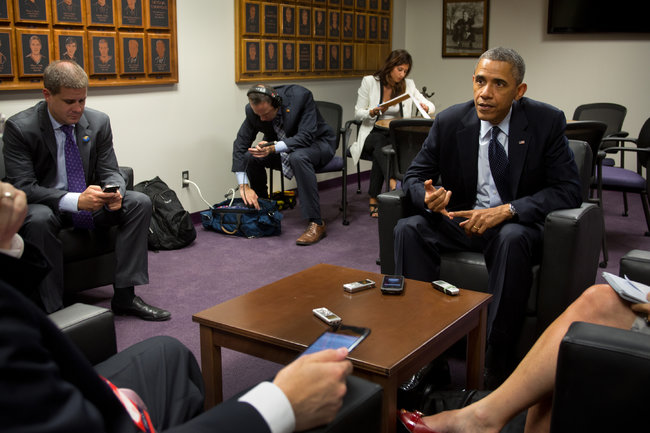
excerpts from transcript of a (rare, print) interview with President Obama conducted by Jackie Calmes and Michael D. Shear of The New York Times. The interview was conducted at Knox College in Galesburg, Ill., on July 24, 2013 . . .
PRESIDENT: . . . I think if I’m arguing for entirely different policies and Congress ends up pursuing policies that I think don’t make sense and we get a bad result, it’s hard to argue that’d be my legacy. And so I’ll worry about my legacy later or I’ll let historians worry about my legacy.
I do worry about what’s happening to ordinary families and all across the country. When we know that rebuilding our infrastructure right now would put people back to work and it’s never been cheaper for us to do so, and this is all deferred maintenance that we’re going to have to do at some point anyway, I worry that we’re not moving faster to seize the moment. When we know that families are getting killed by college costs, for us not to take bold action -- which means that young people are graduating with massive debt, they can’t buy a home as soon as they want, they can’t start that business that they’ve got a great idea for -- that worries me.
. . . what I want to make sure everybody in Washington is obsessed with is how are we growing the economy, how are we increasing middle-class incomes and middle-class wages, and increasing middle-class security. And if we’re not talking about that, then we’re talking about the wrong thing.
. . . obviously, what Congress does matters. As I said in the speech, the economy is far stronger now than it was four and a half years ago. Most economists believe that growth will actually pick up next quarter and the second half of the year. And the one thing that could really screw things up would be if you have a manufactured crisis and Republicans choose to play brinksmanship all over again.
. . . one of the challenges, as I said in the speech, is that there’s almost a kneejerk habit right now that if I’m for it, then they’ve got to be against it. And I think there are a lot of Republicans who are frustrated by that, because they want to be for something, not just against something. But they’ve got to work through that pattern that’s developed over the last couple of years . . .
Now I'm going to do something which might surprise those who see this post as some fawning defense of this President. I'm going to agree with what I think is his point about this President's frequent insistence that there's something worthwhile about republicans that can be negotiated with or compromised with. I don't think most of the talk was anything more than a political head-fake which was more directed at the public perception of his office, than it involved any substantial or unnecessary.
Compromise is the natural function of our democratic system of government which is challenged to reconcile the myriad of interests and concerns from a diverse group of national legislators from many different regions of the country. I do believe there is value in taking an aggressive stand for what you believe in, but I'm not always convinced that just arguing is always the best course.
I believe President Obama has been slow to recognize the importance of taking a firm and principled stand against what is just opposition for opposition's sake. He's waking up to it now, perhaps too late - maybe, to be fair to him, he just thought the stakes were too high to just argue and accomplish nothing in the wake of all of the obstinacy. Yes, he has taken some, but Frank is correct if he's arguing that they've not been a hallmark of a presidency which began with many, many pledges from Barack Obama to 'work with' and 'reach out to republicans.'
We need to END republicanism, not partner with it's practitioners.
Democratic principles need to dominate the political arena, not sidle up beside republicans looking for some reciprocal grope.
Republicanism is not just an opposition party, it is a dangerous and destructive philosophy. Put into practice, it is naked corporatism, unquenchable militarism, unashamed discrimination, and anti-democratic tyranny. This republican class who is in power right now is the worst in my lifetime; nothing but a front for their corporate masters.
They are putting our nation at risk and threatening the health of the earth itself. This shouldn't be just a battle to just sit a couple of rungs above them. They need to be disenfranchised from successfully promoting and furthering their agenda.
"Reaching out" to them will be opportunistically characterized by these thugs as acceptance and acquiescence; ultimately rejected by them as not good enough or not far enough. They need to be taken down, and their supporters need to understand we're not willing to subject the nation, any more, to the consequences of the republican party's elaborate con job masquerading as policy.
We shouldn't pretend that there aren't specific issues which form a dividing line. Most of these, on the Democratic side, are long standing efforts to provide basic needs and to uphold or establish basic rights which the republicans obstruct with whatever position or strategy suits the moment, often completely running over their previous philosophy, like their former objections to 'nation-building', or conservatives' former support of privacy rights.
What the President seemed to be unaware of in making these expressions of comity, is that many of the compromises he's seeking may well make sense in the political arena - like clearing some untidy backlog of unfinished business. Yet, most of those compromises threaten divide many in the country from the Democratic party which has pledged, and fought to support and defend these opportunistically-discarded initiatives in the past. That 'partisanship' is a NECESSARY response to republican obstructionism.
These days, our party doesn't have a progressive agenda; it has a timid and defensive one in the face of an extreme republican opposition, and I reject any implication that our Democratic politics has EVER been unnecessarily confrontational. These 'lifelong republicans' need to be aggressively challenged and discredited when they try and push their obstructionist, industry enabling agenda, not mollycoddled.
Edit history
Recommendations
0 members have recommended this reply (displayed in chronological order): = new reply since forum marked as read
Highlight:
NoneDon't highlight anything
5 newestHighlight 5 most recent replies
RecommendedHighlight replies with 5 or more recommendations
= new reply since forum marked as read
Highlight:
NoneDon't highlight anything
5 newestHighlight 5 most recent replies
RecommendedHighlight replies with 5 or more recommendations