EPI: The wedges between productivity and median compensation growth [View all]
The wedges between productivity and median compensation growth
By Lawrence Mishel
Income inequality has grown over the last 30 years or more driven by three dynamics: rising inequality of labor income (wages and compensation), rising inequality of capital income, and an increasing share of income going to capital income rather than labor income. As a consequence, examining market-based incomes one finds that “the top 1 percent of households have secured a very large share of all of the gains in income—59.9 percent of the gains from 1979–2007, while the top 0.1 percent seized an even more disproportionate share: 36 percent. In comparison, only 8.6 percent of income gains have gone to the bottom 90 percent” (Mishel and Bivens 2011).
A key to understanding this growth of income inequality—and the disappointing increases in workers’ wages and compensation and middle-class incomes—is understanding the divergence of pay and productivity. Productivity growth has risen substantially over the last few decades but the hourly compensation of the typical worker has seen much more modest growth, especially in the last 10 years or so. The gap between productivity and the compensation growth for the typical worker has been larger in the “lost decade” since the early 2000s than at any point in the post-World War II period. In contrast, productivity and the compensation of the typical worker grew in tandem over the early postwar period until the 1970s.
Productivity growth, which is the growth of the output of goods and services per hour worked, provides the basis for the growth of living standards. However, the experience of the vast majority of workers in recent decades has been that productivity growth actually provides only the
potential for rising living standards: Recent history, especially since 2000, has shown that wages and compensation for the typical worker and income growth for the typical family have lagged tremendously behind the nation’s fast productivity growth. This paper uses data from EPI’s upcoming
The State of Working America, 12th Edition (Mishel, Bivens, Gould, and Shierholz 2012) to document and explain these trends, particularly those of recent years.
<...>
Assessing the factors behind the productivity-median compensation gap
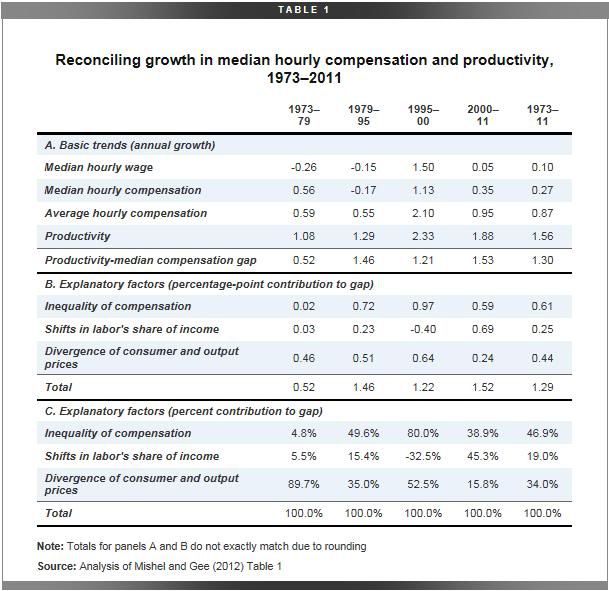
Table 1 depicts the basic trends and identifies the contribution of each factor in driving the productivity-median compensation gap in particular sub-periods and overall from 1973 to 2011. The particular sub-periods chosen are business cycle peaks—years of low unemployment— with some exceptions. The two business cycles, 1979–89 and 1989–2000, are divided into the periods 1979–95 and 1995–2000 to separate the period of low productivity growth from the period starting in 1995 when productivity growth accelerated (and unemployment fell to low levels). The last period, 2000–11, extends from the end of the 1990s recovery to the most recent year of data.
- more -
http://www.epi.org/publication/ib330-productivity-vs-compensation/

 = new reply since forum marked as read