The Gospel of Consumption And the better future we left behind [View all]
In a 1927 interview with the magazine Nation’s Business, Secretary of Labor James J. Davis...noted that “the textile mills of this country can produce all the cloth needed in six months’ operation each year” and that 14 percent of the American shoe factories could produce a year’s supply of footwear. The magazine went on to suggest, “It may be that the world’s needs ultimately will be produced by three days’ work a week.”
Business leaders were less than enthusiastic about the prospect of a society no longer centered on the production of goods. For them, the new “labor-saving” machinery presented not a vision of liberation but a threat to their position at the center of power.... The emphasis should be put on work—more work and better work.” “Nothing,” he claimed, “breeds radicalism more than unhappiness unless it is leisure...”
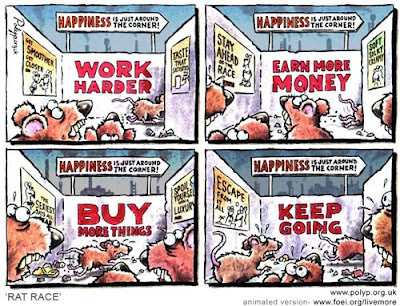
In other words, the machinery offers us an opportunity to work less, an opportunity that as a society we have chosen not to take. Instead, we have allowed the owners of those machines to define their purpose: not reduction of labor, but “higher productivity”—and with it the imperative to consume virtually everything that the machinery can possibly produce...
By 1991 the amount of goods and services produced for each hour of labor was double what it had been in 1948. By 2006 that figure had risen another 30 percent. In other words, if as a society we made a collective decision to get by on the amount we produced and consumed seventeen years ago, we could cut back from the standard forty-hour week to 5.3 hours per day—or 2.7 hours if we were willing to return to the 1948 level...Rather than realizing the enriched social life that Kellogg’s vision offered us, we have impoverished our human communities with a form of materialism that leaves us in relative isolation from family, friends, and neighbors....
http://www.orionmagazine.org/index.php/articles/article/2962/
 = new reply since forum marked as read