Welcome to DU!
The truly grassroots left-of-center political community where regular people, not algorithms, drive the discussions and set the standards.
Join the community:
Create a free account
Support DU (and get rid of ads!):
Become a Star Member
Latest Breaking News
Editorials & Other Articles
General Discussion
The DU Lounge
All Forums
Issue Forums
Culture Forums
Alliance Forums
Region Forums
Support Forums
Help & Search
General Discussion
In reply to the discussion: The War Machine - I Just Asked Erik Prince To Stop Bribing Politicians (David Swanson) [View all]
Octafish
(55,745 posts)13. Congratulations, johnnyreb. University of Virginia is a global cultural treasure.
"Adversity doesn't build character, it reveals it." -- Anonymous.
So. Talking about pressure:
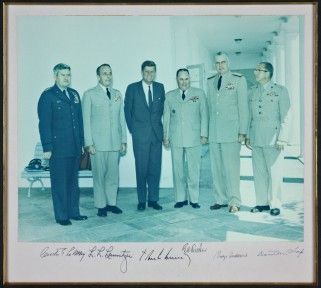
'Go in there and frig around with the missiles, you're screwed'
The moment general mocked JFK behind his back at the height of Cuban Missile Crisis caught on tape
By DANIEL BATES
The Mail
24 September 2012
It was the height of the Cuban Missile Crisis and the nation was supposed to be pulling together.
But John F Kennedy’s top generals were actually bad-mouthing him behind his back - whilst standing in the White House.
When the former US President left the room Marine Corps Commandant General David Shoup said that Mr Kennedy was doing things ‘piecemeal’ and needed a talking to.
SNIP...
But the tapes reveal that after Mr Kennedy and Defence Secretary Robert McNamara went out the room, General Shoup launched into his own tirade - without realising the tape was still running.
CONTINUED...
http://www.dailymail.co.uk/news/article-2207946/Revealed-JFKs-stabbing-generals-mocked-President-battled-avoid-regarded-trigger-happy-Americans-lost-Berlin.html
It's almost odd that this wasn't mentioned in my hometown newspaper. The elite must want us to forget something important. Let's ask an expert...
As Noam Chomsky reported, Shoup was alone among the Joint Chiefs to oppose escalation in Vietnam. However, in this case, the White House taping system caught the Marine Commandant in an act of insubordination -- denigrating the Commander in Chief before his fellow Joint Chiefs of Staff. The mis-translation of what was said in the meeting had been the "gold standard" among historians since the publication of tape transcripts created by Ernest R. May and Philip D. Zelikow, "academic" friends of the right.
What JFK Really Said
The author checked the Cuban-missile-crisis transcript in The Kennedy Tapes against the recorded words. He discovered "errors that undermine its reliability for historians, teachers, and general readers
by Sheldon M. Stern
The Atlantic
EXCERPT...
An unforgettable moment in these unique historical records concerns JFK's apprehension that military action in Cuba might touch off the ultimate nightmare of nuclear war, which he grimly describes at a meeting on October 18 as "the final failure." Brian McGrory, of The Boston Globe, who listened to this tape with me in 1994, after it was declassified, used those words in the lead of his article on the newly released tapes. But when I checked the transcript recently, I was unable to find "the final failure." Certain that the editors must be right, since they had technically cleaner tapes, I listened again; there is no question that Kennedy says "the final failure." The editors, however, have transcribed it as "the prime failure."
SNIP...
The participants then discuss evidence that work on the missile sites is continuing. They debate whether to add petroleum, oil, and lubricants (POL) to the list of quarantined materials immediately, or to wait twenty-four hours to see if talks proposed by UN Secretary-General U Thant produce a breakthrough. McGeorge Bundy, Kennedy's national security adviser, suggests that they "leave the timing until we've talked about the U Thant initiative." The inaccuracy in The Kennedy Tapes is especially bizarre in this case, with Bundy saying "leave the timing until we've talked about the attack thing." These last two examples—"the destroyers " and "the attack thing"—could easily leave a reader wondering what in the world these men were talking about. (Three days later, on October 29, U Thant was mentioned again. JFK asserts, "We want U Thant to know that Adlai is our voice." But The Kennedy Tapes transcribes this line as "We want you to know that Adlai is our voice."

October 27 saw the darkest moment in the crisis. An unconfirmed report was received at midday that a U-2 spy plane had been shot down over Cuba by a Soviet SAM missile, and the pilot killed. On the tape of the late-afternoon meeting Kennedy discusses whether to order an air strike on the SAM sites if the incident is repeated (a delay that produced consternation at the Pentagon). He declares that two options are on the table: begin conversations about Khrushchev's proposal to swap Soviet missiles in Cuba for U.S. missiles in Turkey, or reject discussions until the Cuban crisis is settled. Kennedy chooses the first, with the caveat that the Soviets must provide proof that they have ceased work on the missile sites. He repeatedly refers to "conversations" and "discussions" and concludes, "Obviously, they're not going to settle the Cuban question until they get some conversation on Cuba." Incredibly, The Kennedy Tapes substitutes "compensation" for "conversation." It's easy to imagine how Cold War veterans like Rusk, Bundy, and McCone would have reacted to any suggestion of compensation for the Soviets in Cuba.
On October 29, the day after Khrushchev agreed to remove the missiles, the President and his advisers, relieved but not euphoric, conclude that surveillance and the quarantine will continue until the missiles have actually been removed. After a lull in the meeting, during which the conversation turns to college football, the President observes, "I imagine the Air Force must be a little mad," referring to the division of responsibility for aerial photography between the Air Force and the Joint Chiefs' photo-reconnaissance office. The Kennedy Tapes transcribes this as "I imagine the airports must be looking bad," which must leave many readers scratching their heads: the removal of the missiles had nothing to do with Cuban airports. Kennedy then ponders why, in the end, the Soviets decided to back down. He notes, "We had decided Saturday night to begin this air strike on Tuesday." No effort was made to conceal the military buildup in southern Florida, and Kennedy wonders if the impending strikes pushed the Russians to withdraw their missiles. The Kennedy Tapes, however, has JFK saying "We got the signs of life to begin this air strike on Tuesday," making his shrewd speculation unintelligible.
ONE particular error, among scores not cited above, seems to epitomize the problems with these transcripts. On the October 18 tape Dean Rusk argues that before taking military action in Cuba, the United States should consult Khrushchev, in the unlikely event that he would agree to remove the missiles. "But at least it will take that point out of the way," The Kennedy Tapes has Rusk saying, "and it's on the record." But Rusk actually said that this consultation would remove that point "for the historical record." The historical record is indeed the issue here.
CONTINUED...
http://www.theatlantic.com/past/docs/issues/2000/05/stern.htm
The "prime failure" is much different than "final failure." Presidents -- especially the Hawks since then -- have all made clear to the Soviets, Russians, terrorists, rogue states that nuclear war was winnable and survivable. Unfortunately, "survivable" could be defined as zero enemy and one American. As long as they're on the inside of Mt. Thunder when the spaghetti hits the fan, they're OK with those figures.
Now this guy Larry J. Sabato from your old school surprised a lot of folks by stating what he thought -- not what he could prove, but what he thought, regarding Dallas in his keynote address at the Duquesne conference in 2013: "Why the Study of the JFK Assassination Continues...and Should." Then he dropped this bombshell in US News & World Report:
Was JFK's Assassination a Conspiracy?
EXCERPT...
As the American Enterprise Institute's Karlyn Bowman and Andrew Rugg wrote in U.S. News earlier this month, the notion of a cabal to kill Kennedy is the most widely-believed conspiracy theory in America. An April 2013 poll showed that nearly 60 percent of Americans believe others were involved in the assassination. A recent Gallup poll showed the same thing, with 61 percent of Americans believing there was a conspiracy; the Mafia and the “federal government” are the most popular culprits. Even Secretary of State John Kerry has said that “to this day I have serious doubts that Lee Harvey Oswald acted alone.”
SNIP...
The Arguments
-----------
YES — A complacent media let someone get away with murder
JOHN KELIN, Author
-----------
YES — Physical evidence shows JFK was hit with multiple bullets from multiple directions
MICHAEL VOLLBACH, RONALD BURDA, Professors of Behavioral and Social Sciences at Oakland Community College Comment
-----------
YES — None of the available theories prove just one man killed JFK
JEFFERSON MORLEY, Moderator of JFK Facts
-----------
YES — Bungled investigations into JFK's death may keep the truth under wraps forever
LARRY SABATO, Director of the University of Virginia Center for Politics
-----------
NO — After 50 years, any concrete evidence of a JFK conspiracy would have been found
JOHN MCADAMS, Professor of Political Science at Marquette University
SOURCE: http://www.usnews.com/debate-club/was-jfks-assassination-a-conspiracy?int=1fe97e
Thank you for sharing about UVA. I always thought you were a gentleman -- should have seen you are a Cavalier.
Edit history
Please sign in to view edit histories.
Recommendations
0 members have recommended this reply (displayed in chronological order):
16 replies
 = new reply since forum marked as read
Highlight:
NoneDon't highlight anything
5 newestHighlight 5 most recent replies
RecommendedHighlight replies with 5 or more recommendations
= new reply since forum marked as read
Highlight:
NoneDon't highlight anything
5 newestHighlight 5 most recent replies
RecommendedHighlight replies with 5 or more recommendations
= new reply since forum marked as read
Highlight:
NoneDon't highlight anything
5 newestHighlight 5 most recent replies
RecommendedHighlight replies with 5 or more recommendations
The War Machine - I Just Asked Erik Prince To Stop Bribing Politicians (David Swanson) [View all]
Octafish
Apr 2015
OP
Like 'Twilight Zone' where the car's broke, monsters are coming, and the sheriff is an alien.
Octafish
Apr 2015
#6
The time will come when being on the side of the Henry Wallace's of the world will be
Dont call me Shirley
Apr 2015
#12
Congratulations, johnnyreb. University of Virginia is a global cultural treasure.
Octafish
Apr 2015
#13