I was unaware it was requested to automatically provide back up data for any assertion.
I made some assertions which I believe are correct based on my general knowledge.
Below some back up data as requested:
1- "the TPP does create an enticement for China to lurk out of its nationalistic wood."
This would request a compilation of data far too great. I am simply making the relatively intuitive satement that large trade blocs have traditionally enticed independent nations around to trade with them. That holds ture of the large historical free trade zones I mentioned earlier: Roman Empire, Caliphate, Imperial China. I did not make the clai it repelled third parties intent on waging war. If China wants to attack the US, the TPP won't be a deterrent.
2- undervaluation of China's military. Articles all over the place. One here:
Various government and independent calculations for the PLA's expenditures for 2003 - the most recent year for which a significant number of institutions published estimates - ranged from $30.6 billion to $141 billion based on official exchange rates or purchasing power parity (PPP) models. China's declared military budget in 2003 was $22.3 billion at official exchange rates. In 2003 IISS estimated Chinese PPP-based military spending at about $85 billion, while SIPRI's PPP estimate was $140 billion. In 2003 the official budget was RMB 185.3 billion, which was $22.4 billion at current exchange rates. In 2010 IISS estimated Chinese PPP-based military spending at about $114 billion, or 1.88% of GDP. By 2010 the official budget had increased to RMB 532.1 billion, or $77.9 billion at official exchange rates. In Military and Security Developments Involving the People's Republic of China 2010 the US Defense Department estimated that actual Chinese military spending was double this about, over $150 billion on an official exchange rate (OER) basis.
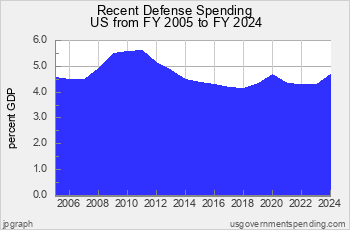
3- impact of the insane Iraq invasion on bringing US military budgets upwards:
 = new reply since forum marked as read