General Discussion
In reply to the discussion: Where Does America Fit In The World? [View all]
KoKo
(84,711 posts)Ian Bremmer
From Wikipedia, the free encyclopedia
Ian Bremmer

Ian Bremmer
Born November 12, 1969 (age 45)
United States
Occupation Political scientist, author, entrepreneur
Education BA, Tulane University
MA, PhD, Stanford University
Website
ianbremmer.com
Ian Bremmer (born November 12, 1969) is an American political scientist specializing in U.S. foreign policy, states in transition, and global political risk. He is the president and founder of Eurasia Group, a political risk research and consulting firm. As of December 2014, he is foreign affairs columnist and editor-at-large at TIME.[1] In 2013, he was named Global Research Professor at New York University.[2] Eurasia Group provides analysis and expertise about how political developments and national security dynamics move markets and shape investment environments across the globe.
Contents
Life and career
Bremmer is most widely known for advances in political risk; referred to as the "guru" in the field by the Economist[3] and The Wall Street Journal[4] and, more directly, bringing political science as a discipline to the financial markets.[5] In 2001, Bremmer created Wall Street's first global political risk index, now the GPRI (Global Political Risk Index). Bremmer's definition of an emerging market as "a country where politics matters at least as much as economics to the market"[6] is a standard reference in the political risk field.
Bremmer has published nine books, including the national bestsellers Every Nation for Itself: Winners and Losers in a G-Zero World (Portfolio, May 2012), which details risks and opportunities in a world without global leadership, and The End of the Free Market: Who Wins the War Between States and Corporations (Portfolio, May 2010), which describes the global phenomenon of state capitalism and its implications for economics and politics. He also wrote The J Curve: A New Way to Understand Why Nations Rise and Fall (Simon & Schuster, 2006), selected by The Economist as one of the best books of 2006.[7] He recently came out with Superpower: Three Choices for America's Role in the World (Portfolio, May 2015), which calls for a complete rethink of America’s role in the world, following on its incoherent and prohibitively expensive foreign policy strategy since the end of the Cold War.
Bremmer is a frequent writer and commentator in the media. He is the foreign affairs columnist and editor-at-large for TIME Magazine, a contributor for the Financial Times A-List,[8] and has also published articles in the Washington Post, the New York Times, The Wall Street Journal, Harvard Business Review, Foreign Affairs and many other publications. He appears regularly on CNBC, CNN, Fox News Channel, Bloomberg Television, National Public Radio, the BBC, and other networks.
Among his professional appointments, Bremmer serves on the Presidents Council of the Near East Foundation, the Leadership Council for the Concordia Summit, and the Board of Trustees of Intelligence Squared. In 2007, he was named as a 'Young Global Leader' of the World Economic Forum, and in 2010 founded and was appointed Chair of the Forum's Global Agenda Council for Geopolitical Risk.
Bremmer received his B.A. at Tulane University, and his M.A. and Ph.D. in political science from Stanford University in 1994. He then served on the faculty of the Hoover Institution where, at 25, he became the Institution's youngest ever National Fellow. He has held research and faculty positions at New York University (where he presently teaches), Columbia University, the EastWest Institute, the World Policy Institute, Lawrence Livermore National Laboratory, and the Asia Society Policy Institute, where he has served as First Harold J. Newman Distinguished Fellow in Geopolitics since 2015.
Bremmer is of Armenian and German descent.[9]
Key concepts
The J-Curve
Main article: The J Curve: A New Way to Understand Why Nations Rise and Fall
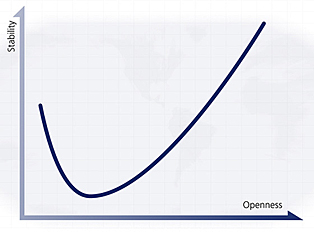
Bremmer's J curve[10] outlines the link between a country's openness and its stability. While many countries are stable because they are open (the United States, France, Japan), others are stable because they are closed (North Korea, Cuba, Iraq under Saddam Hussein). States can travel both forward (right) and backwards (left) along this J curve, so stability and openness are never secure. The J is steeper on the left hand side, as it is easier for a leader in a failed state to create stability by closing the country than to build a civil society and establish accountable institutions; the curve is higher on the far right than left because states that prevail in opening their societies (Eastern Europe, for example) ultimately become more stable than authoritarian regimes.
State capitalism
Ian Bremmer describes state capitalism as a system in which the state dominates markets primarily for political gain. In his book, The End of the Free Market: Who Wins the War Between States and Corporations (New York: Portfolio, 2010), Bremmer describes China as the primary driver for the rise of state capitalism as a challenge to the free market economies of the developed world, particularly in the aftermath of the financial crisis.[11]
More at:
https://en.wikipedia.org/wiki/Ian_Bremmer
Edit history
Recommendations
0 members have recommended this reply (displayed in chronological order): = new reply since forum marked as read
Highlight:
NoneDon't highlight anything
5 newestHighlight 5 most recent replies
RecommendedHighlight replies with 5 or more recommendations
= new reply since forum marked as read
Highlight:
NoneDon't highlight anything
5 newestHighlight 5 most recent replies
RecommendedHighlight replies with 5 or more recommendations