General Discussion
In reply to the discussion: Doesn't Matter How Bad Walker Or Brownback Are They Would Be Elected Again. [View all]
HereSince1628
(36,063 posts)Why this is, is as you say, not a simple problem, but it most assuredly has elements that demonstrate patterns that involve race. Race per se as an explanatory factor is questionable but it does appear to be a highly correlated confounder to yet named effector that moves the pattern.
Wisconsin, like many states, has a population that isn't distributed uniformly, most of the people live in urban areas, and most of them in Milwaukee:
https://s.yimg.com/fz/api/res/1.2/CwErGhC1ki8670x12pux1g--/YXBwaWQ9c3JjaGRkO2g9NjAwO3E9OTU7dz02MDA-/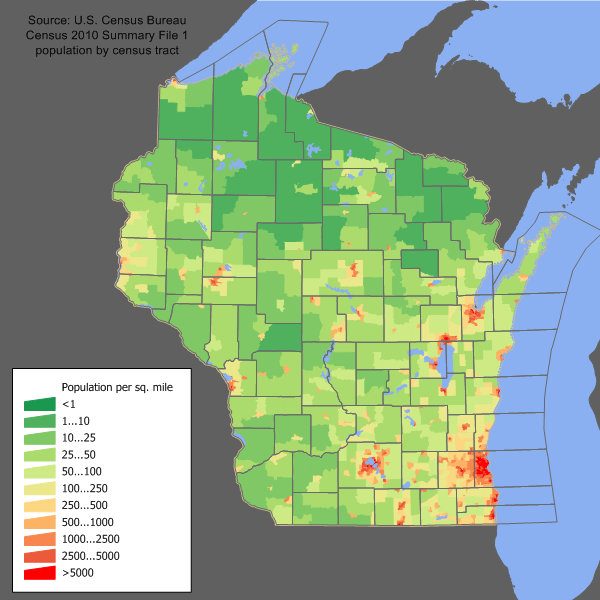
This distribution creates something of a everyone else vs Milwaukee political arena, although it isn't always just Republican against Milwaukee (nw WI, wsw WI, and Janesville-Madison area have democratic strength but except for Madison low population/little power).
Because the distribution of African Americans largely follows the urban vs everyone else pattern, it's easily mixed into attempts to explain WI politics. There is no doubt racism is a strong undercurrent in Milw. The impact of discrimination against blacks is still an important factor in explaining almost every social and economic issue in the city and the county.
The national democratic party struggles against its image as an urban party, but by the numbers it turns out that most WI dem voters are urban and significantly African American (the largest exception to this is the Green Bay-Appleton-Oskosh corridor, which while basically urban has low African American population and identifies with much of the northland as anti-Milwaukee and is republican)
Urban democrats in WI (as shown above, largely blacks) tend to have a significantly lower turnout in off-year and special elections than in national elections. Why is that? Possibly because significance of such elections is viewed as less important. Perhaps because local and state politics have had a history of making less difference to the lives of these voters than have national politics.
Perhaps because polling equipment is unequally distributed to make voting time consuming, perhaps because part-time workers can't risk their jobs by committing time to vote. It is a plaguing but unresolved question.
Whatever underlies the problem, its a dynamic that involves black voters in WI. The off-year turnout penalty realized by WI dems is at the heart of the ~5%-~8% swing in Democratic strength between gubernatorial elections (off year, and one special elections) and national elections in WI. It largely accounts for how this purple state routinely goes for Democratic presidential candidates, but goes for Scott Walker
Edit history
Recommendations
0 members have recommended this reply (displayed in chronological order): = new reply since forum marked as read
Highlight:
NoneDon't highlight anything
5 newestHighlight 5 most recent replies
RecommendedHighlight replies with 5 or more recommendations
= new reply since forum marked as read
Highlight:
NoneDon't highlight anything
5 newestHighlight 5 most recent replies
RecommendedHighlight replies with 5 or more recommendations