Welcome to DU!
The truly grassroots left-of-center political community where regular people, not algorithms, drive the discussions and set the standards.
Join the community:
Create a free account
Support DU (and get rid of ads!):
Become a Star Member
Latest Breaking News
Editorials & Other Articles
General Discussion
The DU Lounge
All Forums
Issue Forums
Culture Forums
Alliance Forums
Region Forums
Support Forums
Help & Search
General Discussion
In reply to the discussion: Canada Claims It Will Back Out of TPP to Protect Its Sovereignty [View all]
Octafish
(55,745 posts)30. Before Greece, the neo-Libs outta Chicago liberated Chile...
The following you know, Rex, but it is important to remind gentle reader of DU that these people are dead serious gangsters, before Greece there was Chile:
"The Chicago Boys in Chile: Economic Freedom's Awful Toll"
Orlando Letelier
August 28, 1976
It would seem to be a common-sensical sort of observation that economic policies are conditioned by and at the same time modify the social and political situation where they are put into practice. Economic policies, therefore, are introduced in order to alter social structures.
If I dwell on these considerations, therefore, it is because the necessary connection between economic policy and its sociopolitical setting appears to be absent from many analyses of the current situation in Chile. To put it briefly, the violation of human rights, the system of institutionalized brutality, the drastic control and suppression of every form of meaningful dissent is discussed (and often condemned) as a phenomenon only indirectly linked, or indeed entirely unrelated, to the classical unrestrained free market policies that have been enforced by the military junta. This failure to connect has been particularly characteristic of private and public financial institutions, which have publicly praised and supported the economic policies adopted by the Pinochet government, while regretting the bad international image the junta has gained from its incomprehensible persistence in torturing, jailing and persecuting all its critics. A recent World Bank decision to grant a $33 million loan to the junta was justified by its President, Robert McNamara, as based on purely technical criteria, implying no particular relationship to the present political and social conditions in the country. The same line of justification has been followed by American private banks which, in the words of a spokesman for a business consulting firm, have been falling all over one another to make loans. (See Ann Crittenden: 'Loans from Abroad Flow to Chile's Rightist Junta', (The New York Times, February 20.) But probably no one has expressed this attitude better than the US Secretary of the Treasury. After a visit to Chile, during which he discussed human rights violations by the military government, William Simon congratulated Pinochet for bringing economic freedom to the Chilean people (The Times, May 17). This particularly convenient concept of a social system in which economic freedom and political terror coexist without touching each other, allows these financial spokesmen to support their concept of freedom while exercising their verbal muscles in defense of human rights.
The usefulness of the distinction has been particularly appreciated by those who have generated the economic policies now being carried out in Chile. In Newsweek of June 14, Milton Friedman, who is the intellectual architect and unofficial adviser for the team of economists now running the Chilean economy, stated: In spite of my profound disagreement with the authoritarian political system of Chile, I do not consider it as evil for an economist to render technical economic advice to the Chilean Government, any more than I would regard it as evil for a physician to give technical medical advice to the Chilean Government to help end a medical plague.
It is curious that the man who wrote a book, Capitalism and Freedom, to drive home the argument that only classical economic liberalism can support political democracy can now so easily disentangle economics from politics when the economic theories he advocates coincide with an absolute restriction of every type of democratic freedom. One would logically expect that if those who curtail private enterprise are held responsible for the effects of their measures in the political sphere, those who impose unrestrained economic freedom would also be held responsible when the imposition of this policy is inevitably accompanied by massive repression, hunger, unemployment and the permanence of a brutal police state.
SNIP...
An International Monetary Fund Report of May 1976 points out: The process of returning to the private sector the vast majority of the enterprises which over the previous fifteen years, but especially in 1971-73, had become part of the public sector continued (during 1975) ... At the end of 1973 the Public Development Corporation (CORFO) had a total of 492 enterprises, including eighteen commercial banks ... Of this total, 253 enterprises ... have been returned to their former owners. Among the other 239 enterprises ... 104 (among them ten banks) have been sold; sixteen (including two banks) have already been adjudicated, with the completion of the transfer procedure being a matter of weeks; the sale of another twenty-one is being negotiated bilaterally with groups of potential buyers... Competitive bidding is still to be solicited for the remaining enterprises. Obviously the buyers are always a small number of powerful economic interests who have been adding these enterprises to the monopolistic or oligopolistic structures within which they operate. At the same time, a considerable number of industries have been sold to transnational corporations, among them the national tire industry (INSA), bought by Firestone for an undisclosed sum, and one of the main paper pulp industries (Celulosa Forestal Arauco), bought by Parsons & Whittemore.
SNIP...
Although the economic policies have more mercilessly affected the working classes, the general debacle has significantly touched the middle class as well. At the same time, medium-size national enterprises have had their expectations destroyed by the reduction in demand, and have been engulfed and destroyed by the monopolies against which they were supposed to compete. Because of the collapse of the automobile industry, hundreds of machine shops and small industries which acted as subcontractors have faced bankruptcy. Three major textile firms (FIAD, Tomé Oveja and Bellavista) are working three days a week; several shoe companies, among them Calzados Bata, have had to close. Ferriloza, one of the main producers of consumer durables, recently declared itself bankrupt. Facing this situation, Raul Sahli, the new president of the Chilean Industrialists' Association and himself linked to big monopolies, declared earlier in the year: The social market economy should be applied in all its breadth. If there are industrialists who complain because of this, let them go to hell. I won't defend them. He is so quoted by André Gunder Frank in a Second Open Letter to Milton Friedman and Arnold Harberger, April 1976.
The nature of the economic prescription and its results can be most vividly stated by citing the pattern of domestic income distribution. In 1972, the Popular Unity Government employees and workers received 62.9% of the total national income; 37.1% went to the propertied sector. By 1974 the share of the wage earners had been reduced to 38.2%, while the participation of property had increased to 61.8%. During 1975, 16 average real wages are estimated to have declined by almost 8%, according to the International Monetary Fund. lt is probable that these regressive trends in income distribution have continued during 1976. What it means is that during the last three years several billions of dollars were taken from the pockets of wage earners and placed in those of capitalists and landowners. These are the economic results of the application in Chile of the prescription proposed by Friedman and his group.
CONTINUED...
http://www.historyisaweapon.com/defcon1/letelierchicagoboys.html
Less than a month after this is published, Orlando Letelier is assassinated on the orders of the Chilean secret police.
Yeah, see? All your stuff belongs to us, see? Yeah!
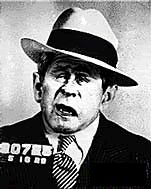
FWIW: Poppy Bush knew all about Operation Condor and didn't stop them killing Orlando Letelier and Ronni Moffit. He even told Ed Koch, "Sorry if you get killed. Nothing we can do."
Edit history
Please sign in to view edit histories.
Recommendations
0 members have recommended this reply (displayed in chronological order):
35 replies
 = new reply since forum marked as read
Highlight:
NoneDon't highlight anything
5 newestHighlight 5 most recent replies
RecommendedHighlight replies with 5 or more recommendations
= new reply since forum marked as read
Highlight:
NoneDon't highlight anything
5 newestHighlight 5 most recent replies
RecommendedHighlight replies with 5 or more recommendations
= new reply since forum marked as read
Highlight:
NoneDon't highlight anything
5 newestHighlight 5 most recent replies
RecommendedHighlight replies with 5 or more recommendations
Yeah, Canada does not want to have to label its poultry/meats as to country of origin.
Hoyt
Jul 2015
#1
So how do you and O'Malley rationalize legitimizing Brunei and their human rights abuses?
Bluenorthwest
Jul 2015
#11
So you would like to see NK be given most favored nation status? And you equate having a diplomatic
Bluenorthwest
Jul 2015
#18
You're a classic "neo-liberal". Your views are by-the-book. Quit feigning indignation
Romulox
Jul 2015
#19
You do realize that Brunei is establishing harsh laws in order to 'protect their people from the
Bluenorthwest
Jul 2015
#21
corporate whores in both countries are having a slight tiff, temporarily postponing the
msongs
Jul 2015
#7
JBS worries a lot about government "sovereignty" and nationalism. That is typical of the far-right.
pampango
Jul 2015
#33