When fire can eat a rainforest in a relatively cool climate, you know the Earth is beginning to burn [View all]
By Subhankar Banerjee, an internationally exhibited photographer and writer. His most recent book is Arctic Voices: Resistance at the Tipping Point. He won a 2012 Lannan Foundation Cultural Freedom Award and has been deeply involved with the native tribes of the Arctic in trying to prevent the destruction of Arctic lands and seas. Originally published at TomDispatch
The wettest rainforest in the continental United States had gone up in flames and the smoke was so thick, so blanketing, that you could see it miles away. Deep in Washington’s Olympic National Park, the aptly named Paradise Fire, undaunted by the dampness of it all, was eating the forest alive and destroying an ecological Eden. In this season of drought across the West, there have been far bigger blazes but none quite so symbolic or offering quite such grim news. It isn’t the size of the fire (though it is the largest in the park’s history), nor its intensity. It’s something else entirely — the fact that it shouldn’t have been burning at all. When fire can eat a rainforest in a relatively cool climate, you know the Earth is beginning to burn.
And here’s the thing: the Olympic Peninsula is my home. Its destruction is my personal nightmare and I couldn’t stay away.
Smoke Gets in My Eyes
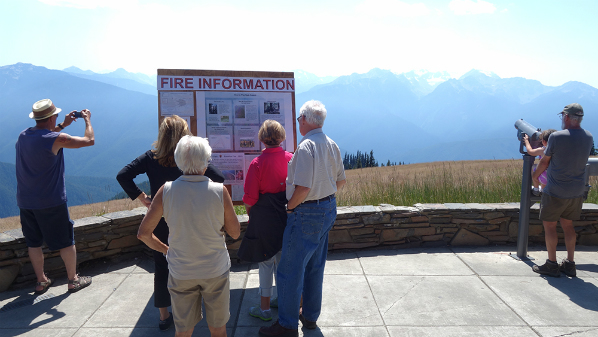
“What a bummer! Can’t even see Mount Olympus,” a disappointed tourist exclaimed from the Hurricane Ridge visitor center. Still pointing his camera at the hazy mountain-scape, he added that “on a sunny day like this” he would ordinarily have gotten a “clear shot of the range.” Indeed, on a good day, that vantage point guarantees you a postcard-perfect view of the Olympic Mountains and their glaciers, making Hurricane Ridge the most visited location in the park, with the Hoh rainforest coming in a close second. And a lot of people have taken photos there. With its more than three million annual visitors, the park barely trails its two more famous western cousins, Yosemite and Yellowstone, on the tourist circuit.
Days of rain had come the weekend before, soaking the rainforest without staunching the Paradise Fire. The wetness did, however, help create those massive clouds of smoke that wrecked the view miles away on that blazing hot Sunday, July 19th. Though no fire was visible from the visitor center — it was the old-growth rainforest of the Queets River Valley on the other side of Mount Olympus that was burning — massive plumes of smoke were rising from the Elwha River and Long Creek valleys.
[font size="1"]
Fire Information Bulletin Board and Smoke from Fire, Hurricane Ridge Visitor Center, Olympic National Park, July 19, 2015.[/font]
By then, I felt as if smoke had become my companion. I had first encountered it on another hot, sunny Sunday two weeks earlier. ................(more)
http://www.nakedcapitalism.com/2015/07/paradise-burning-why-we-all-need-to-learn-the-world-anthropogenic.html

 = new reply since forum marked as read