Welcome to DU!
The truly grassroots left-of-center political community where regular people, not algorithms, drive the discussions and set the standards.
Join the community:
Create a free account
Support DU (and get rid of ads!):
Become a Star Member
Latest Breaking News
Editorials & Other Articles
General Discussion
The DU Lounge
All Forums
Issue Forums
Culture Forums
Alliance Forums
Region Forums
Support Forums
Help & Search
General Discussion
In reply to the discussion: What the Astronaut saw. [View all]
Octafish
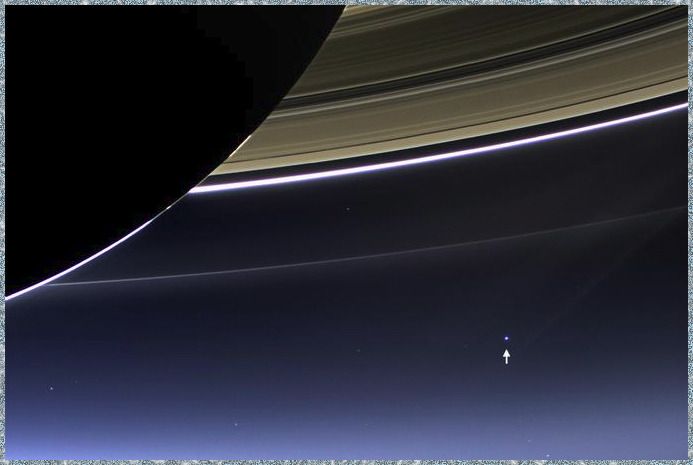
(55,745 posts)87. The Day the Earth Smiled
Earth as seen from beyond Saturn by the Cassini spacecraft.
PS: You are most welcome, allan01. Thank you for sharing you and your mom's experiences. I grew up in the 60s -- the luckiest kid on the planet, as my best friend's dad worked at Whirlpool -- St. Joseph/Benton Harbor, Michigan's big manufacturer of home appliances and maker of NASA space food. Bill's pop was in the PR department and brought home press releases and information that we used to start our "NASA scrapbooks."
As 9- and 11-year olds, we would write to the various NASA facilities around the country and they would ALWAYS respond -- with kind letters, accompanied by news releases, NASA Facts, pamphlets, mission summaries and all manner of information that we would consume and talk about until the next package arrived. We followed most of the Gemini missions together, starting with Gemini IV and Ed White's spacewalk. My mom would go out on the morning of a launch and buy reel-to-reel tapes so we could record Walter Cronkite and Jules Bergman's reportage.
We were devastated by the loss of a Gemini crew in a training accident and then the Apollo 1 fire. We learned at an early age about loss. We also learned never give up. It was our moms who helped us move forward. Thank you so much for helping me remember that time.
On July 19, 2013, in an event celebrated the world over, NASA's Cassini spacecraft slipped into Saturn's shadow and turned to image the planet, seven of its moons, its inner rings -- and, in the background, our home planet, Earth.
With the sun's powerful and potentially damaging rays eclipsed by Saturn itself, Cassini's onboard cameras were able to take advantage of this unique viewing geometry. They acquired a panoramic mosaic of the Saturn system that allows scientists to see details in the rings and throughout the system as they are backlit by the sun. This mosaic is special as it marks the third time our home planet was imaged from the outer solar system; the second time it was imaged by Cassini from Saturn's orbit; and the first time ever that inhabitants of Earth were made aware in advance that their photo would be taken from such a great distance.
With both Cassini's wide-angle and narrow-angle cameras aimed at Saturn, Cassini was able to capture 323 images in just over four hours. This final mosaic uses 141 of those wide-angle images. Images taken using the red, green and blue spectral filters of the wide-angle camera were combined and mosaicked together to create this natural-color view. A brightened version with contrast and color enhanced, a version with just the planets annotated, and an unannotated version are also available.
This image spans about 404,880 miles (651,591 kilometers) across.
CONTINUED...
http://saturn.jpl.nasa.gov/photos/imagedetails/index.cfm?imageId=4918
With the sun's powerful and potentially damaging rays eclipsed by Saturn itself, Cassini's onboard cameras were able to take advantage of this unique viewing geometry. They acquired a panoramic mosaic of the Saturn system that allows scientists to see details in the rings and throughout the system as they are backlit by the sun. This mosaic is special as it marks the third time our home planet was imaged from the outer solar system; the second time it was imaged by Cassini from Saturn's orbit; and the first time ever that inhabitants of Earth were made aware in advance that their photo would be taken from such a great distance.
With both Cassini's wide-angle and narrow-angle cameras aimed at Saturn, Cassini was able to capture 323 images in just over four hours. This final mosaic uses 141 of those wide-angle images. Images taken using the red, green and blue spectral filters of the wide-angle camera were combined and mosaicked together to create this natural-color view. A brightened version with contrast and color enhanced, a version with just the planets annotated, and an unannotated version are also available.
This image spans about 404,880 miles (651,591 kilometers) across.
CONTINUED...
http://saturn.jpl.nasa.gov/photos/imagedetails/index.cfm?imageId=4918
PS: You are most welcome, allan01. Thank you for sharing you and your mom's experiences. I grew up in the 60s -- the luckiest kid on the planet, as my best friend's dad worked at Whirlpool -- St. Joseph/Benton Harbor, Michigan's big manufacturer of home appliances and maker of NASA space food. Bill's pop was in the PR department and brought home press releases and information that we used to start our "NASA scrapbooks."
As 9- and 11-year olds, we would write to the various NASA facilities around the country and they would ALWAYS respond -- with kind letters, accompanied by news releases, NASA Facts, pamphlets, mission summaries and all manner of information that we would consume and talk about until the next package arrived. We followed most of the Gemini missions together, starting with Gemini IV and Ed White's spacewalk. My mom would go out on the morning of a launch and buy reel-to-reel tapes so we could record Walter Cronkite and Jules Bergman's reportage.
We were devastated by the loss of a Gemini crew in a training accident and then the Apollo 1 fire. We learned at an early age about loss. We also learned never give up. It was our moms who helped us move forward. Thank you so much for helping me remember that time.
Edit history
Please sign in to view edit histories.
Recommendations
0 members have recommended this reply (displayed in chronological order):
102 replies
 = new reply since forum marked as read
Highlight:
NoneDon't highlight anything
5 newestHighlight 5 most recent replies
RecommendedHighlight replies with 5 or more recommendations
= new reply since forum marked as read
Highlight:
NoneDon't highlight anything
5 newestHighlight 5 most recent replies
RecommendedHighlight replies with 5 or more recommendations
= new reply since forum marked as read
Highlight:
NoneDon't highlight anything
5 newestHighlight 5 most recent replies
RecommendedHighlight replies with 5 or more recommendations
I can't quite make out the border between France and Germany or the US and Canada
pampango
Nov 2015
#1
"commonality and interdependence. We are one world." Excellent. I like to think that liberals
pampango
Nov 2015
#15
Really? I learned in elementary school that France is green and Germany is pink
struggle4progress
Nov 2015
#23
"I see Earth. It is so beautiful!" — Yuri A. Gagarin, first words in space, 12 April 1961
Octafish
Nov 2015
#8
Thanks for the beautiful image which I have adopted as my PC desktop background.
John1956PA
Nov 2015
#4
Thanks for the link to the archived images from the early NASA space missions.
John1956PA
Nov 2015
#16
there's a lot of these orgs in SoCal--Manly P Hall decided to synthesize as many occult traditions
MisterP
Nov 2015
#13
''Science is not only compatible with spirituality; it is a profound source of spirituality...''
Octafish
Nov 2015
#100
''I was surrounded by stars...I also felt an incredible sense of responsibility.'' -- Alexei Leonov
Octafish
Nov 2015
#96
I wonder from up there if they could hear the drums of war. They are beating very loudly
sabrina 1
Nov 2015
#32
Carl Sagan in hifiguy's COSMOS video downthread: energy usage is a sign of intelligent life.
Octafish
Nov 2015
#99
I do not believe that Ben Carson could even wrap his head around this concept.
Tipperary
Nov 2015
#36
You know many "pilots" UFO claims have been debunked correct? Even your hero....
Logical
Nov 2015
#56
Still nothing to say about UFO related aircraft disappearances and crashes, Logical.
Octafish
Nov 2015
#69
One of my favorite scenes in the series "From The Earth To The Moon"....
Spitfire of ATJ
Nov 2015
#72
is it the book "earthrise" or another where some of the astronauts talk about a change in
niyad
Nov 2015
#84
I've had my disagreements with you on other issues, Octafish, but that was a great quote.
Tommy_Carcetti
Nov 2015
#94