General Discussion
In reply to the discussion: WE ARE STARDUST! [View all]
Octafish
(55,745 posts)We really are, elleng. Amazing place, our universe.
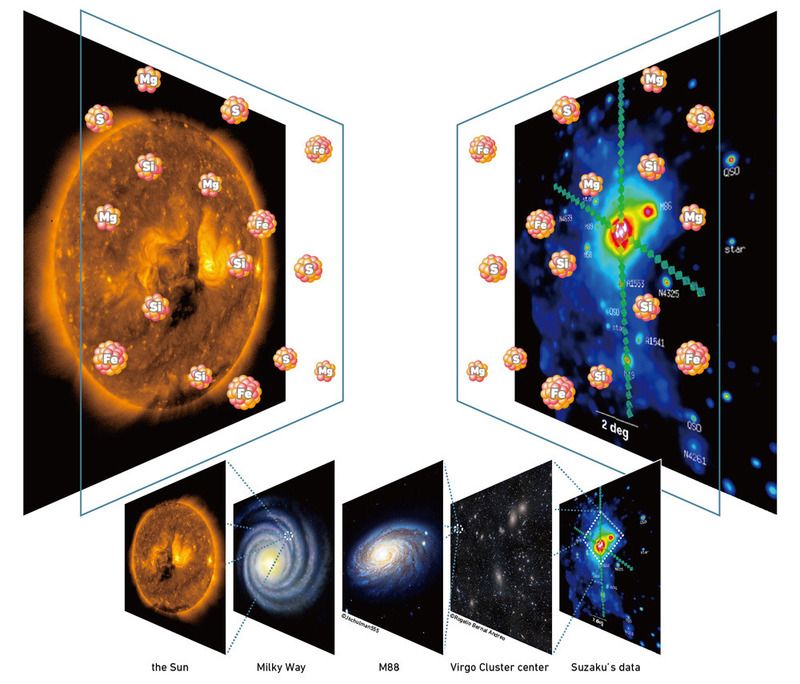
Our Solar System Mirrors the Chemical Makeup of the Universe
JAXA, Oct. 23, 2015
“The Suzaku satellite has opened a brand new window on the Universe and shown us that wherever you look, over vast scales, the mix of chemical elements is essentially the same" said Steven Allen, Professor of Physics at Stanford University and co-author of the study. "It's a beautifully simple result, and another step in understanding how the Universe around us came to be.”
All of the chemical elements that are heavier than carbon, the oxygen we breathe, the silicon that makes up the sand on the beach, were produced inside stars through nuclear fusion and released by stellar explosions called supernovae. By measuring the chemical composition of the Universe, scientists are trying to reconstruct the history of how, when, and where each of the chemical elements so necessary for the evolution of life were produced.
SNIP...
JAXA’s Suzaku X-ray satellite dedicated a great amount of observing time, collecting data over many weeks, to address this problem. The first such deep observations, targeting the brightest system, the Perseus Cluster (shown at top of the page), allowed remarkably detailed measurements of the iron abundance in the intra-cluster medium on large scales. However, information about chemical elements predominantly produced by core collapse supernovae was still missing.
For such measurements, observations of a galaxy cluster with a lower average temperature were needed, in order for the emission from lighter elements to be comparatively stronger than in the Perseus Cluster. Suzaku therefore spent about two weeks looking at the Virgo Cluster, the nearest and second brightest cluster in the X-ray sky, which has such a suitably low temperature. With this new data set, Simionescu and her colleagues at JAXA and Stanford University succeeded to detect not only iron but for the first time also magnesium, silicon and sulphur all the way to the edge of this galaxy cluster. Their results are reported in a study published recently in the Astrophysical Journal.
“What we found was that the ratios between the abundances of iron, silicon, sulphur, and magnesium, are constant throughout the entire volume of the Virgo Cluster, and indeed roughly consistent with the composition of our own Sun and most of the stars in our Galaxy”, explains Dr. Norbert Werner from Stanford University, a co-author of the article. Galaxy clusters cover such a large volume that the content of each such object is believed to be representative for the rest of the Universe as well. The new Suzaku finding means that the chemical elements in the cosmos are very well mixed, with a chemical composition that remains the same from scales of the solar radius (hundreds of thousands of kilometers) to the size of a cluster of galaxies (several million light years).
Although there may still be a few special places in the Universe that retain a different chemical make-up, on average, the bulk of the Universe has a very similar composition to our local neighbourhood — the same raw soup of elements that is necessary for life like ours is found, wherever you look.
The Daily Galaxy via JAXA
SOURCE: http://www.dailygalaxy.com/my_weblog/2015/10/our-solar-system-mirrors-the-chemical-makeup-of-the-universe.html
Edit history
Recommendations
0 members have recommended this reply (displayed in chronological order): = new reply since forum marked as read
Highlight:
NoneDon't highlight anything
5 newestHighlight 5 most recent replies
RecommendedHighlight replies with 5 or more recommendations
= new reply since forum marked as read
Highlight:
NoneDon't highlight anything
5 newestHighlight 5 most recent replies
RecommendedHighlight replies with 5 or more recommendations