Welcome to DU!
The truly grassroots left-of-center political community where regular people, not algorithms, drive the discussions and set the standards.
Join the community:
Create a free account
Support DU (and get rid of ads!):
Become a Star Member
Latest Breaking News
Editorials & Other Articles
General Discussion
The DU Lounge
All Forums
Issue Forums
Culture Forums
Alliance Forums
Region Forums
Support Forums
Help & Search
General Discussion
Showing Original Post only (View all)
The four-letter word supporters of free trade never utter: DEBT [View all]
Last edited Wed Jun 29, 2016, 04:04 PM - Edit history (3)
(repost of an earlier thread of mine)Have you been told by some "expert" on TV or in a print article that Americans save money by purchasing cheap foreign goods at places such as Wal-Mart or Target? That Americans' real incomes, despite stagnating wages, magically "rise" because of access to cheap foreign goods? And have you believed them? Then ask yourself the following:
Are you saddled with credit card debt? A home mortgage that seems to be growing more ominous? A student loan that you will not be able to retire even if you were to live to age 200?
If you are, or if your neighbors are (indeed, much of the rest of the nation is), then the reason can ultimately be traced to a factory in Ohio being relocated to Mexico. And to a textile mill in South Carolina moving to Indonesia. And to an auto plant in Detroit going to China. Or simply thousands of other factories ceasing to exist at all due to cheap imports.
That is because stagnant wages brought about by trade liberalization have decreased consumer purchasing power, while government policy has encouraged borrowing to make up the difference: credit cards, auto loans, home equity loans, student loans, all kinds of loans. Furthermore, the US government's simultaneous near-sponsorship of Wall Street has resulted in creating a sophisticated new industry: the financial industry. We've traded making material things for Americans to sell to themselves and the world market for making new instruments for banks to sell to cash-strapped American consumers. And whatever little money consumers might save by purchasing slightly less expensive foreign-made retail goods is greatly outweighed by their monthly debt payments -- debt payments unthinkable a generation ago.
Backdrop:
Before the era of trade liberalization (allowing cheap imports to enter the US market, an era commencing roughly in the early 1970's and continuing to the present time), household debt was virtually unknown. Homeowners did carry mortgages, but strong wages and strong job security easily retired these mortgages in timely fashion. Credit card debt was almost non-existent; wages were that strong.
Similarly, with the sole exception of wartime periods, government debt was also unknown.
But something happened when cheap imports began to flood the US market. People began to use credit cards much more often than they did in the past. They also took on larger auto loans, larger mortgages, larger student loans.
And, crucially, they also had much more trouble retiring these debts -- forever.
Trade agreements have also ballooned the nation's federal debt:
Free trade agreements have also ballooned the trade deficit, which, in turn, results in a huge increase in government (national) debt, as noted by economist Ian Fletcher:
Now for the debt part of the equation. As I have noted before a nation's accumulation of debt is closely linked to its running of trade deficits, because when we import more than we export, we must pay for it by either selling off existing assets or accumulating debt. (This is a simple matter of accounting, not even economics, so it shouldn't be that controversial, no matter how controversial other aspect of the issue are.)
Over the past 35 years or so that we have been running trade deficits, we have mostly paid for this by assuming debt, and especially in recent years, a huge part of that debt has been public debt. One consequence has been that in order to manipulate the dollar price of its currency downward and boost exports, China has been buying huge amounts of U.S. Treasury securities. Thus the same mechanism that caused our trade deficits also increased our governmental debt.
Over the past 35 years or so that we have been running trade deficits, we have mostly paid for this by assuming debt, and especially in recent years, a huge part of that debt has been public debt. One consequence has been that in order to manipulate the dollar price of its currency downward and boost exports, China has been buying huge amounts of U.S. Treasury securities. Thus the same mechanism that caused our trade deficits also increased our governmental debt.
Note the upward trajectory of both household and national debt in the era of "trade liberalization":


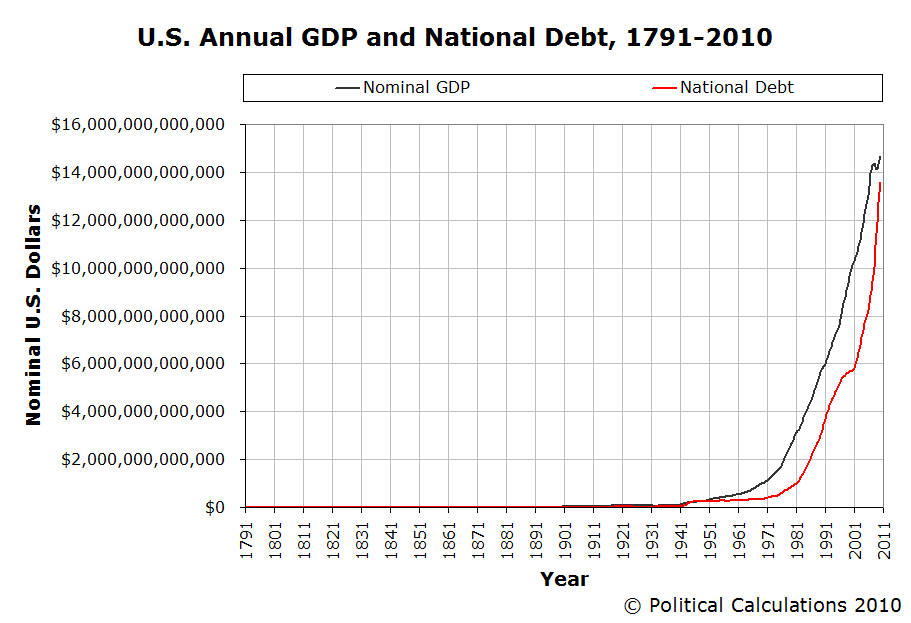

The United States is now experiencing the same syndrome that all the great empires of the past did when they traded away their economies' golden gooses: unsustainable, runaway debt -- at all levels.
14 replies
 = new reply since forum marked as read
Highlight:
NoneDon't highlight anything
5 newestHighlight 5 most recent replies
= new reply since forum marked as read
Highlight:
NoneDon't highlight anything
5 newestHighlight 5 most recent replies
= new reply since forum marked as read
Highlight:
NoneDon't highlight anything
5 newestHighlight 5 most recent replies
"Allowing cheap imports" to enter market forced American companies to make better, more affordable
Hoyt
Jun 2016
#2
It was automation first trade is about 3rd or 4th on the list but its easy to demagogue others
uponit7771
Jun 2016
#10
No, to take advanctage of a cheaper labor market... still makes it the 3rd or 4th reason why ...
uponit7771
Jun 2016
#13