General Discussion
Showing Original Post only (View all)
What good is economic justice, if I don't have the social justice to access and keep it? [View all]
**Asking for a friend**
===================================
Please, before answering google "The end of Reconstruction"
Here are a few thoughts.
======================================
End of Reconstruction
The end of Reconstruction returned control of the government in the South to the white southerners who promptly disenfranchised African-Americans.
snip
The period of Reconstruction continues to be disputed by historians today. One view considers Reconstruction to have been an opportunity lost. Instead of working to heal the wounds, it caused greater rifts between the South and the North, by imposing Northern rule on the South without dealing with the underlying social and economic problems.
The other school of thought states that the racism of the South would not allow Reconstruction to succeed. This racism insured that, once federal troops were no longer available to protect the rights of blacks, these rights would be immediately eliminated.
In 1882, Ex-slave Frederick Douglass probably put it best when he wrote: "Though slavery was abolished, the wrongs of my people were not ended. Though they were slaves, they were not yet quite free. No man can be truly free whose liberty is dependent upon the thoughts, feeling, and actions of others, and who has himself no means in his own hands for guarding, protecting, defending, and maintaining that liberty. Yet the Negro after his emancipation was precisely in this state of destitution. He was free from the individual master but the slave of society. He had neither money, property, nor friends. He was free from the old plantation, but he had nothing but the dusty road under his feet. He was free from the old quarter that once gave him shelter, but a slave to the rains of summer and the frost of winter. He was in a word, literally tuned loose, naked, hungry, and destitute to the open sky."
http://www.historycentral.com/rec/EndofRec.html
===================================
Then there was this long after the Emancipation Proclamation.
===================================
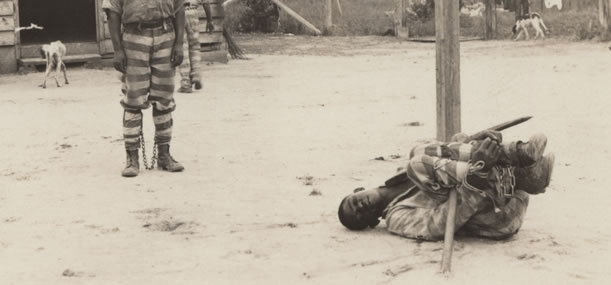
The Age of Neo-Slavery
In this groundbreaking historical expose, Douglas A. Blackmon brings to light one of the most shameful chapters in American history—when a cynical new form of slavery was resurrected from the ashes of the Civil War and re-imposed on hundreds of thousands of African-Americans until the dawn of World War II.
Under laws enacted specifically to intimidate blacks, tens of thousands of African Americans were arbitrarily arrested, hit with outrageous fines, and charged for the costs of their own arrests. With no means to pay these ostensible “debts,” prisoners were sold as forced laborers to coal mines, lumber camps, brickyards, railroads, quarries and farm plantations. Thousands of other African Americans were simply seized by southern landowners and compelled into years of involuntary servitude. Government officials leased falsely imprisoned blacks to small-town entrepreneurs, provincial farmers, and dozens of corporations—including U.S. Steel Corp.—looking for cheap and abundant labor. Armies of "free" black men labored without compensation, were repeatedly bought and sold, and were forced through beatings and physical torture to do the bidding of white masters for decades after the official abolition of American slavery.
The neoslavery system exploited legal loopholes and federal policies which discouraged prosecution of whites for continuing to hold black workers against their wills. As it poured millions of dollars into southern government treasuries, the new slavery also became a key instrument in the terrorization of African Americans seeking full participation in the U.S. political system.
Based on a vast record of original documents and personal narratives, SLAVERY BY ANOTHER NAME unearths the lost stories of slaves and their descendants who journeyed into freedom after the Emancipation Proclamation and then back into the shadow of involuntary servitude. It also reveals the stories of those who fought unsuccessfully against the re-emergence of human labor trafficking, the modern companies that profited most from neoslavery, and the system’s final demise in the 1940s, partly due to fears of enemy propaganda about American racial abuse at the beginning of World War II.
SLAVERY BY ANOTHER NAME is a moving, sobering account of a little-known crime against African Americans, and the insidious legacy of racism that reverberates today.
http://www.slaverybyanothername.com/the-book/
=================================
 = new reply since forum marked as read
Highlight:
NoneDon't highlight anything
5 newestHighlight 5 most recent replies
= new reply since forum marked as read
Highlight:
NoneDon't highlight anything
5 newestHighlight 5 most recent replies