Welcome to DU!
The truly grassroots left-of-center political community where regular people, not algorithms, drive the discussions and set the standards.
Join the community:
Create a free account
Support DU (and get rid of ads!):
Become a Star Member
Latest Breaking News
Editorials & Other Articles
General Discussion
The DU Lounge
All Forums
Issue Forums
Culture Forums
Alliance Forums
Region Forums
Support Forums
Help & Search
General Discussion
Showing Original Post only (View all)
How to Tell If You're a Supertaster [View all]
Last edited Sun Nov 19, 2017, 05:21 PM - Edit history (1)
http://nautil.us/issue/54/the-unspoken/how-to-tell-if-youre-a-supertasterMost humans can be placed into three major categories of tasters—nontasters, tasters, and supertasters, roughly in the ratio of 25 percent: 50 percent: 25 percent. There is also a small percentage (less than 1 percent) of humanity categorized in a super-supertaster category. Supertasters are mostly women, and people of European ancestry are usually not supertasters. So what exactly is a supertaster? You might think that a supertaster would have a lot of fun eating and drinking, but it’s more like the opposite. Because supertasters experience tastes more intensely than nontasters and tasters, the effects of different tastes detected by tongues of supertasters are amplified relative to the nontasters and tasters. Super-supertasters have it even worse than supertasters. Taste is a good case of “more is not better.”
The best way to describe the differences between the categories of tasting is to take one of my favorite beverages to taste—beer—and explain how each of the categories of tasting will respond to this beverage. The Master Brewers Association of the Americas recommend what is called the American Society of Brewing Chemists flavor wheel to help its members assess the taste of their brews. The flavor wheel was created by a coauthor of Sensory Evaluation Techniques, first published in the 1970s and now in its fifth edition. Morten Meilgaard, a professor of the senses and how to measure them, created the taste wheel to lend a more quantitative aspect to beer tasting.
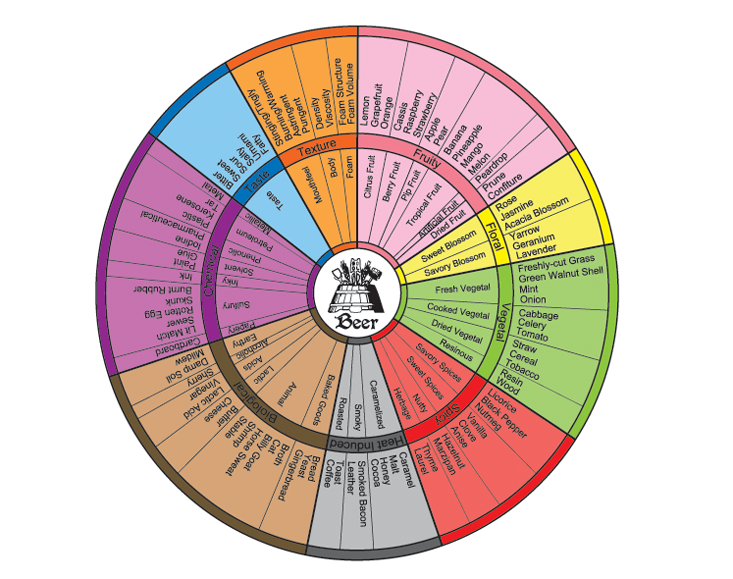
The taste wheel is quite complex and has gone through many iterations since Meilgaard created it, but it does focus on the complexities of the perception of beer. Examples of the more than 100 possible categories of taste include grapefruit, caramel, farmyard, funky, burnt tire, and baby sick/diapers (which I hope never to taste). It is safe to say that these tastes are the result of many factors, but they all emanate from the very simple contents of beer. In fact, to protect the simple contents of beer, in 1516 Germans created the Bavarian Beer Purity Law, or Reinheitsgebot. The purity law forbids any beverage labeled “beer” to be made with anything but hops, water, and barley. Although yeast is needed in brewing, it is a microbe, and was obviously not recognized as an ingredient 500 years ago. So, the modern concept of taste in most classical beers comes from only four ingredients. The most interesting aspect of the taste of beer, at least to me, comes from the hops and the sugars in the brew, and of course the alcohol that is the product of fermentation implemented by yeast on the sugars from grain.
Although beer is probably several millennia old, hops have been a part of brewing beer for a little more than a millennium. Its widespread use began in the last 800 years in Germany and was cemented in brewing technology with the invention of India pale ale (IPA) in the early to mid 19th century. With the modern advent of microbreweries and the development of custom-made hoppy beers such as the many IPAs that are on the market, this beverage becomes one that has a wide range of bitterness. It might be surprising to note that hops were first used as a preservative in beers. The bitter taste from hops is an afterthought. The manipulation of hops today as an integral ingredient in producing craft beers makes for some pretty wildly hoppy beers. (All of which I enjoy immensely, making me more than likely a normal taster.)
40 replies
 = new reply since forum marked as read
Highlight:
NoneDon't highlight anything
5 newestHighlight 5 most recent replies
= new reply since forum marked as read
Highlight:
NoneDon't highlight anything
5 newestHighlight 5 most recent replies
= new reply since forum marked as read
Highlight:
NoneDon't highlight anything
5 newestHighlight 5 most recent replies
i am a supertaster, but obviously diff. i love onions & most of the cabbage family,
pansypoo53219
Nov 2017
#36
I read somewhere that there is a specific gene that causes the soapy cilantro taste--
Mrs. Overall
Nov 2017
#9
You can avoid it in Mexican food, but Vietnamese food takes it to another level.
LeftInTX
Nov 2017
#35
I'm not either, but the diet soda drinkers in my life are hooked like coffee drinkers.
kcr
Nov 2017
#24
It takes 3 weeks of only drinking diet soda and not having any refined sugar
stevenleser
Nov 2017
#39