Welcome to DU!
The truly grassroots left-of-center political community where regular people, not algorithms, drive the discussions and set the standards.
Join the community:
Create a free account
Support DU (and get rid of ads!):
Become a Star Member
Latest Breaking News
Editorials & Other Articles
General Discussion
The DU Lounge
All Forums
Issue Forums
Culture Forums
Alliance Forums
Region Forums
Support Forums
Help & Search
Latest Breaking News
In reply to the discussion: Wife-Beating Fed Judge Mark Fuller, Who Railroaded Siegelman, Resigns [View all]OnyxCollie
(9,958 posts)15. I don't know how much power Obama has.
Presidents come and go.
The Justice Department (specifically David Margolis) on the other hand...
Who is David Margolis?
"Bad News for the Bad Guys"
"This is truly bad news -- for the bad guys," Mark A.R. Kleinman wrote
(http://www.markarkleiman.com/archives/valerie_plame_/2005/08/career_prosecutor_to_supervise_plame_probe.php)
August 13, 2005. "Margolis made his prosecutorial bones doing organized crime cases, eventually rising to Chief of the Organized Crime and Racketeering Section of the Justice Department's Criminal Division, from which position he supervised the seventeen Organized Crime Strike Forces which more or less won the war on the Mafia. ... Margolis has a stratospheric IQ, has been known to wear Willie Nelson t-shirts to work, is used to long investigations using somewhat edgy investigative techniques, and can't be intimidated by anybody."
"This is truly bad news -- for the bad guys," Mark A.R. Kleinman wrote
(http://www.markarkleiman.com/archives/valerie_plame_/2005/08/career_prosecutor_to_supervise_plame_probe.php)
August 13, 2005. "Margolis made his prosecutorial bones doing organized crime cases, eventually rising to Chief of the Organized Crime and Racketeering Section of the Justice Department's Criminal Division, from which position he supervised the seventeen Organized Crime Strike Forces which more or less won the war on the Mafia. ... Margolis has a stratospheric IQ, has been known to wear Willie Nelson t-shirts to work, is used to long investigations using somewhat edgy investigative techniques, and can't be intimidated by anybody."
“Since (Bush-appointee Richard) Armitage is currently the Under Secretary of State, he is in charge of the Foreign Narcotics Control Office of the State Department, which is supposed to control cocaine and heroin…. The famous quote by Kerry Committee senior panel member Senator Daniel Inouye of Hawaii (D-Hawaii) should be noted. When Armitage was put under oath, he kept calling him (Armitage) "Mr. Cocaine" instead of "Mr. Secretary…."
“Armitage was also a member of the restricted access group known as RAG-1 (Restricted Access Group One) along with Elliott Abrams, Clair George, Attorney General Ed Meese, David Margolis, Chief of Domestic Criminal Operations of the Department of Justice. The purpose of RAG-1 was first to develop and then to coordinate the CIA’s policy of trafficking in narcotics on a large-scale basis, in order to produce ongoing covert revenue streams pursuant to the aid and sustenance of illegal operations of state.
“Richard Armitage coordinated CIA heroin trafficking principally out of Cambodia and Laos, and he was a close confederate of General Huang Soong, the CIA’s principal (narcotics) trafficker in Cambodia…. (Note: Bush certainly knew about Armitage’s sordid history when he appointed him. In fact, Bush may have done so to further his own, personally frustrated reach within the black budget community, which has excluded presidents from its prized technology secrets)
http://sandiego.indymedia.org/en/2004/11/106834.shtml
“Armitage was also a member of the restricted access group known as RAG-1 (Restricted Access Group One) along with Elliott Abrams, Clair George, Attorney General Ed Meese, David Margolis, Chief of Domestic Criminal Operations of the Department of Justice. The purpose of RAG-1 was first to develop and then to coordinate the CIA’s policy of trafficking in narcotics on a large-scale basis, in order to produce ongoing covert revenue streams pursuant to the aid and sustenance of illegal operations of state.
“Richard Armitage coordinated CIA heroin trafficking principally out of Cambodia and Laos, and he was a close confederate of General Huang Soong, the CIA’s principal (narcotics) trafficker in Cambodia…. (Note: Bush certainly knew about Armitage’s sordid history when he appointed him. In fact, Bush may have done so to further his own, personally frustrated reach within the black budget community, which has excluded presidents from its prized technology secrets)
http://sandiego.indymedia.org/en/2004/11/106834.shtml
http://www.democraticunderground.com/discuss/duboard.php?az=view_all&address=132x2009524
The Public Integrity Section's real purpose is to act as a unit within a much larger political liability control mechanism within the Department of Justice. The Public Integrity Section also acts to coordinate the management and suppression of information and the management of political liability with other federal agencies.
Lee Radek has been Chief of the Public Integrity Section for a very long time. He has acted with his confederates within the DoJ, namely Dave Margolis , then Chief of the Domestic Criminal Section and Mark Richards, then Chief of the International Criminal Section of the DoJ. These three men, operating under the auspices of Deputy Attorney General George Terwilliger, essentially managed the Iran-Contra Cover-up for the Department of Justice.
I have talked with Dave Margolis several times. The only thing he ever did was threaten me. He would say to me that if I revealed anything to congressional committees, or if I leaked any thing out into the press, that I would be subject to all sorts of unpleasant things. Everything was "national security" with these guys.
The Public Integrity Section's real purpose is to act as a unit within a much larger political liability control mechanism within the Department of Justice. The Public Integrity Section also acts to coordinate the management and suppression of information and the management of political liability with other federal agencies.
Lee Radek has been Chief of the Public Integrity Section for a very long time. He has acted with his confederates within the DoJ, namely Dave Margolis , then Chief of the Domestic Criminal Section and Mark Richards, then Chief of the International Criminal Section of the DoJ. These three men, operating under the auspices of Deputy Attorney General George Terwilliger, essentially managed the Iran-Contra Cover-up for the Department of Justice.
I have talked with Dave Margolis several times. The only thing he ever did was threaten me. He would say to me that if I revealed anything to congressional committees, or if I leaked any thing out into the press, that I would be subject to all sorts of unpleasant things. Everything was "national security" with these guys.
HOUSE COMMITTEE ON THE JUDICIARY HOLDS A HEARING ON THE U.S. ATTORNEYS INVESTIGATION
OCTOBER 3, 2008
SANCHEZ: OK, thank you.
And just two last questions. As this administration leaves office, one of the concerns that I have is the potential for documents and witness -- or documents to disappear and witness intimidation to occur.
And your report establishes ample evidence of this type of conduct having occurred. Department officials still don't seem to understand some of the gravity of what has happened here.
And even as recently as a week ago Monday, senior DOJ officials -- specifically, David Margolis, who has joked about the U.S. attorney firings as the, quote, unquote, "recent unpleasantness," and I would allege it's a little bit more than unpleasantness -- was continuing to intimidate career employees by warning them that they should not communicate with the press if they are concerned about wrongdoing.
OCTOBER 3, 2008
SANCHEZ: OK, thank you.
And just two last questions. As this administration leaves office, one of the concerns that I have is the potential for documents and witness -- or documents to disappear and witness intimidation to occur.
And your report establishes ample evidence of this type of conduct having occurred. Department officials still don't seem to understand some of the gravity of what has happened here.
And even as recently as a week ago Monday, senior DOJ officials -- specifically, David Margolis, who has joked about the U.S. attorney firings as the, quote, unquote, "recent unpleasantness," and I would allege it's a little bit more than unpleasantness -- was continuing to intimidate career employees by warning them that they should not communicate with the press if they are concerned about wrongdoing.
Now, what does David Margolis have to do with Don Siegelman?
Department of Justice Pulls a Whitewash on Siegelman Whistleblower
http://legalschnauzer.blogspot.com/2009/10/department-of-justice-pulls-whitewash.html
The report becomes even more dubious when you consider OSC's recent history. Federal agents raided the office of former OSC chief Scott J. Bloch in May 2008 amid allegations of improper political bias and obstruction of justice. The New York Times reported that agents were trying to determine if Bloch, a 2003 George W. Bush appointee, had hired an outside firm to scrub his computer.
Gee, where would a Bush loyalist ever come up with such an idea?
As we reported last November, substantial evidence indicates Bloch and associate deputy attorney general David Margolis did their best to sweep Grimes' allegations under the rug and protect Leura Canary. And it appears that Bloch, before leaving office with the feds on his tail, removed Grimes' most serious allegations--making sure investigators would not even look into them.
How bad have things been at OSC in recent years? Consider this article from governmentexecutive.com in May 2009. It provides a searing analysis of the agency's woes:
http://legalschnauzer.blogspot.com/2009/10/department-of-justice-pulls-whitewash.html
The report becomes even more dubious when you consider OSC's recent history. Federal agents raided the office of former OSC chief Scott J. Bloch in May 2008 amid allegations of improper political bias and obstruction of justice. The New York Times reported that agents were trying to determine if Bloch, a 2003 George W. Bush appointee, had hired an outside firm to scrub his computer.
Gee, where would a Bush loyalist ever come up with such an idea?
As we reported last November, substantial evidence indicates Bloch and associate deputy attorney general David Margolis did their best to sweep Grimes' allegations under the rug and protect Leura Canary. And it appears that Bloch, before leaving office with the feds on his tail, removed Grimes' most serious allegations--making sure investigators would not even look into them.
How bad have things been at OSC in recent years? Consider this article from governmentexecutive.com in May 2009. It provides a searing analysis of the agency's woes:
The Office of Special Counsel is an independent oversight agency charged with protecting federal employees from prohibited personnel practices, particularly whistleblower retaliation. For an agency that must build a reputation for fairness with federal employees and other agencies, scandals like the ones during Bloch's tenure can be especially harmful.
"There was a lot of damage done," says former Deputy Special Counsel Timothy Hannapel, who served under Clinton-appointed Special Counsel Elaine Kaplan. "We'd tried to put the agency on a new path to credibility and . . . it was all just erased and in a drastic way, with the credibility of the agency at rock bottom."
http://www.sourcewatch.org/index.php?title=David_Margolis
David Margolis was chosen in August 2005 by Deputy Attorney General James B. Comey to supervise Special Counsel Patrick J. Fitzgerald who is conducting the Valerie Plame CIA leak investigation.
"Comey was the only official overseeing special counsel Patrick Fitzgerald's leak investigation. With Attorney General Alberto Gonzales recused, department officials say they are still trying to resolve whom Fitzgerald will now report to," Michael Isikoff wrote in the August 15, 2005, Newsweek.
David Margolis was chosen in August 2005 by Deputy Attorney General James B. Comey to supervise Special Counsel Patrick J. Fitzgerald who is conducting the Valerie Plame CIA leak investigation.
"Comey was the only official overseeing special counsel Patrick Fitzgerald's leak investigation. With Attorney General Alberto Gonzales recused, department officials say they are still trying to resolve whom Fitzgerald will now report to," Michael Isikoff wrote in the August 15, 2005, Newsweek.
AFTERNOON SESSION OF A HEARING OF THE HOUSE JUDICIARY COMMITTEE SUBJECT: OVERSIGHT OF THE U.S. DEPARTMENT OF JUSTICE CHAIRED BY: REPRESENTATIVE JOHN CONYERS (D-MI) WITNESS: ATTORNEY GENERAL ALBERTO GONZALES LOCATION: 2141RAYBURN HOUSE OFFICE BUILDING, WASHINGTON, D.C. TIME: 12:17 P.M. EDT DATE: THURSDAY, MAY 10, 2007
REP. CANNON: No, this is the Cohen editorial, the one she referred to, yes.
General Gonzales, thanks for being here. I think you're very gracious to address these accusations as serious and not react to the suggestion of duplicity. There may be duplicity out of 110,000 employees, but I think you've been very direct here this morning.
You're familiar with Mr. Margolis at the Department of Justice, are you not?
ATTY GEN. GONZALES: Yes.
REP. CANNON: And my understanding is, he's the senior career employee at the department. Is that right?
ATTY GEN. GONZALES: I think he may not be the senior, but he's certainly one of the most senior.
REP. CANNON: Probably one of the most outspoken. And he was actually interviewed, and I'd like read some of the comments that he made. He was asked by Mr. Broderick-Sokol: "And then you testified -- then you testified that you said something to the effect of 'but this goes -- but this does open the door to a more responsible' -- and you used that word" -- that is, "more responsible" -- "to a focused process to identify weak performers and make some changes, and you thought that was a good idea."
And Mr. Margolis said -- responded, "I thought it was a great idea, long overdue."
Now, Mr. -- I believe it was Mr. Scott who was talking about the CRS report on firings at the Department of Justice, which is retrospective, of course. And here you've got a senior member or a senior person at the Department of Justice pointing out that he thought what you were doing here was a great idea.
A little more here. "To move on to another thing, you mentioned -- during your testimony earlier in the day, I believe that you had indicated that you thought it was good of the department to embark on an exercise like this." That is, reviewing U.S. attorneys.
Mr. Margolis: "Absolutely. And I should add one of my sadnesses" -- his word -- "I have a lot of sadness about this, but it was a great idea. Our execution wasn't particularly good, but we didn't have much experience with it."
So this is a new idea, new process here. But one of my great sadnesses is I fear that down the road, people will shy away from doing this again because of the burning here. In other words, he's condemning the politicization of this process. And so when a U.S. attorney called me a couple of weeks ago to run an idea past me, he said I want to take some action, but I want to run it past you and take your temperature because I don't want to get fired. I said to him, "Buddy, you could urinate on the president's leg now and it wouldn't work" -- (laughter) -- suggesting that the department has, in fact, been affected.
And again, Mr. Margolis is one of the very senior career guys who happens -- I think you would agree he loves the department?
ATTY. GEN. GONZALES: No question about that.
REP. CANNON: He cares about the institution.
REP. CANNON: And was called on to testify, because they thought he would do what he suggested could be done without being fired I suppose. Were you involved in any way, he was asked, about the decision to put Ms. Lam on the list?
He says, "So it didn't surprise me in that sense. Because when Mercer was PDAG, he used to tell me about problems he was having with her, vis-a-vis immigration and immigration and guns."
ATTY. GEN. GONZALES: I believe.
REP. CANNON: Then he goes on, and he says, "Based upon my interaction with her and what other people, including Ms. Mercer, said, both then and now, in reading my -- and I love Carol like a sister. An outstanding investigative lawyer, an outstanding trial lawyer, tough as nails, honest as the day is long, but had her own ideas about what the priorities of the department would be and was probably insubordinate on those things."
Nobody's claiming Mr. Margolis is political or politicizing this process. He's saying this is a process that was good, and he wants it to happen or to continue.
Then he says, "She called me primarily to tell me that, I think she said, I think I just got fired by Mike Battle." A little later, he says, "And then she speculated to me that it was over immigration and guns." She had been told what the problem was.
By the way, I think he said it was a very pleasant conversation. So this is not about competency. Nobody's saying Ms. Lam wasn't competent. But she wasn't doing and she understood she wasn't doing what the president wanted. Do you think that's correct, Mr. Gonzales?
ATTY. GEN. GONZALES: I think there's -- first of all, let me just say that Carol and these other United States attorneys -- I mean, they're fine individuals and very, very fine lawyers.
REP. CANNON: Thank you. I don't want to cut you off, but I just want to put one more. And this is Mr. Margolis again, "I was asked about David Iglesias. Given everything I know today, he would have been number one on my list to go, and that's because he didn't call and report the phone calls." That's right, and he goes on to talk about that.
So we did have some problems with some of these guys in the sense they weren't exactly paradigms of competence, were they?
ATTY. GEN. GONZALES: It was my idea that these individuals had been identified by the senior leadership in the department as having issues or concerns. And that a change would be legitimate.
REP. CANNON: No, this is the Cohen editorial, the one she referred to, yes.
General Gonzales, thanks for being here. I think you're very gracious to address these accusations as serious and not react to the suggestion of duplicity. There may be duplicity out of 110,000 employees, but I think you've been very direct here this morning.
You're familiar with Mr. Margolis at the Department of Justice, are you not?
ATTY GEN. GONZALES: Yes.
REP. CANNON: And my understanding is, he's the senior career employee at the department. Is that right?
ATTY GEN. GONZALES: I think he may not be the senior, but he's certainly one of the most senior.
REP. CANNON: Probably one of the most outspoken. And he was actually interviewed, and I'd like read some of the comments that he made. He was asked by Mr. Broderick-Sokol: "And then you testified -- then you testified that you said something to the effect of 'but this goes -- but this does open the door to a more responsible' -- and you used that word" -- that is, "more responsible" -- "to a focused process to identify weak performers and make some changes, and you thought that was a good idea."
And Mr. Margolis said -- responded, "I thought it was a great idea, long overdue."
Now, Mr. -- I believe it was Mr. Scott who was talking about the CRS report on firings at the Department of Justice, which is retrospective, of course. And here you've got a senior member or a senior person at the Department of Justice pointing out that he thought what you were doing here was a great idea.
A little more here. "To move on to another thing, you mentioned -- during your testimony earlier in the day, I believe that you had indicated that you thought it was good of the department to embark on an exercise like this." That is, reviewing U.S. attorneys.
Mr. Margolis: "Absolutely. And I should add one of my sadnesses" -- his word -- "I have a lot of sadness about this, but it was a great idea. Our execution wasn't particularly good, but we didn't have much experience with it."
So this is a new idea, new process here. But one of my great sadnesses is I fear that down the road, people will shy away from doing this again because of the burning here. In other words, he's condemning the politicization of this process. And so when a U.S. attorney called me a couple of weeks ago to run an idea past me, he said I want to take some action, but I want to run it past you and take your temperature because I don't want to get fired. I said to him, "Buddy, you could urinate on the president's leg now and it wouldn't work" -- (laughter) -- suggesting that the department has, in fact, been affected.
And again, Mr. Margolis is one of the very senior career guys who happens -- I think you would agree he loves the department?
ATTY. GEN. GONZALES: No question about that.
REP. CANNON: He cares about the institution.
REP. CANNON: And was called on to testify, because they thought he would do what he suggested could be done without being fired I suppose. Were you involved in any way, he was asked, about the decision to put Ms. Lam on the list?
He says, "So it didn't surprise me in that sense. Because when Mercer was PDAG, he used to tell me about problems he was having with her, vis-a-vis immigration and immigration and guns."
ATTY. GEN. GONZALES: I believe.
REP. CANNON: Then he goes on, and he says, "Based upon my interaction with her and what other people, including Ms. Mercer, said, both then and now, in reading my -- and I love Carol like a sister. An outstanding investigative lawyer, an outstanding trial lawyer, tough as nails, honest as the day is long, but had her own ideas about what the priorities of the department would be and was probably insubordinate on those things."
Nobody's claiming Mr. Margolis is political or politicizing this process. He's saying this is a process that was good, and he wants it to happen or to continue.
Then he says, "She called me primarily to tell me that, I think she said, I think I just got fired by Mike Battle." A little later, he says, "And then she speculated to me that it was over immigration and guns." She had been told what the problem was.
By the way, I think he said it was a very pleasant conversation. So this is not about competency. Nobody's saying Ms. Lam wasn't competent. But she wasn't doing and she understood she wasn't doing what the president wanted. Do you think that's correct, Mr. Gonzales?
ATTY. GEN. GONZALES: I think there's -- first of all, let me just say that Carol and these other United States attorneys -- I mean, they're fine individuals and very, very fine lawyers.
REP. CANNON: Thank you. I don't want to cut you off, but I just want to put one more. And this is Mr. Margolis again, "I was asked about David Iglesias. Given everything I know today, he would have been number one on my list to go, and that's because he didn't call and report the phone calls." That's right, and he goes on to talk about that.
So we did have some problems with some of these guys in the sense they weren't exactly paradigms of competence, were they?
ATTY. GEN. GONZALES: It was my idea that these individuals had been identified by the senior leadership in the department as having issues or concerns. And that a change would be legitimate.
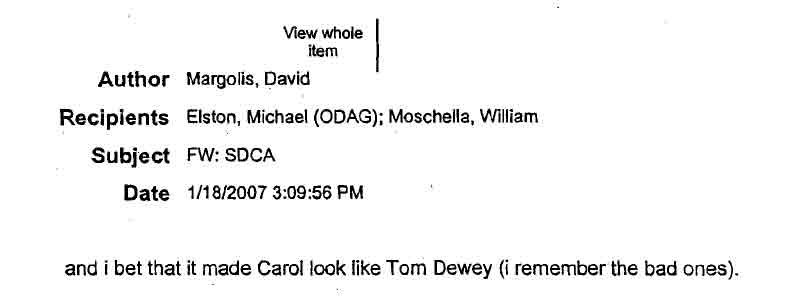
Email response regarding a news story on fired US Attorney Carol Lam:
[URL=
 .html][IMG]
 [/IMG][/URL]
This is the person whom David Margolis remembers as a “bad one.”
Thomas E. Dewey
http://en.wikipedia.org/wiki/Thomas_E._Dewey
Dewey rocketed to fame in 1935, when he was appointed special prosecutor in New York County (Manhattan) by Governor Herbert H. Lehman. A "runaway grand jury" had publicly complained that William C. Dodge, the District Attorney, was not aggressively pursuing the mob and political corruption. Lehman, to avoid charges of partisanship, asked four prominent Republicans to serve as special prosecutor. All four refused and recommended Dewey.[12]
~snip~
Dewey's targets were organized racketeering: the large-scale criminal enterprises, especially extortion, the "numbers game", and prostitution. He pursued Tammany Hall political leaders known for their ties to gangsters, such as James Joseph Hines.
~snip~
Dewey next turned his attention to Luciano. Dewey raided 80 houses of prostitution in the New York City area and arrested hundreds of prostitutes and "madams". Many of the prostitutes — some of whom told of being beaten and abused by Mafia thugs — were willing to testify to avoid prison time. Three implicated Luciano as controller of organized prostitution in the New York/New Jersey area — one of the largest prostitution rings in American history.[11] In the greatest victory of his legal career, Dewey won the conviction of Luciano for the prostitution racket, with a sentence of 30 to 50 years.[13]
However, Dewey did more than simply prosecute gangsters. In 1936 Dewey helped indict and convict Richard Whitney, the former president of the New York Stock Exchange, for embezzlement. Dewey also led efforts to protect dockworkers and poultry farmers and workers from racketeering in New York.[14] In 1936 Dewey received The Hundred Year Association of New York's Gold Medal Award "in recognition of outstanding contributions to the City of New York". In 1939 Dewey prosecuted American Nazi leader Fritz Julius Kuhn for embezzlement, crippling Kuhn's organization and limiting its ability to support Nazi Germany in World War II.
http://en.wikipedia.org/wiki/Thomas_E._Dewey
Dewey rocketed to fame in 1935, when he was appointed special prosecutor in New York County (Manhattan) by Governor Herbert H. Lehman. A "runaway grand jury" had publicly complained that William C. Dodge, the District Attorney, was not aggressively pursuing the mob and political corruption. Lehman, to avoid charges of partisanship, asked four prominent Republicans to serve as special prosecutor. All four refused and recommended Dewey.[12]
~snip~
Dewey's targets were organized racketeering: the large-scale criminal enterprises, especially extortion, the "numbers game", and prostitution. He pursued Tammany Hall political leaders known for their ties to gangsters, such as James Joseph Hines.
~snip~
Dewey next turned his attention to Luciano. Dewey raided 80 houses of prostitution in the New York City area and arrested hundreds of prostitutes and "madams". Many of the prostitutes — some of whom told of being beaten and abused by Mafia thugs — were willing to testify to avoid prison time. Three implicated Luciano as controller of organized prostitution in the New York/New Jersey area — one of the largest prostitution rings in American history.[11] In the greatest victory of his legal career, Dewey won the conviction of Luciano for the prostitution racket, with a sentence of 30 to 50 years.[13]
However, Dewey did more than simply prosecute gangsters. In 1936 Dewey helped indict and convict Richard Whitney, the former president of the New York Stock Exchange, for embezzlement. Dewey also led efforts to protect dockworkers and poultry farmers and workers from racketeering in New York.[14] In 1936 Dewey received The Hundred Year Association of New York's Gold Medal Award "in recognition of outstanding contributions to the City of New York". In 1939 Dewey prosecuted American Nazi leader Fritz Julius Kuhn for embezzlement, crippling Kuhn's organization and limiting its ability to support Nazi Germany in World War II.
HOUSE JUDICIARY COMMITTEE HOLDS A HEARING ON THE U.S. ATTORNEY FIRINGS
MAY 23, 2007
DELAHUNT: Thank you, Mr. Chairman.
Thank you for your appearance here today. And I just want to speak about the process -- the hiring process and the termination process. It came to me as a surprise that someone of your experience -- and I say this respectfully -- was delegated by the attorney general, via an executive order, that bypassed Mr. McNulty, that was extraordinary in its powers and authority to someone of your limited experience in terms of your legal experience. Were you familiar with that order?
GOODLING: I was.
DELAHUNT: That's -- you answered my question. What came to me as a surprise -- and maybe you can explain to us why the executive order by the attorney general bypassed Mr. McNulty who is the second in command. And as an addendum to that order, a so-called control sheet, it was stated that he was not to be made aware of the order. I find that disturbing in terms of having a professional process that wasn't about political appointees, but was about career and interim appointees.
DELAHUNT: That I find very disturbing.
GOODLING: I'd like to explain to you what the reason was.
DELAHUNT: Please.
GOODLING: This issue came up late in the fall of 2005. The Justice Management Division notified me that they had determined that the deputies attorney general going back many years -- or at least a long period of time, maybe even into the previous administration -- had been signing off on personnel actions that had never been delegated to them, and in some cases had further delegated those decisions to others. And they told me that David Margolis was one of those individuals that had made some decisions. There had never been a delegation of the personnel authority down to the deputy attorney general, and no ability for that individual to further delegate. And they had realized that they had a problem, that there had been all these personnel actions that had been signed off...
~snip~
CANNON: Actually, no, he told this committee that he did report the contact, using not the telephone or e-mail, but through the medium of the press. I don't know if you're aware of that or not, but I -- personally I think the reasons for his replacement are self manifest and probably don't need to be gone into much more.
But we've discussed the president's power involved in appointing these really at-will employees. I'd like to read into the record a description of the job security for U.S. attorneys by Mr. David Margolis. I love this line: "If Senator Kerry were elected after the 2004 election, these people would be out on the street, anyway. So it's not like we're, you know, taking the jobs out from under them."
MAY 23, 2007
DELAHUNT: Thank you, Mr. Chairman.
Thank you for your appearance here today. And I just want to speak about the process -- the hiring process and the termination process. It came to me as a surprise that someone of your experience -- and I say this respectfully -- was delegated by the attorney general, via an executive order, that bypassed Mr. McNulty, that was extraordinary in its powers and authority to someone of your limited experience in terms of your legal experience. Were you familiar with that order?
GOODLING: I was.
DELAHUNT: That's -- you answered my question. What came to me as a surprise -- and maybe you can explain to us why the executive order by the attorney general bypassed Mr. McNulty who is the second in command. And as an addendum to that order, a so-called control sheet, it was stated that he was not to be made aware of the order. I find that disturbing in terms of having a professional process that wasn't about political appointees, but was about career and interim appointees.
DELAHUNT: That I find very disturbing.
GOODLING: I'd like to explain to you what the reason was.
DELAHUNT: Please.
GOODLING: This issue came up late in the fall of 2005. The Justice Management Division notified me that they had determined that the deputies attorney general going back many years -- or at least a long period of time, maybe even into the previous administration -- had been signing off on personnel actions that had never been delegated to them, and in some cases had further delegated those decisions to others. And they told me that David Margolis was one of those individuals that had made some decisions. There had never been a delegation of the personnel authority down to the deputy attorney general, and no ability for that individual to further delegate. And they had realized that they had a problem, that there had been all these personnel actions that had been signed off...
~snip~
CANNON: Actually, no, he told this committee that he did report the contact, using not the telephone or e-mail, but through the medium of the press. I don't know if you're aware of that or not, but I -- personally I think the reasons for his replacement are self manifest and probably don't need to be gone into much more.
But we've discussed the president's power involved in appointing these really at-will employees. I'd like to read into the record a description of the job security for U.S. attorneys by Mr. David Margolis. I love this line: "If Senator Kerry were elected after the 2004 election, these people would be out on the street, anyway. So it's not like we're, you know, taking the jobs out from under them."
DAg 2740-2780
An Investigation of Allegations of Politicized Hiring by Monica Goodling and Other Staff in the Office of the Attorney General
(U.S. Dept. of Justice)
Finally, we found that in a separate example of political screening, Goodling contacted Associate Deputy Attorney General David Margolis to inquire about Ohlson, who was being considered for the position of EOIR Director, after Rooney had announced his retirement in February 2007. According to Margolis, Goodling asked: “As to your friend Kevin Ohlson, can you tell me whether he’s a D or an R?” Margolis told us that he told Goodling that Ohlson was a career Department attorney, but that he may have been more “politically attuned” to Republicans than to Democrats. (p. 112)
An Investigation of Allegations of Politicized Hiring by Monica Goodling and Other Staff in the Office of the Attorney General
(U.S. Dept. of Justice)
Finally, we found that in a separate example of political screening, Goodling contacted Associate Deputy Attorney General David Margolis to inquire about Ohlson, who was being considered for the position of EOIR Director, after Rooney had announced his retirement in February 2007. According to Margolis, Goodling asked: “As to your friend Kevin Ohlson, can you tell me whether he’s a D or an R?” Margolis told us that he told Goodling that Ohlson was a career Department attorney, but that he may have been more “politically attuned” to Republicans than to Democrats. (p. 112)
For Sampson, Hiring At DOJ Was All Republicans All The Times
http://talkingpointsmemo.com/muckraker/img-src-http-talkingpointsmemo…ign-left-for-sampson-hiring-at-doj-was-all-republicans-all-the-times
Also, Sampson often called over to the White House personnel office seeking "ideas for immigration judge postings." Sampson told a staffer to "contact the White House to get any candidate ideas that they had for immigration judges".
In one case, Sampson pushed a prospective judicial candidate who was supported by White House political director Karl Rove.
Regarding that candidate, whose name was not disclosed, Kevin Ohlson, then deputy director of the Executive Office for Immigration Review, told the IG's investigators that he was "fully aware of the fact" that Sampson was pushing Rove's pick and that was affecting the formal evaluation.
"The finger was on the scale," Ohlson said.
That candidate was ultimately appointed to be an immigration judge in October 2005, the report said.
http://talkingpointsmemo.com/muckraker/img-src-http-talkingpointsmemo…ign-left-for-sampson-hiring-at-doj-was-all-republicans-all-the-times
Also, Sampson often called over to the White House personnel office seeking "ideas for immigration judge postings." Sampson told a staffer to "contact the White House to get any candidate ideas that they had for immigration judges".
In one case, Sampson pushed a prospective judicial candidate who was supported by White House political director Karl Rove.
Regarding that candidate, whose name was not disclosed, Kevin Ohlson, then deputy director of the Executive Office for Immigration Review, told the IG's investigators that he was "fully aware of the fact" that Sampson was pushing Rove's pick and that was affecting the formal evaluation.
"The finger was on the scale," Ohlson said.
That candidate was ultimately appointed to be an immigration judge in October 2005, the report said.
Former Holder Chief of Staff to Lead New Misconduct Unit
http://www.mainjustice.com/2011/01/18/former-holder-chief-of-staff-to-lead-new-misconduct-unit/print/
Attorney General Eric Holder announced Tuesday he has appointed one of his most trusted associates to head a new unit that will deal with disciplinary actions against career attorneys.
Kevin Ohlson will bring “high standards of professionalism and integrity” to his position at the new Professional Misconduct Review Unit., Holder said in a statement [1]. Ohlson was [2] Holder’s Chief of Staff and Counselor from February 2009 until this week. He also served as Holder’s spokesman in the 1990s, when Holder was the U.S. Attorney for the District of Columbia.
The new unit will handle disciplinary action stemming from Office of Professional Responsibility findings, in which intentional or reckless professional misconduct is alleged. The unit will decide whether evidence and the law back those OPR discoveries. It will also take over from OPR the responsibility for deciding whether the misconduct merits referral to the prosecutor’s state bar association for discipline.
OPR will continue to send discoveries of mistakes and bad judgment to the relevant U.S. Attorney through the Executive Office for United States Attorneys or the DOJ component chief
http://www.mainjustice.com/2011/01/18/former-holder-chief-of-staff-to-lead-new-misconduct-unit/print/
Attorney General Eric Holder announced Tuesday he has appointed one of his most trusted associates to head a new unit that will deal with disciplinary actions against career attorneys.
Kevin Ohlson will bring “high standards of professionalism and integrity” to his position at the new Professional Misconduct Review Unit., Holder said in a statement [1]. Ohlson was [2] Holder’s Chief of Staff and Counselor from February 2009 until this week. He also served as Holder’s spokesman in the 1990s, when Holder was the U.S. Attorney for the District of Columbia.
The new unit will handle disciplinary action stemming from Office of Professional Responsibility findings, in which intentional or reckless professional misconduct is alleged. The unit will decide whether evidence and the law back those OPR discoveries. It will also take over from OPR the responsibility for deciding whether the misconduct merits referral to the prosecutor’s state bar association for discipline.
OPR will continue to send discoveries of mistakes and bad judgment to the relevant U.S. Attorney through the Executive Office for United States Attorneys or the DOJ component chief
Report Faults 2 Authors of Bush Terror Memos
http://www.nytimes.com/2010/02/20/us/politics/20justice.html?_r=0
The ethics lawyers, in the Office of Professional Responsibility, concluded that two department lawyers involved in analyzing and justifying waterboarding and other interrogation tactics — Jay S. Bybee, now a federal judge, and John C. Yoo, now a professor at the University of California, Berkeley — had demonstrated “professional misconduct.” It said the lawyers had ignored legal precedents and provided slipshod legal advice to the White House in possible violation of international and federal laws on torture. That report was among the documents made public Friday.
But David Margolis, a career lawyer at the Justice Department, rejected that conclusion in a report of his own released Friday. He said the ethics lawyers, in condemning the lawyers’ actions, had given short shrift to the national climate of urgency in which Mr. Bybee and Mr. Yoo acted after the attacks of Sept. 11, 2001. “Among the difficulties in assessing these memos now over seven years after their issuance is that the context is lost,” Mr. Margolis said.
~snip~
Mr. Margolis said that in rejecting harsher sanctions, “this decision should not be viewed as an endorsement of the legal work that underlies those memoranda.” But he said the legal advice of Mr. Yoo and the other lawyers, while “flawed” and insufficient in some areas, did not rise to the level of “professional misconduct,” which could have resulted in bar reviews or other disciplinary action.
Indeed, Mr. Margolis’s 69-page report was often more critical of the ethics office than of the Bush administration lawyers themselves. Mr. Margolis, who has served at the Justice Department for more than three decades and handles many high-level disciplinary issues, saved some stinging criticism for Mr. Yoo.
http://www.nytimes.com/2010/02/20/us/politics/20justice.html?_r=0
The ethics lawyers, in the Office of Professional Responsibility, concluded that two department lawyers involved in analyzing and justifying waterboarding and other interrogation tactics — Jay S. Bybee, now a federal judge, and John C. Yoo, now a professor at the University of California, Berkeley — had demonstrated “professional misconduct.” It said the lawyers had ignored legal precedents and provided slipshod legal advice to the White House in possible violation of international and federal laws on torture. That report was among the documents made public Friday.
But David Margolis, a career lawyer at the Justice Department, rejected that conclusion in a report of his own released Friday. He said the ethics lawyers, in condemning the lawyers’ actions, had given short shrift to the national climate of urgency in which Mr. Bybee and Mr. Yoo acted after the attacks of Sept. 11, 2001. “Among the difficulties in assessing these memos now over seven years after their issuance is that the context is lost,” Mr. Margolis said.
~snip~
Mr. Margolis said that in rejecting harsher sanctions, “this decision should not be viewed as an endorsement of the legal work that underlies those memoranda.” But he said the legal advice of Mr. Yoo and the other lawyers, while “flawed” and insufficient in some areas, did not rise to the level of “professional misconduct,” which could have resulted in bar reviews or other disciplinary action.
Indeed, Mr. Margolis’s 69-page report was often more critical of the ethics office than of the Bush administration lawyers themselves. Mr. Margolis, who has served at the Justice Department for more than three decades and handles many high-level disciplinary issues, saved some stinging criticism for Mr. Yoo.
Edit history
Please sign in to view edit histories.
Recommendations
0 members have recommended this reply (displayed in chronological order):
34 replies
 = new reply since forum marked as read
Highlight:
NoneDon't highlight anything
5 newestHighlight 5 most recent replies
RecommendedHighlight replies with 5 or more recommendations
= new reply since forum marked as read
Highlight:
NoneDon't highlight anything
5 newestHighlight 5 most recent replies
RecommendedHighlight replies with 5 or more recommendations
= new reply since forum marked as read
Highlight:
NoneDon't highlight anything
5 newestHighlight 5 most recent replies
RecommendedHighlight replies with 5 or more recommendations
Wife-Beating Fed Judge Mark Fuller, Who Railroaded Siegelman, Resigns [View all]
laserhaas
May 2015
OP
Sad to say - would probably be true - but he already has hundreds of millions of dollars
laserhaas
May 2015
#3
Hate to say it, but people who have been "worshipped" are more punished by outing and public
libdem4life
May 2015
#5
In the list of Motivators, money is third or 4th. Learned this in sales. However, was it Mae West
libdem4life
May 2015
#9
Relating it to sales training was indicitive of how basic the concept. I'd ask you to suggest
libdem4life
May 2015
#20
To be sure...even the perennial presidential race hasn't helped much. Good one.
libdem4life
May 2015
#24