Welcome to DU!
The truly grassroots left-of-center political community where regular people, not algorithms, drive the discussions and set the standards.
Join the community:
Create a free account
Support DU (and get rid of ads!):
Become a Star Member
Latest Breaking News
Editorials & Other Articles
General Discussion
The DU Lounge
All Forums
Issue Forums
Culture Forums
Alliance Forums
Region Forums
Support Forums
Help & Search
Latest Breaking News
In reply to the discussion: Maine study finds potentially disastrous threat to single-celled plants that support all life [View all]GliderGuider
(21,088 posts)12. Other ideas:
The problem is too abstract;
The effects are apparently well into the future;
The effect is just being noticed;
The fix isn't known at this time.
Humans have something called a "hyperbolic discount function", that arises from our evolved brain structure:
Communicating Future Threats
Why is it so difficult to generate concern for events that are seen as belonging to the future even though their consequences may be dire? It happens because of the way we're wired.
Millenia of natural selection favoured people who responded immediately to threats or rewards. Individuals that did not immediately run from the tiger were more likely to become the original Darwin Award winners. This selection reinforced our responses to immediate and clearly understood rewards or dangers. The further away in time the reward or danger was, the lower our response to it became, because its influence on our survival was correspondingly less. Even if we waited to run until a distant tiger got closer, the chances were good that we would escape anyway, so there was no need to leave our meal just yet.
This idea is known as the "discount rate". It's the same concept used by banks, where the present value of a future event is discounted depending on how far in the future it will happen. While banks use a linear discount rate (expressed as a percentage), there is strong evidence that human beings use a more complex function that comes from different parts of our brain. The more primitive parts (the brain stem and limbic system) are concerned with immediate survival and emotional responses. They are much less capable of long-term evaluation, but provoke the strongest reactions to pleasure or fear. The neocortex, on the other hand, is our thinking brain. It analyzes, predicts and plans for the future, but has more limited access to our emotional triggers.
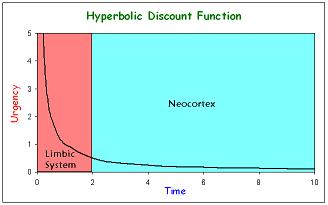
As a result, immediate threats or rewards that require no deep analysis tend to activate the "older" portions of our brain and prompt very strong responses. More abstract threats and rewards identified through the analytical capability of our neocortex don't activate our limbic system, and so usually prompt a much less intense reaction. Immediate, concrete concerns always strongly outweigh distant, abstract ones. The discount function is called "hyperbolic" because it falls off very rapidly at first, then flattens out as time passes. Events that are very near term evoke a sense of urgency that falls off steeply as the time horizon passes from the domain of the limbic system to the domain of the neocortex, resulting in the characteristic shape of a hyperbolic curve:
Why is it so difficult to generate concern for events that are seen as belonging to the future even though their consequences may be dire? It happens because of the way we're wired.
Millenia of natural selection favoured people who responded immediately to threats or rewards. Individuals that did not immediately run from the tiger were more likely to become the original Darwin Award winners. This selection reinforced our responses to immediate and clearly understood rewards or dangers. The further away in time the reward or danger was, the lower our response to it became, because its influence on our survival was correspondingly less. Even if we waited to run until a distant tiger got closer, the chances were good that we would escape anyway, so there was no need to leave our meal just yet.
This idea is known as the "discount rate". It's the same concept used by banks, where the present value of a future event is discounted depending on how far in the future it will happen. While banks use a linear discount rate (expressed as a percentage), there is strong evidence that human beings use a more complex function that comes from different parts of our brain. The more primitive parts (the brain stem and limbic system) are concerned with immediate survival and emotional responses. They are much less capable of long-term evaluation, but provoke the strongest reactions to pleasure or fear. The neocortex, on the other hand, is our thinking brain. It analyzes, predicts and plans for the future, but has more limited access to our emotional triggers.
As a result, immediate threats or rewards that require no deep analysis tend to activate the "older" portions of our brain and prompt very strong responses. More abstract threats and rewards identified through the analytical capability of our neocortex don't activate our limbic system, and so usually prompt a much less intense reaction. Immediate, concrete concerns always strongly outweigh distant, abstract ones. The discount function is called "hyperbolic" because it falls off very rapidly at first, then flattens out as time passes. Events that are very near term evoke a sense of urgency that falls off steeply as the time horizon passes from the domain of the limbic system to the domain of the neocortex, resulting in the characteristic shape of a hyperbolic curve:
Edit history
Please sign in to view edit histories.
Recommendations
0 members have recommended this reply (displayed in chronological order):
48 replies
 = new reply since forum marked as read
Highlight:
NoneDon't highlight anything
5 newestHighlight 5 most recent replies
RecommendedHighlight replies with 5 or more recommendations
= new reply since forum marked as read
Highlight:
NoneDon't highlight anything
5 newestHighlight 5 most recent replies
RecommendedHighlight replies with 5 or more recommendations
= new reply since forum marked as read
Highlight:
NoneDon't highlight anything
5 newestHighlight 5 most recent replies
RecommendedHighlight replies with 5 or more recommendations
Maine study finds potentially disastrous threat to single-celled plants that support all life [View all]
Maine-ah
Jun 2012
OP
I like to present important, complicated issues in the TLDR format (TLDR = Too Long, Didn't Read)
TalkingDog
Jun 2012
#19
Fascinating..I always wondered about that lack of concern about future consequences.
dixiegrrrrl
Jun 2012
#35
Oh, I don't know. I've known a few polymaths in my day who could give any autodidact
coalition_unwilling
Jun 2012
#40
Can't inform the unwashed masses. Wouldn't be good for power, control or profits.
SammyWinstonJack
Jun 2012
#10
Those of us who have tried have generally found that the masses don't listen.
GliderGuider
Jun 2012
#34
You can lead a horse to water but if there isn't a reflection of a sexy girl horse
KurtNYC
Jun 2012
#44
Some moran in the comments section wants to know if George Soros funded the study.
SammyWinstonJack
Jun 2012
#9
And for the solar system, galaxy and universe. I'm only sorry that dolphins and
coalition_unwilling
Jun 2012
#41
I know you are being snarky, but there is an idea out there that changing your own actions
TalkingDog
Jun 2012
#20
Agree. Personal action is important to the individual and those close to them.
GliderGuider
Jun 2012
#24
I have been worried about this ever since I first leaned where oxygen in the air came from.
tabatha
Jun 2012
#29
Since evolution is fake...then we can not expect a mutuation in phytoplankton to occur....
Evasporque
Jun 2012
#45