Welcome to DU!
The truly grassroots left-of-center political community where regular people, not algorithms, drive the discussions and set the standards.
Join the community:
Create a free account
Support DU (and get rid of ads!):
Become a Star Member
Latest Breaking News
Editorials & Other Articles
General Discussion
The DU Lounge
All Forums
Issue Forums
Culture Forums
Alliance Forums
Region Forums
Support Forums
Help & Search
Latest Breaking News
In reply to the discussion: Trump ally apologises for 'cotton-picking' comment about black strategist [View all]
Judi Lynn
(164,183 posts)18. How could anyone NOT be aware of the connection between cotton and slavery?
Why Was Cotton ‘King’?
by Henry Louis Gates, Jr. | Originally posted on The Root
Its beautiful bolls,
And bales of rich value, the Master controls.
Of “mud-stills” he prates, and would haughtily bring
The world to acknowledge that “Cotton is King.”
–The Gospel of Slavery, by “Iron Gray,” [Abel C. Thomas] 1864.
The most commonly used phrase describing the growth of the American economy in the 1830s and 1840s was “Cotton Is King.” We think of this slogan today as describing the plantation economy of the slavery states in the Deep South, which led to the creation of “the second Middle Passage.” But it is important to understand that this was not simply a Southern phenomenon. Cotton was one of the world’s first luxury commodities, after sugar and tobacco, and was also the commodity whose production most dramatically turned millions of black human beings in the United States themselves into commodities. Cotton became the first mass consumer commodity.
Understanding both how extraordinarily profitable cotton was and how interconnected and overlapping were the economies of the cotton plantation, the Northern banking industry, New England textile factories and a huge proportion of the economy of Great Britain helps us to understand why it was something of a miracle that slavery was finally abolished in this country at all.
Let me try to break this down quickly, since it is so fascinating:
Let’s start with the value of the slave population. Steven Deyle shows that in 1860, the value of the slaves was “roughly three times greater than the total amount invested in banks,” and it was “equal to about seven times the total value of all currency in circulation in the country, three times the value of the entire livestock population, twelve times the value of the entire U.S. cotton crop and forty-eight times the total expenditure of the federal government that year.” As mentioned here in a previous column, the invention of the cotton gin greatly increased the productivity of cotton harvesting by slaves. This resulted in dramatically higher profits for planters, which in turn led to a seemingly insatiable increase in the demand for more slaves, in a savage, brutal and vicious cycle.
Now, the value of cotton: Slave-produced cotton “brought commercial ascendancy to New York City, was the driving force for territorial expansion in the Old Southwest and fostered trade between Europe and the United States,” according to Gene Dattel. In fact, cotton productivity, no doubt due to the sharecropping system that replaced slavery, remained central to the American economy for a very long time: “Cotton was the leading American export from 1803 to 1937.”
More:
http://www.pbs.org/wnet/african-americans-many-rivers-to-cross/history/why-was-cotton-king/
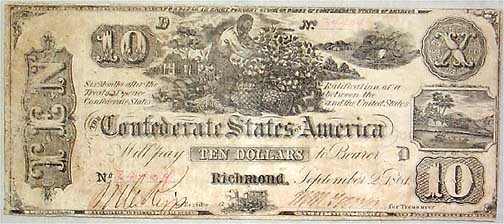
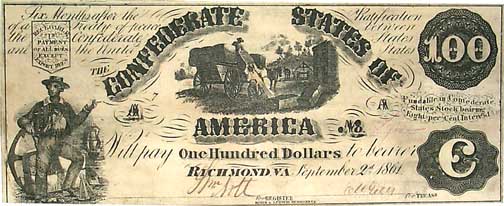
Slaves toiling over the white owners' cotton was even memorialized on the confederate money:

 /800/0


They even loved to take photographs of "their" slaves picking cotton in the fields for every day of their lives after being enslaved:


As you can see they forced children to pick "their" cotton, too. Was it a "rite of passage" when a child got so tall,
he or she was given his or her own shoulder bag, so he/she could join the parents in the field, picking cotton? Jesus.
This is NOTHING I would want to celebrate, don't know about you.....
I hope the slavers will NEVER be forgiven, using the lives of human beings to support themselves in a lavish life-style,
wearing the clothes their prisoners made possible by struggling, suffering their entire lives for NOTHING, living in fear
the "owners" might get angry at them if they made a mistake, and lash them with whips, or worse, then even kill them,
after sending out the militia to capture them, if they dared to try to escape, to make an example of them to the others.
Edit history
Please sign in to view edit histories.
Recommendations
0 members have recommended this reply (displayed in chronological order):
39 replies
 = new reply since forum marked as read
Highlight:
NoneDon't highlight anything
5 newestHighlight 5 most recent replies
RecommendedHighlight replies with 5 or more recommendations
= new reply since forum marked as read
Highlight:
NoneDon't highlight anything
5 newestHighlight 5 most recent replies
RecommendedHighlight replies with 5 or more recommendations
= new reply since forum marked as read
Highlight:
NoneDon't highlight anything
5 newestHighlight 5 most recent replies
RecommendedHighlight replies with 5 or more recommendations
Trump ally apologises for 'cotton-picking' comment about black strategist [View all]
Judi Lynn
Jun 2018
OP
Bossie appears to be from Boston, where I doubt "cotton-picking" is a common phrase
flibbitygiblets
Jun 2018
#4
True, it could be a mistake. Why, I remember the last time I said that about someone --
LastLiberal in PalmSprings
Jun 2018
#8
I've never even heard a Southerner say that. And that guy was from Massachusetts.
flibbitygiblets
Jun 2018
#16
GOP turd meant it as a racist insult to the black panelist, no question.
appalachiablue
Jun 2018
#26
Same here. Raised in south Louisiana. It's an old expression not intended to be racial.
Honeycombe8
Jun 2018
#30
Cold, bold, racist, bigoted. Bossie 'cotton picking,' Lewandowski 'womp, womp'
appalachiablue
Jun 2018
#6
So many intelligent people were able to live their entire lives without saying it, ever.
Judi Lynn
Jun 2018
#19