Latest Breaking News
In reply to the discussion: UPDATE: Brexit vote: British Parliament rejects Theresa May's Brexit deal [View all]
Denzil_DC
(8,924 posts)It at least means she's unlikely to try, try, and try again at this stage.
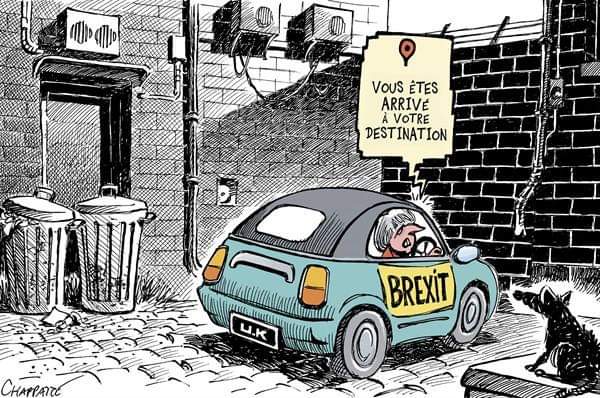
(pic stolen from Twitter)
There was no doubt about a defeat on this deal, but pundits had assessed a significant margin would be at least around 75-100. This margin should be decisive.
It goes without saying that May has to go.
Message from the EU (with more than a degree of impatience at this point):
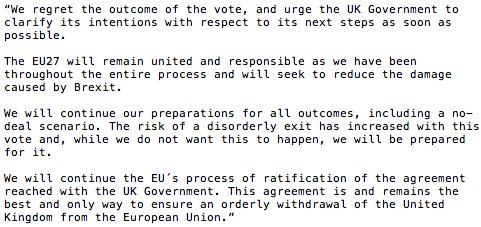
What next? We'll see how tomorrow's no confidence motion goes (I'm not holding my breath).
Could this have been avoided? Voices are now saying she has to reach across the aisle, rather than the gentile patricianship that seems to be the core of her character.
Here's an important take from a Welsh politician on Twitter (and if May had had the wisdom to take this tack over two years ago, things could have gone quite differently, even for an ardent Remainer like me). An early draft of May's major pre-vote speech from a day ago claimed that previous UK referendum results had been accepted, whereas her and her party's votes in Parliament had doggedly opposed them, to the extent that Scottish devolution was originally rejected on a technicality until a second referendum, and opposition to Welsh devolution was actually a plank in a Conservative election manifesto.
Setting aside Theresa May's misremembering/rank hypocrisy [delete according to taste] concerning her own and her own party's position, the lesson of Wales 1997 is actually about 'loser's consent' 1/
Welsh devolutionists (led by Ron Davies) fully realised that there was a real legitimacy question resulting from the very narrow referendum result. They worried about it, thought about and got people like myself to brief them about it in pretty lurid terms 2/
And to the extent that these things are possible, they deliberately set about trying to generate 'loser's consent' for the result.
* By involving opponents of devolution in discussions about the internal processes that would be adopted in the new National Assembly 3/
* By being unusually cross-party in their approach during the parliamentary passage of what became the 1998 Government of Wales Act (kudos here to the Wales
Office team of Ron Davies, @PeterHain and Win Griffiths)
4/
In other words, they realised that the referendum result was only a fragile mandate on which to build a new constitutional dispensation for Wales. That mandate had to be shored up. Undergirded. Supported.
5/
And the only way to do that was to be cross-party and to do what they could to reach out to and address the concerns of their opponents.
It helped, of course, that this approach 'went with the grain' of that particular ministerial team. There were also willing interlocutors
6/
But the fundamental point was that they realised that the narrowness of the referendum result meant that they simply had to make every effort to build consent among those who had been opposed as well as those who just hadn't bothered to participate in the vote.
Whole Twitter thread here: https://threadreaderapp.com/thread/1084721238809997313.html
Instead, any attempts (e.g. by the Scottish Government) at offering constructive input into the negotiation process were rejected, and Remainers were labeled "Bremoaners" and traitors or worse.
Hell mend her.
Edit history
Recommendations
0 members have recommended this reply (displayed in chronological order): = new reply since forum marked as read
Highlight:
NoneDon't highlight anything
5 newestHighlight 5 most recent replies
RecommendedHighlight replies with 5 or more recommendations
= new reply since forum marked as read
Highlight:
NoneDon't highlight anything
5 newestHighlight 5 most recent replies
RecommendedHighlight replies with 5 or more recommendations