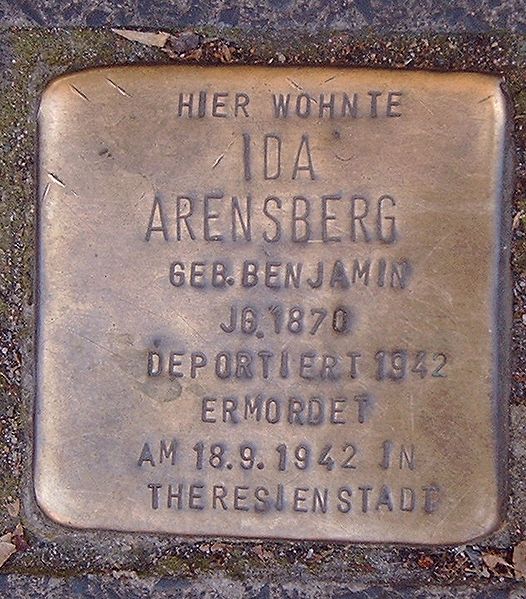

A Stolperstein (from German, "stumbling block"

is a monument created by Gunter Demnig which commemorates a victim of the Holocaust. Stolpersteine are small, cobblestone-sized memorials for an individual victim of Nazism. They commemorate individuals – both those who died and survivors – who were consigned by the Nazis to prisons, euthanasia facilities, sterilization clinics, concentration camps, and extermination camps, as well as those who responded to persecution by emigrating or committing suicide.
While the vast majority of stolpersteine commemorate Jewish victims of the Holocaust, others have been placed for Sinti and Romani people (also called gypsies), homosexuals, Jehovah's Witnesses, black people, Christians (both Protestants and Catholics) opposed to the Nazis, members of the Communist Party and the Resistance, military deserters, and the physically and mentally disabled.
Stolperstein No. 40,000: During his TEDxKOELN talk on May 14, 2013 Gunter Demnig announced the installation of the 40,000th. stolperstein on July 3, 2013 in Oldambt (Drieborg), Netherlands. It was one of the 10 Stolpersteine in memory of Dutch communists who were executed by the German occupation forces after they were betrayed by countrymen for hiding Jews and Roma.
People’s attention is drawn towards the stolpersteine by reports in newspapers and their personal experience. Their thoughts are directed towards the victims. Cambridge historian, Joseph Pearson, argues that "It is not what is written [on the stolpersteine] which intrigues, because the inscription is insufficient to conjure a person. It is the emptiness, void, lack of information, the maw of the forgotten, which gives the monuments their power and lifts them from the banality of a statistic."
http://en.wikipedia.org/wiki/Stolperstein

 = new reply since forum marked as read