I tend to agree with Major Nikon. I have been intimately involved with lightning strikes for over 50 years. I was struck in the knees at Camp Thunder (I kid you not!) Boy Scout camp when I worked on staff there. I have taken lightning strikes in Lockheed JetStar II, Lockheed SP-2E, Boeing 737, and MD-80 aircraft. Since my retirement from the airline, I have worked five fire seasons in a 30-foot fire lookout tower on a 6400 foot butte in the Oregon high desert - a lightning magnet if ever there was one!
I had lightning safety engineers in the fire lookout tower in 2009. They explained to me how the lightning repulsion and lightning shedding protections of such towers work, and how they differ. They told me that the USFS has never lost a fire lookout in a tower to lightning, in over 100 years of staffing such towers. A few have been hurt, but it is a risk that goes without saying when you sign on for such a job.
I took a very near or direct strike in August of this past year. Like a strike I took in a Boeing 737-400 going into Tucson in the mid-90s, I knew it was coming. My hair started standing up in both instances.
About 95% of all lightning strikes carry a negative (-) charge. The other 5% are hotter, stronger positively charged "bolts." There is no doubt in my mind that there have been unexplained aircraft crashes from lightning strikes, and injuries in tower-like facilities too. Also, 95% of our western wildland fires are started by lightning.
As storms become more frequent, more numerous, and stronger in our changing climate, lightning will become more dangerous. Care and prudency are the watchwords, not hand-wringing and panic.
Now, I guess, is as good a time as any to announce my new fire lookout gig to DU. I will be leaving my beloved Deschutes National Forest for a lookout in the Coronado NF in southern Arizona. This lookout is the oldest staffed lookout in the US, it is in designated wilderness, and it sits on a rock outcropping at near 9000 feet. One of the reasons I chose this lookout (which is on the National Register of Historic Places) is to enhance my lightning photography portfolio (which is now weak). So, BRING IT ON!
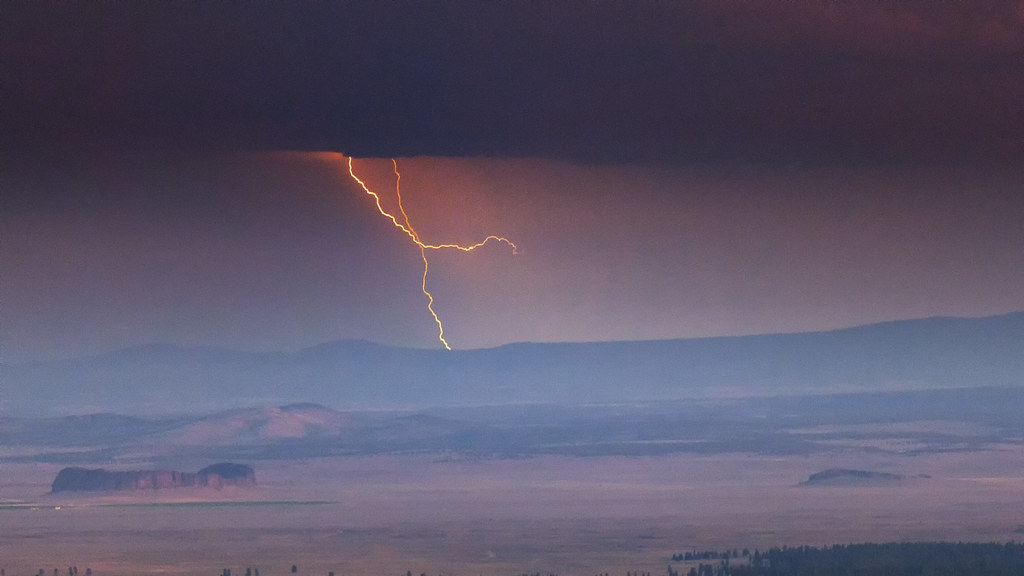
Looking out over Ft. Rock (Oregon) in 2010. The peak just to the left of the lightning is Hager Mountain. The lookout on Hager got clobbered during this storm, and the woman staffing the lookout sustained minor injuries.

 = new reply since forum marked as read