Latest Breaking News
In reply to the discussion: Iraq's Maliki: I won't quit as condition of US strikes against Isis militants [View all]happyslug
(14,779 posts)The first written record we have is of a Pharaoh reporting about his great victory over the Hitties from Asia Minor near Megiddo. It is also suppose to be the location of the "Final Conflict" in the book of Revelations:
http://en.wikipedia.org/wiki/Tel_Megiddo
Megiddo is tied in with Armageddon:
http://en.wikipedia.org/wiki/Armageddon
The reason for this is just outside of Megiddo the Coastal Road from Egypt to Damascus splits, one going to Tyre and Asia Minor the other to Damascus and to the Euphrates and Tigris Rivers. These three groups have also come to blow in that general region for it you are Egypt and want to invade Asia Minor you take the road to Asia Minor, but that leaves you open to an attack from the Euphrates and Tigris Rivers. If you are an invading force from Asia Minor Heading for Egypt, once passed Megiddo, you are opened up to having your supply lines cut from the Euphrates and Tigris Rivers. If you are invading from the Euphrates and Tigris Rivers once passed Megiddo you are opened up to your supply lines being cut off from Asia Minor.
Here is a map of Israel, notice the coastal plan, it is flat from Egypt to Megiddo
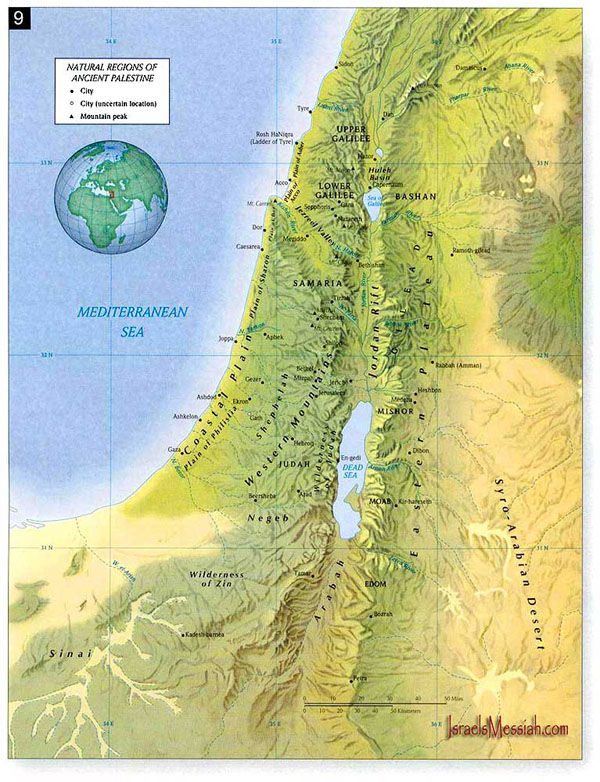
At Megiddo, anyone on foot has to go over that ridge, then at turn to Tyre or Damascus.
if you are going north pick your poison, if you are heading South, then Asia Minor or Iraq can move up to that Ridge and block you from your supplies. Thus Megiddo is a hot stop for battles and always has been.
Thus the book of revelations is based on fact, the fact that Megiddo is along a choke point for any invading force going north or south. To move north or south you must secure that area, but it is NOT high enough to act as a natural barrier. You can move your army around any point on that ridge. The problem so can your enemy. Thus Megiddo was always a fort to base an army in, that can run to other points on that ridge and prevent someone going north or south. Thus Megiddo, itself has seen few battles, it has seen battles all around it. This is where the Egyptian, Asia Minor and Iraqi/Iranian/Persian Empires tend to meet.
Iran/Persia, since the First Persian Empire has tended to control the lower parts of the Euphrates and Tigris Rivers. Prior to the first Persian Empire the lower Euphrates and Tigris Rivers was held by various Empires of that region out of Babylonia. Those earlier empire all had extensive connections with present day Iran. Thus Babylonia could always spread West ward if Iran let it go and prior to the first Persian Empire, the Iranian did that. Once the First Persian Empire was established it took over the role of the Babylonia.
Side note: The Ancient Kingdoms of Israel and later Judea, were centered around Jerusalem. Jerusalem is off in the interior away from the Coastal highway. Israel did claim the coast, but between the Phoenicians to the north and the Philistines to the south, what Israel claimed in pre Roman times was restricted. Rome Expanded the borders of Judea, and after the second Jewish revolt 132-135 AD, changed the name to Palestine, which was roughly the Latin version of Philistine.
The various armies marching through Palestine (What is now called Israel) tended to stay away from Jerusalem, to many areas for an ambush and possession of Jerusalem is NOT needed to invade Egypt or Asia Minor or Iraq/Iran. Jerusalem is to far inland to be of any use in such an invasion. Napoleon pointed this out to one of his General during his Egyptian Campaign when Napoleon was asked if he was planning to march on Jerusalem, Napoleon said no, to dangerous for to little gain. Jerusalem could be taken later if it became the center for attacks on the Napoleon's supply line along the coast but there was no need to take it as he marched North (and the same has been the history of Palestine/Israel since ancient times)
I once told someone that the Book of Revelations is correct, for it is NOT just based on dreams revealed to the writer of Revelations, but on the history of the region. Worse, the attack from the North by "Mog" is typical of attacks on Asia Minor and Iran during times of decrease world wide temperatures i.e. as it get colder up north, people in the north turn south in search of food and end up either going themselves to Asia Minor, or pushing other people south into Asia Minor. The same in the case if Iran, but Iran has deserts to its north so the push will be much less. To get to Egypt any invader has to get by Asia Minor and/or Iran thus Egypt will be the least affected up front.
Thus when you have unrest in the Balkans or the Ukraine, it forces whoever controls Asia Minor to pull troops from the middle east and put them in the Caucasus, Balkans, the Ukraine or Asia Minor Proper. This weakens whatever hold Asia Minor has over the Middle East, providing both Egypt and Iran to makes moves to expand their own areas of Control. Thus the Army of the South marches north, to meet the Army of the East. Their clash in the battle of Armageddon.
Thus the battle of revelations will occur for such battles have occur since the beginning of recorded history.
Battle of Megiddo in 1918:
http://en.wikipedia.org/wiki/Battle_of_Megiddo_(1918)
Battle of Megiddo about 1500 BC:
http://en.wikipedia.org/wiki/Battle_of_Megiddo_(15th_century_BC)
The Mongol Defeat in the Jarzeel Valley at the battle of Ain Jalut
http://en.wikipedia.org/wiki/Battle_of_Ain_Jalut
A little more on Jarzeel Valley:
http://www.challengetourism.com/The-Valleys-and-Mt.Gilboa/jezreel-valley.html
Jarzeel is the best way to go from the Mediterranean sea to the Dead Sea. The reason for this is up to two million years ago, the Mediterranean sea would flood up the Jarzeel Valley to the dead sea.
Now, between 5.96 to 5.33 million years ago, the Mediterranean sea dried up. Since the Mediterranean sea is filled today by waters from the Atlantic some how the Mediterranean sea was cut off from the Atlantic. There is a debate on HOW this happened, but that it happened is no longer debated.
http://en.wikipedia.org/wiki/Messinian_salinity_crisis
Now, during that time period the Mediterranean sea did almost fill up a couple of time, during period of extensive wet weather. This brought much of it up to present levels, which given the nature of Jarzell Valley (which was lower at that time period) the waters of the Mediterranean sea would flow into the Jordan River and into the Dead Sea.
This flooding continued after the Mediterranean sea connected again to the Atlantic around 5.33 million years ago. This ended about 2.2 Million years ago. These flood would flow down the Jarzell Valley making it a smoother and flatter route then anything else between the Mediterranean sea and the Jordan Valley. The general increase in height in the area has not had to much affect increasing the difficulty of travelling the valley.
Now, the eastern most part of the Jarzell Valley flows into the Jordan river.
 ?w=625&h=578
On the above map, remember Haifa and Acre are the cities at the Mediterranean side of the Jarzell Valley.
Always remember we are talking about the Fertile Crescent, here is a map where wheat can be grown in the middle east in most years. South and East of the Crescent, it is to dry to plant crops, and thus used as pasture.
 ?w=625&h=454
http://nealrauhauser.wordpress.com/2013/06/16/rivers-of-the-fertile-crecsent/
Thus the Jarzell Valley is where battles occur for it is fertile AND flat. Perfect to feed an Army and to operate an army. This is do to the interaction between the Mediterranean Sea, the Atlantic Ocean and the Dead Sea.
One last fact about the Jarzell Valley, they is no good NATURE port south of Acre, which is at the end of the Jarzell Valley. It is far enough away from Tyre to be independent of Tyre when Acre had support from Israel, Judea or whoever held the interior. Thus if you want to attack north or south Acre is the key to support any such invasion. That enhances the importance of Acre in military operations in the Middle East.
Notice the Fertile Crescent itself and how much of it reflects the borders of Iraq. The present southern border of Iraq was drawn by the British in 1921, and was determined by how far an Airplane of that time period could fly and return to its airbase between the two rivers. The rest was left to King Saud I of Saudi Arabia.
What we fight over today, is in many ways what people fought over 4000 years ago. In the middle east it is water and land that can be watered, either by rain or irrigation. Ancient Persians and Modern Iranians (Different names for the same people) are considered some of the best builders of irrigation systems in the world. Drilling into mountains to get at water that can be used to grows (these methods are also used in Afghanistan). Iraq, NOT be in the mountains, used river to field irrigation like Egypt (and the US). The US also uses water from Aquifers, which tend to be depleted over a period of 100 years (unlike the Persian Mountain system, which refills after every rain storm).
Remember Water is what people fight over in the Middle East. Oil is a way to pay for water systems and thus water. One of the reasons the Turks were able to take over Asia Minor from the Greeks, is that Asia Minor is a lot drier today then it was under the Ancient Greeks and Romans. As Central Asia Minor Dried up, it became to dry to farm and the farms were abandoned, replaced by herders. At first these were Christian Herders but after the Battle of Manzikurt in 1071, it became the area controlled by the Turks coming from Central Asia.
http://en.wikipedia.org/wiki/Battle_of_Manzikert
This drying out of Central Asia Minor seems to have been steady since Ancient Times. May be related to the drying of the Sahara. The Sahara has been drying for 6000 years. This is not seen along the coasts, coastal rains keep those areas wet enough for farming (Thus a lot of Greeks still lived on the coasts of Asia Minor till WWI). Greece is surrounded by water and thus influences by such coastal rains. Italy is just narrow enough to also be affected by coastal rains on its coast (please note Northern Italy, Rome on North, is subject to more West to East weather flow typical of temper zone climates. Spain also has dry desert areas, for they are to far from the coast to get water from coastal rain fall. Northern Spain in like Northern Italy gets enough West East weather pattern to farmable lands (Spain during the Middle ages til today, move Sheep from the Southern Areas to the Northern areas depending if rain was falling in the south). People in Asia Minor seems to have done what the Spanish does in Spain, but
http://www.npr.org/templates/story/story.php?storyId=90289718
Movement of Sheep in Spain:
http://news.yahoo.com/spanish-shepherds-guide-2-000-sheep-madrid-173325838.html
http://en.wikipedia.org/wiki/Transhumance
While such movement occurs in Iran and modern Spain, it is limited to Northeastern Turkey for some reason, probably because the center is to dry and except for the coasts no real improvement for the sheep and no one wants the sheep in lands subject to planting crops. In Spain the movement tends to be through marginal farming areas to areas where grazing sheep is the best use of that land. Thus central Turkey may have no place to move their sheep except onto farm lands along the coasts, and the farmers would object to that.
All this has to do with WATER. Water is the biggest restriction to human life in the Middle East. Moslem and Jews both oppose raising and eating pigs, why? Pigs use as much water as a human being, thus for every pig one keeps in the Middle East, that means one less person. Horses are not as water hogs as sheep (and provide speed when needed) and horses were NOT known to be an Arab animal til Mohammad said each Moslem must own at least one horse for fighting with other Moslem against the Enemies of Islam.
Camels are a Middle East Animals, that the Roman moved to North Africa about the time of Christ. Why? The old Carthage trade route to the Niger Valley had dried up and the old Carthage method of using horse draw carts was becoming increasingly impossible to do, given the increase loss of water sources on the route. This was a product of the increasing dryness of the Sahara Desert, something independent of Climate Change (but seems to be accelerating do to increase levels of carbon in the atmosphere.
I bring up Camels in the Sahara to point out the decrease level of water in the Sahara and that may also be the reason for increase dryness in Asia Minor. And with that decrease in water, Turkey has become less capable of projecting power into the Middle East (Greek support for the Kurds also tied up a lot of Turkey's efforts).
Thus the fight, right now, is between Saudi Arabia and Iran. It is a continuance of the old Roman-Persian fight over who controls the waters of the Fertile Crescent. Turkey is staying out of the present fight, but if the fight gets out of hand Turkey may intervene (through the question is on which side? The Turkish army likes the present Government of Egypt and the House of Saud, the present Government of Turkey prefers the Moslem Brotherhood rulers of Egypt and while they do not favor Iran, they also oppose the House of Saud (Thus may back Iran, both to secure they energy supplies, but also to undermine the House of Saud).
Thus while Turkey claims it has no interest, the other powers know better (and Iran keeps Greece supplied with oil to give the Turks another headache to worry about).
Thus the Middle East is the interaction of these three powers AND their interaction with the various countries in between. Each of the three main powers know they can not control the middle east without help, and thus looks for allies among the various people between the three powers. Prior to 600 it was Latin/Catholic, Greek/ Orthodox and Arab/Eastern Rite Speakers vs Iranian Speakers (Egyptian is a variation of Arabic). After 600 AD it was Greek Speakers/ Orthodox vs Arab Speakers/ Eastern Rite/ Islamic. After abut 800 AD it was Greek Speakers/ Orthodox vs Arab/Speakers/ Eastern Rite/ Sunni Moselm vs Shiite/Iranian Speakers. After 1071 it was Turks/Sunni vs Iranian/Shitte vs Egyptian/Shiite. After the second crusade it was Turks/Sunni/Arabic vs Krud/Egyptian/Sunni/eastern Rite vs Greek/Orthodox vs Catholic/"Franks". After the Crusades it was Mongol/Pagan/Iraian vs Catholic/"Frank" vs Greek/Orthodox. After Timerlane, it was Turk/Sunni/Greek/Orthodox vs Egyptian/Sunni/Eastern Rite vs Iranian/Shiite. This continued after fall of Constantinople (remember the above "Allies" were not always allies during the periods in question, but during most of such periods they were, thus the Turks took Constantinople from the Greeks, but maintained they overall understanding that the Ottoman Empire was as much Greek Orthodox as it was Turkish and Islamic).
During efforts of Reforms starting in the 1600s, the Greek-Turkish alliance slowly broke down, as the Turks made an effort NOT to recruit they soldiers from Christians but from other Turks. The recruiting of Janissaries from Christian then forcing them to convert to Islam, gave the Ottoman a whole group of people who understood the Christians the Ottomans were ruling but retain much of their Christian background to bridge the two cultures. This system started to break down in the late 1500s, and was abolished in 1683 (but remains of it survived in theory till 1827 when Janissaries were abolished).
I bring this up, for Egypt stayed more or less Independent after the 1519 (when Egypt was technically conquest of Egypt by the Ottoman Empire, but the Manluks, who had ruled Egypt since the Crusades were permitted to stay in charge of Egypt except at the highest level). Thus you had Shiite/Iranian Speakers, Greek Speakers/Orthodox, Sunni/Arab Speakers/Eastern Rite and Turkish/Sunni fighting it out. Some were "Subject" to others, but the infighting was intense. France even intervene throughout this time period, mostly in Lebanon in support of the Catholics In Lebanon.
Allies comes and go, but these were the main groups over the last 2500 years. Things do change, sometimes it is religion, some time were the troops are recruited from, sometime it is who is the Caliph, sometime it is who Patriarch of Alexandria or Constantinople. Who is allied with who often changes (and I do not mean between the three main powers, but the little tribes in between, with each tribe and city doing they best to work out the best deal they can between the three major powers. On the other hand, the three main powers tend to remain the same, Iran, Asia Minor and Egypt.
The above needs a good editing, but it is a rough outline of the problems in the Middle East. It needs to be rewritten but I do not have the time (nor the disposition). It is also time for me to go to bed so I am ending this thread, uncompleted but what I believe enough disjointed facts to make the point I am trying to make. The Middle East is a Complex place where simple solutions are not possible. Accept that and only go in when you have to, and then plan to pull out quickly once the military objective is achieved. You may have to go back in several years later, but that is a workable plan, unlike what Bush, then Clinton, then Bush and now Obama have done.
Edit history
Recommendations
0 members have recommended this reply (displayed in chronological order): = new reply since forum marked as read
Highlight:
NoneDon't highlight anything
5 newestHighlight 5 most recent replies
RecommendedHighlight replies with 5 or more recommendations
= new reply since forum marked as read
Highlight:
NoneDon't highlight anything
5 newestHighlight 5 most recent replies
RecommendedHighlight replies with 5 or more recommendations