Welcome to DU!
The truly grassroots left-of-center political community where regular people, not algorithms, drive the discussions and set the standards.
Join the community:
Create a free account
Support DU (and get rid of ads!):
Become a Star Member
Latest Breaking News
Editorials & Other Articles
General Discussion
The DU Lounge
All Forums
Issue Forums
Culture Forums
Alliance Forums
Region Forums
Support Forums
Help & Search
Latest Breaking News
In reply to the discussion: 'Alarm bells' as greenhouse gases hit new high: UN [View all]GliderGuider
(21,088 posts)7. Humans appear to be genetically predisposed to ignore threats like this
Or at least to give them a very low priority compared to immediate, concrete threats like job losses, slowing economic growth or who is doing what to whom in the Middle East.
We have what amounts to a hard-wired "discount function" for risk:
http://www.paulchefurka.ca/Hyperbolic%20Discount%20Functions.html
Why is it so difficult to generate concern for events that are seen as belonging to the future even though their consequences may be dire? Why is it so easy to generate concern for much smaller events that are happening right now? Consider the outpouring of generosity that happens when a local family without insurance is burned out of their home. In a single day the community will respond more than they would to a year's worth haranguing by Climate Change activists.
This happens, apparently, because of the way we're wired. It is the result of many millenia of mutation, genetic drift and natural selection - selection that favoured people who responded immediately to threats or rewards. Those individuals that did not respond immediately (perhaps they didn't run from the tiger or eat the food that was in front of them) were more likely to be "selected out" of the gene pool. They were the original Darwin Award winners. This selection reinforced our responses to immediate and clearly understood rewards or dangers. In fact, the further away in time the reward or danger was, the lower our response to it became, because its influence on our survival was correspondingly less. Even if we waited to run until the tiger got closer, the chances were good that we would escape anyway, so there was no need to leave our meal just yet. This idea is known as the "discount rate". It's the same concept used by banks, where the present value of a future event is discounted depending on how far in the future it is.
While banks use a linear discount rate (expressed as a percentage), there is strong evidence that human beings use a more complex function that comes from different parts of our brain. The more primitive parts (the brain stem and limbic system) are concerned with immediate survival and emotional responses. They are much less capable of long-term evaluation, but provoke the strongest reactions to pleasure or fear. The neocortex, on the other hand, is our thinking brain. It analyzes, predicts and plans for the future, but has more limited access to our emotional triggers.
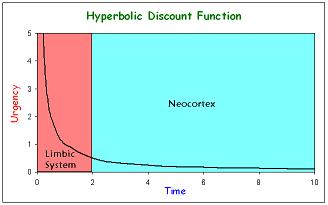
As a result, immediate threats or rewards that require no deep analysis tend to activate the "earlier" portions of our brain and prompt very strong responses. More abstract threats and rewards identified through the analytical capability of our neocortex don't activate our limbic system, and so usually prompt a much less intense reaction. In addition, emotions easily override the intellect, so you get reactions like, "Yes, I think Global Warming is important, but I have a date tonight with the hottest guy on the face of the planet!" That's not a lack of concern for the future, it's a direct result of the way we are constructed. It's because of our hard-wired "hyperbolic discount function". Immediate and concrete concerns always strongly outweigh the distant and abstract; it's the reason we got this far as a species. The discount function is called "hyperbolic" because it falls off rapidly at first, then flattens out as time passes. Events that are very near term evoke a sense of urgency that falls off steeply as the time horizon passes from the domain of the limbic system to the domain of the neocortex, resulting in the characteristic shape of a hyperbolic curve:
Why is it so difficult to generate concern for events that are seen as belonging to the future even though their consequences may be dire? Why is it so easy to generate concern for much smaller events that are happening right now? Consider the outpouring of generosity that happens when a local family without insurance is burned out of their home. In a single day the community will respond more than they would to a year's worth haranguing by Climate Change activists.
This happens, apparently, because of the way we're wired. It is the result of many millenia of mutation, genetic drift and natural selection - selection that favoured people who responded immediately to threats or rewards. Those individuals that did not respond immediately (perhaps they didn't run from the tiger or eat the food that was in front of them) were more likely to be "selected out" of the gene pool. They were the original Darwin Award winners. This selection reinforced our responses to immediate and clearly understood rewards or dangers. In fact, the further away in time the reward or danger was, the lower our response to it became, because its influence on our survival was correspondingly less. Even if we waited to run until the tiger got closer, the chances were good that we would escape anyway, so there was no need to leave our meal just yet. This idea is known as the "discount rate". It's the same concept used by banks, where the present value of a future event is discounted depending on how far in the future it is.
While banks use a linear discount rate (expressed as a percentage), there is strong evidence that human beings use a more complex function that comes from different parts of our brain. The more primitive parts (the brain stem and limbic system) are concerned with immediate survival and emotional responses. They are much less capable of long-term evaluation, but provoke the strongest reactions to pleasure or fear. The neocortex, on the other hand, is our thinking brain. It analyzes, predicts and plans for the future, but has more limited access to our emotional triggers.
As a result, immediate threats or rewards that require no deep analysis tend to activate the "earlier" portions of our brain and prompt very strong responses. More abstract threats and rewards identified through the analytical capability of our neocortex don't activate our limbic system, and so usually prompt a much less intense reaction. In addition, emotions easily override the intellect, so you get reactions like, "Yes, I think Global Warming is important, but I have a date tonight with the hottest guy on the face of the planet!" That's not a lack of concern for the future, it's a direct result of the way we are constructed. It's because of our hard-wired "hyperbolic discount function". Immediate and concrete concerns always strongly outweigh the distant and abstract; it's the reason we got this far as a species. The discount function is called "hyperbolic" because it falls off rapidly at first, then flattens out as time passes. Events that are very near term evoke a sense of urgency that falls off steeply as the time horizon passes from the domain of the limbic system to the domain of the neocortex, resulting in the characteristic shape of a hyperbolic curve:
As a result I don't hold out any hope that we will change our ways before the emergency becomes a full-blown planetary catastrophe.
Edit history
Please sign in to view edit histories.
Recommendations
0 members have recommended this reply (displayed in chronological order):
24 replies
 = new reply since forum marked as read
Highlight:
NoneDon't highlight anything
5 newestHighlight 5 most recent replies
RecommendedHighlight replies with 5 or more recommendations
= new reply since forum marked as read
Highlight:
NoneDon't highlight anything
5 newestHighlight 5 most recent replies
RecommendedHighlight replies with 5 or more recommendations
= new reply since forum marked as read
Highlight:
NoneDon't highlight anything
5 newestHighlight 5 most recent replies
RecommendedHighlight replies with 5 or more recommendations
Wouldn't you think they would at least be motivated out of concern for their own children...
deurbano
Sep 2014
#5
Yes, but without burning oil billionaires can't become trillionaires in the next decade.
valerief
Sep 2014
#4
"Humans appear to be genetically predisposed to ignore threats like this" *facepalm*.
AverageJoe90
Sep 2014
#14
Some recent scientific support for my views, from a peer-reviewed journal:
GliderGuider
Sep 2014
#22
Interesting thesis, to be sure, but it doesn't necessarily prove the point you were trying to make.
AverageJoe90
Sep 2014
#23
And the frog says, "This pot is getting a little warm, but I'm sure everything will be OK.
pampango
Sep 2014
#8
By returning organic matter into our agricultural soils, we could sink a lot of carbon quickly.
greatlaurel
Sep 2014
#18