Editorials & Other Articles
In reply to the discussion: They were once America's cruelest, richest slave traders. Why does no one know their names? [View all]
appalachiablue
(44,196 posts)Last edited Sat Sep 14, 2019, 07:39 PM - Edit history (1)
-- (Wiki). The Franklin and Armfield Office, which houses the Freedom House Museum, is a historic commercial building at 1315 Duke Street in Alexandria, Virginia (until 1846, the District of Columbia). Built c. 1810-20, it was first used as a private residence before being converted to the offices of the largest slave trading firm in the United States, started in 1828 by Isaac Franklin and John Armfield.
"As many as [a] million people are thought to have passed through between 1828 and 1861, on their way to bondage in Mississippi and Louisiana". Another source, using ship manifests (lists of slaves) in the National Archives, gives the number as "at least 5,000". One million is generally historians' estimate of the total of all slaves who were moved to the Deep South in the domestic slave trade.
The building was designated a National Historic Landmark in 1978, and has also been designated a Virginia Historic Landmark. The building is owned by the Northern Virginia Urban League; it is operated as a museum, with exhibits about the slave trading firm and the life of a slave. The building was constructed as a residence in the 1810s by Robert Young, a brigadier general in the District of Columbia National Guard. Due to financial reverses, Young was soon afterward forced to sell the house. It was purchased in 1828 by Isaac Franklin and his nephew John Armfield, who established it as their Washington-area office, and the residence of Armfield.

- The Franklin and Armfield house with its neighboring slave pens in 1836.
The property then extended further east, and they added structures for holding and trading in slaves. They also provided, for 25¢ a day, housing in their jail for slaveowners visiting Washington. The two-story extension to the rear of this house was part of the slave-holding facilities, which included high walls, and interior chambers that featured prison-like grated doors and windows.
Franklin left the business, starting in 1835, and Armfield sold the property to another slave trader in 1836. It continued to be used for slave trading until Alexandria fell to Union Army forces early in the American Civil War. The owners in 1861 were Price, Birch & Co., "dealers in slaves". The Union used the property to imprison Confederate soldiers. Late in the war, it was used as L'Ouverture Hospital for black soldiers, and as housing for contrabands.
After the war, the outlying slave pens, of which there are photographs, were torn down. The bricks may have been reused in the construction of the adjacent townhouses. After serving a variety of other uses, the main building is now used for Freedom House Museum, with exhibits devoted to the slave trade. The second floor houses the offices of the Northern Virginia Urban League. More, https://en.wikipedia.org/wiki/Franklin_and_Armfield_Office
-------------------------------
-- (Alex. Times, Nov. 7, 2013) 'Out of the Attic: Notorious local slave dealer had hand in Solomon Northup’s kidnapping.' The new movie “12 Years a Slave” documents the tragic tale of Solomon Northup, a black man from Saratoga Springs, N.Y., who was kidnapped in 1841 and sold into slavery by a notorious human trafficker from Washington, D.C. In his writings, Northup records the name of his kidnapper as “Burch,” but it was actually James H. Birch, who would later preside over Alexandria’s largest slave pen at 1315 Duke St.
In 18th-century Alexandria, slave auctions often were held spontaneously on sidewalks or street corners. But by the early 19th century, with the importation of slaves outlawed and the tobacco crop dissipating in Northern Virginia because of soil exhaustion, shipping slaves from the commonwealth to the emerging cotton fields of the Deep South became extremely lucrative. It is during this time that permanent slave facilities were established along Duke Street. Alexandria became the second-largest slave center in the country, just behind New Orleans.
[Built as a private home] in 1812, the Duke Street dwelling was leased by the firm of Franklin and Armfield in 1828 and converted into a large slave jail and pen. The strategic location of the site — between the bustling city to the east and vast farmlands to the west — allowed the firm to efficiently contain and then ship off hundreds of slaves at any one time. In 1858, partners Charles M. Price and John Cook acquired the Franklin and Armfield property. Cook left the partnership soon after and was replaced by Birch. Soon the front facade was emblazoned with the name “Price, Birch & Co. Dealers in Slaves.”
When Union troops entered Alexandria on May 24, 1861, they found the building hastily abandoned, with one slave still chained to the basement floor. This photograph of the facility, taken about 1862, shows the main building after it was turned into a prison by federal authorities. Although Solomon Northup was never actually associated with this site, the inhumane conditions maintained by his nemesis — Birch — in Alexandria were quite similar to those he experienced.. https://alextimes.com/2013/11/notorious-local-slave-dealer-had-hand-in-solomon-northups-kidnapping/

- Union Army guard outside Price, Birch & Co. slave pen in Alexandria, Va. c. 1862.
-----------------------------------
--(NPS) FRANKLIN & ARMFIELD OFFICE: Based in Alexandria, Virginia, Isaac Franklin and John Armfield were the largest traders of enslaved African Americans in the nation between 1828 and 1836. The men bought enslaved people at low prices in the Upper South and sold them at much higher prices in the Lower South. While Armfield remained in Alexandria to purchase bondsmen for shipment south, Franklin handled sales in New Orleans and Natchez. Franklin and Armfield orchestrated the trafficking of thousands of enslaved African Americans from their Alexandria office to the horrific labor conditions of the lower South in what has been called the Second Middle Passage.
Between 1810 and 1820, Robert Young, Brigadier General of the Second Militia of the District of Columbia, commissioned the construction of a house on Duke Street in Alexandria, Virginia. Shortly after completion, General Young was forced to sell it because of financial problems. In 1828, Franklin and Armfield leased the building for their slave-trading operation and later purchased the property. The main block of the house served as the firm's office and Armfield's residence. The two-story attached wing at the rear housed enslaved people at night. Both ends of the structure had partially roofed courtyards where captives passed their daylight hours. High walls of whitewashed brick surrounded these courtyards.
Every summer, slave drivers marched chained groups of enslaved people from Virginia through Tennessee to Mississippi and Louisiana. In the fall and spring, the firm used its fleet of sailing ships to traffic people to New Orleans. The firm had agents in almost every important Southern city. In the early 1830s, Franklin and Armfield bought and sold between 1,000 and 2,000 people each year. https://www.nps.gov/places/franklin-and-armfield-office.htm
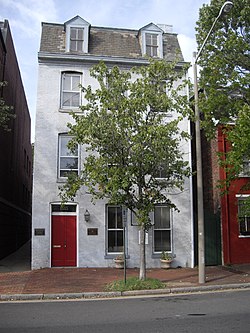
- Freedom House
Edit history
Recommendations
0 members have recommended this reply (displayed in chronological order): = new reply since forum marked as read
Highlight:
NoneDon't highlight anything
5 newestHighlight 5 most recent replies
RecommendedHighlight replies with 5 or more recommendations
= new reply since forum marked as read
Highlight:
NoneDon't highlight anything
5 newestHighlight 5 most recent replies
RecommendedHighlight replies with 5 or more recommendations