Welcome to DU!
The truly grassroots left-of-center political community where regular people, not algorithms, drive the discussions and set the standards.
Join the community:
Create a free account
Support DU (and get rid of ads!):
Become a Star Member
Latest Breaking News
Editorials & Other Articles
General Discussion
The DU Lounge
All Forums
Issue Forums
Culture Forums
Alliance Forums
Region Forums
Support Forums
Help & Search
Editorials & Other Articles
Showing Original Post only (View all)
Prejudices That Led to Witch- Hunts Still Affect Women Today, Says Historian [View all]

- Historian Lucy Worsley.
_____
- The Guardian, May 17, 2022.
- Lucy Worsley, whose BBC TV series focuses on powerless people, says women continue to bear brunt of men’s rage. -
Prejudices that led to witch-hunts hundreds of years ago have not disappeared and women are still on the receiving end of men’s anger, a leading historian has said. Writing in the Radio Times, Lucy Worsley, a historian and author, said: “[Although] we like to think we’re better than the people who hunted witches, witch-hunting still happens in some parts of the world today.”
The prejudices that led to witch-hunts in the 16th and 17th centuries continue to exist and women, especially outspoken ones, were still targeted by men, she said. She said: “The prejudices that led to witch-hunts haven’t completely disappeared. It’s still the case that women – especially odd-seeming, mouthy ones – often feel the anger of the men whose hackles they raise.
“Today, ever so many people, but perhaps women in particular, feel a sense of kinship with our ancestors who were persecuted in this way. Anyone who has ever been put down as a ‘difficult’ woman hears a distant echo of the past.” The historian’s four-part series, Lucy Worsley Investigates, takes a closer look at the experiences of people who “lacked power in the past”, with one such example being Agnes Sampson, a Scottish woman who was accused of being a witch and burned at the stake in 1591.
On International Women’s Day in March, the first minister of Scotland issued an apology to the 4,000 people in the country, the vast majority being women, who were convicted and often executed under the Witchcraft Act of 1563. “Those who met this fate were not witches, they were people, and they were overwhelmingly women,” Nicola Sturgeon said. “At a time when women were not even allowed to speak as witnesses in a courtroom, they were accused and killed because they were poor, different, vulnerable or in many cases just because they were women.” According to Worsley, Sampson was only one of the many women accused of witchcraft in 16th- and 17th-century Scotland, and “represents ever so many more”...
https://www.theguardian.com/society/2022/may/17/women-men-witch-hunts-lucy-worsley-tv-series
- Lucy Worsley https://lucyworsley.com/
_________
- Witch Trials in the Early Modern Period, https://en.wikipedia.org/wiki/Witch_trials_in_the_early_modern_period#:~:text=Prosecutions%20for%20the%20crime%20of,over%20the%20age%20of%2040.
- The Little-Known Story of 16th- to 18th-Century Nordic Witch Trials, Smithsonian Magazine, 2020,
https://www.smithsonianmag.com/smart-news/new-exhibition-rewrites-story-nordic-witch-trials-180976205/#:~:text=Though%20the%20practice%20of%20witchcraft,and%20their%20accomplices%E2%80%9D%20in%201617.
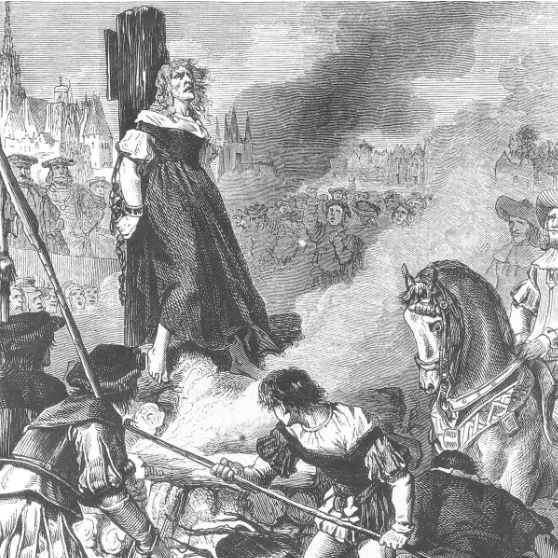
- The burning of a witch in Vienna, Austria in 1538.
15 replies
 = new reply since forum marked as read
Highlight:
NoneDon't highlight anything
5 newestHighlight 5 most recent replies
= new reply since forum marked as read
Highlight:
NoneDon't highlight anything
5 newestHighlight 5 most recent replies
= new reply since forum marked as read
Highlight:
NoneDon't highlight anything
5 newestHighlight 5 most recent replies
Prejudices That Led to Witch- Hunts Still Affect Women Today, Says Historian [View all]
appalachiablue
May 2022
OP
I believe this to be true. I have watched several of Lucy Worsley's documentaries and...
wcmagumba
May 2022
#1
India's Widows, Abused at Home, Have Sought Refuge in This Holy City for Centuries
appalachiablue
May 2022
#4
NYT article on widows abandoned by their families in India. Also Al Jazeera:
appalachiablue
May 2022
#15
And I will keep posting this from these Canadians that never took their finger off the button
Cheezoholic
May 2022
#6