The Great Recession in Black Wealth [View all]
from Dollars & Sense:
The Great Recession in Black Wealth
White wealth reaches historic high of twenty times black wealth.
By Jeannette Wicks-Lim
The Great Recession produced the largest setback in racial wealth equality in the United States over the last quarter century. In 2009 the average white household’s wealth was twenty times that of the average black household, nearly double that in previous years, according to a 2011 report by the Pew Research Center.
Driving this surge in inequality is a devastating drop in black wealth. The typical black household in 2009 was left with less wealth than at any time since 1984, after correcting for inflation.
It’s important to remember wealth’s special role in supporting a household’s economic well-being. Even though income forms the stream of money that collects into a household’s pool of wealth, wealth and income are crucially different. Income pays for everyday living expenses—the groceries, clothes, and gas. A family’s wealth, or net worth, includes all the assets they’ve built up over time (e.g., savings account, retirement fund, home, car) minus any money they owe (e.g., school loans, credit-card debt, mortgage). Access to such wealth determines whether a layoff or medical crisis creates a bump in the road, or pushes a household off a financial cliff. Wealth can also provide families with financial stepping-stones to advance up the economic ladder—such as money for college tuition, or a down payment on a house.
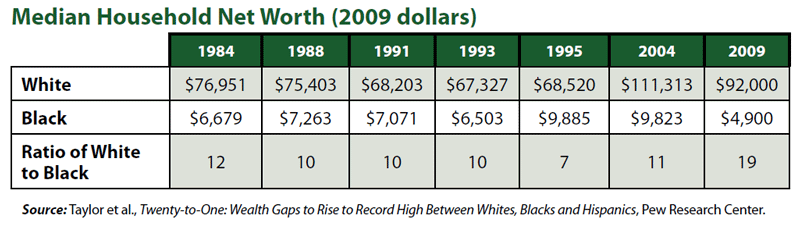
Racial wealth inequality in the United States has always been severe. In 2004, for example, the typical black household had just one dollar in net worth for every 11 dollars of a typical white household. This is because families slowly accumulate wealth over their lifetime and across generations. Wealth, consequently, ties the economic fortunes of today’s households to the explicitly racist economic institutions in America’s past—especially those that existed during key phases of wealth redistribution. For example, the Homesteading Act of 1862 directed the large-scale transfer of government-owned land nearly exclusively to white households. Also, starting in the 1930s, the Federal Housing Authority made a major push to subsidize home mortgages—for primarily white neighborhoods. On top of that, efforts by black communities to generate their own wealth by starting their own businesses were crushed by racial violence, or severely curtailed by Jim Crow Laws in effect until the mid-1960s. ................(more)
The complete piece is at:
http://www.dollarsandsense.org/archives/2012/0112wicks-lim.html

 = new reply since forum marked as read